

Trump's infrastructure plan faces battle in Congress
Washington
US President Donald Trump unveiled a long-awaited infrastructure plan on Monday (Tuesday morning, Singapore time) designed to encourage spending on improvements by states, localities and private investors.
The plan faces an uphill battle in Congress, however, and Mr Trump's remarks have called into question how hard he will fight for it.
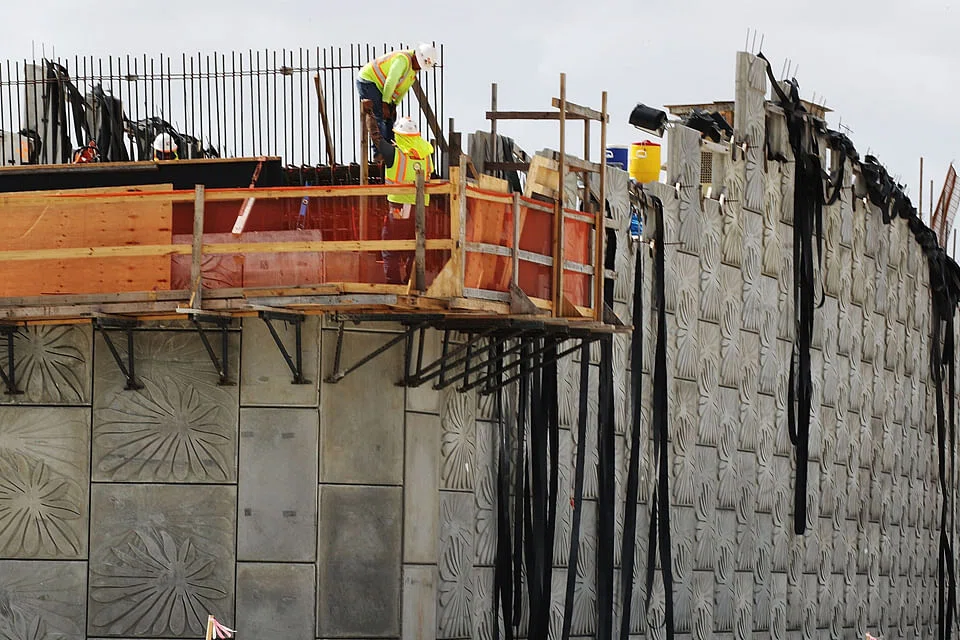
He asked Congress, controlled by his fellow Republicans, to authorise US$200 billion over 10 years to spur a projected US$1.5 trillion in road, bridge and other projects to rebuild what he called "America's crumbling infrastructure".
The proposal came under immediate fire from Democrats, who said it would put a huge burden on local governments without providing enough federal dollars; administration officials acknowledged that it faces a tough road ahead.
Mr Trump, who as a presidential candidate promised a major infrastructure plan, said he looked forward to working with law-makers.
"If, for any reason, they don't want to support it, hey, that's going to be up to them. What was very important to me was the military. What was very important to me was the tax cuts. And what was very important to me was regulation. This is of great importance, but it's not nearly in that category," he told a meeting of state and local officials at the White House.
The plan, which he called the "biggest and boldest infrastructure investment in American history", would reshape how the federal government funds infrastructure projects; it also seeks to sweep away environmental and other regulatory hurdles to new projects.
If the proposal comes to fruition, many Americans could face higher local taxes, fees and tolls imposed by states to pay for new repairs in order to get federal matching funds.
The proposal is intended to spur state and local governments and the private sector to increase spending on infrastructure without a major infusion of federal dollars. It offers relatively little in the way of new federal money considering the magnitude of infrastructure needs, and its US$1.5 trillion projection relies on states and cities accepting far less in matching funds for infrastructure projects than they would receive for traditional federal funds.
The plan also calls for eliminating hurdles to selling federal property and lists as examples of potential properties to sell Reagan National Airport and Dulles International Airport in Washington's Virginia suburbs, as well as two key roadways in the Washington region operated by the National Park Service.
Under the proposal, the Interior Department could tap some funds from energy and mineral extraction to pay for infrastructure improvements on government-owned land such as national parks.
Mr Trump has made his infrastructure plan one of his top legislative priorities this year, ahead of the November mid-term congressional elections in which Democrats will try to take over control of Congress from his party.
Democrats said the administration's budget blueprint would actually cut at least US$168 billion in planned infrastructure spending to pay for the proposal.
Representative Peter DeFazio, the top Democrat on the House of Representatives Transportation and Infrastructure Committee, called Mr Trump's proposal "embarrassingly small"; he added that the plan slashes real federal investments and shifts the burden to cash-strapped states and local governments.
Mr DeFazio said the plan would "pay for Wall Street and foreign investors to toll our roads, and it would gut bedrock environmental, clean water and clean air protections under the guise of speeding up projects".
Democratic Senator Richard Blumenthal said Mr Trump's plan "relies on magical thinking, massive private profits and a pittance in public investment."
US Transportation Secretary Elaine Chao told reporters that the government should lift hurdles to private-sector infrastructure funding and encourage state and local participation. The federal government cannot do it alone, she said.
"Unfortunately there's not enough money to be able to pay for all the infrastructure needs of our country," she said.
The plan does not offer nearly as much new federal funding as Democrats wanted, nor does it directly address how the federal government will find the money it does call for; instead, it points to a variety of proposed cuts in its budget released on Monday.
The administration called the proposal a starting point for negotiations.
The Republican chairman of the House Energy and Commerce Committee, Greg Walden, said in a joint statement with fellow Republicans that "Trump hit the nail on the head when constructing this plan to rebuild America's infrastructure".
At the White House on Monday, Mr Trump met state and local officials, including the governors of Wisconsin, Louisiana, Virginia and Maine; he is due to meet with congressional leaders on Wednesday on the proposal. REUTERS
READ MORE: Trump is pushing the US further towards kleptocracy
TRENDING NOW
Ex-Nvidia CEO Jensen Huang carried a secret for more than a year. It led to his downfall
South-east Asia has lost Nvidia’s best salesman

Demand, tech capabilities position Apac and AI as Skyscanner’s next growth frontiers: CEO Bryan Batista

Jensen Huang discusses comeback as Nvidia CEO with allies: report

