

Trump’s trade gamble will continue despite US Supreme Court rebuke
The president has said he will raise the latest global tariffs to 15%
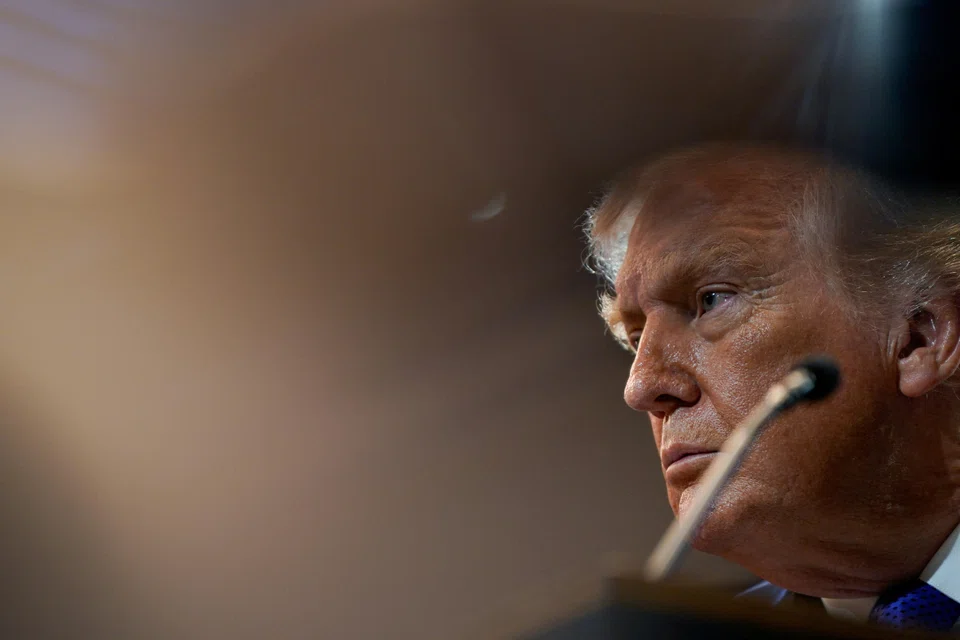
THE US Supreme Court may have ruled 6-3 against President Donald Trump’s use of an international emergency law to impose tariffs, but he seems intent on continuing the experiment he has run with the US economy over the past year, in which he has raised tariffs to levels not seen since the 1930s.
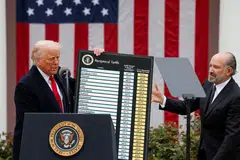
In a news conference at the White House on Friday (Feb 20), Trump made a series of false claims about the economic impact of tariffs, and he promised to replace – or even increase – them using laws other than the one the court rejected.
“It’s ridiculous, but it’s okay. Because we have other ways, numerous other ways,” the president said. “The numbers can be far greater than the hundreds of billions we’ve already taken in.”
On his tariffs, he said: “We broke every record in the book, and we are continuing to do so.”
By the end of Friday, Trump said he would impose a new set of levies, including a 10 per cent across-the-board tariff. Then on Saturday, he suddenly raised the tariffs to 15 per cent, the limit allowed by the new legal provision he was using.
“During the next short number of months, the Trump administration will determine and issue the new and legally permissible tariffs,” he said in a post on Truth Social.
Reshuffling, not recentring
To the president, tariffs are the antidote to globalisation, a way to force more manufacturing back to the US, reduce the country’s reliance on foreign products and lower the trade deficit.
But the economic evidence so far has not been in his favour. Instead of shifting manufacturing back into the US, Trump’s tariffs mostly appear to have reshuffled trade, at great cost to American companies.
Just the day before the Supreme Court issued its ruling, the US government reported annual trade data for 2025, including several metrics that contradicted Trump’s claims.
SEE ALSO



The data showed that the trade deficit – the gap between what the US imports from other countries and what it exports – continued to widen in December, and that the annual trade deficit in goods last year hit a record high. Exports of US services, a strength of the US economy, helped reduce the overall trade deficit.
But Trump has spent little time focusing on that.
One source of the president’s anger – the trade deficit with China – did narrow. Chinese imports fell nearly 30 per cent in 2025.
But US exports to China also fell, including soybeans. And while American businesses and consumers may have bought fewer goods from China, imports from other markets, such as Vietnam and Taiwan, surged.
Trade deficits with Vietnam, Mexico, India and other markets were the largest on record.
Sectoral unevenness
The US economy is generally strong, and some sectors of manufacturing have been doing well. But the gains have been led by industries such as electronics and aerospace that are less exposed to tariffs. Other sectors that face hefty tariffs, including auto manufacturers, have been struggling.
Growth in manufacturing output also hasn’t yet translated into more jobs. US manufacturers cut more than 80,000 jobs in the past year.
The president has ignored any data that does not fit his message.
Earlier in February, Trump claimed on Truth Social that the trade deficit had “been reduced by 78 per cent because of the tariffs being charged to other companies and countries”.
He added that it would “go into positive territory during this year, for the first time in many decades”. It is unclear what metrics the president was referring to, and the White House did not clarify.
It’s not particularly unusual that the US trade deficit in goods would rise from the previous year; the US economy continued to grow on an annual basis, meaning Americans grew richer and bought more foreign goods. But the trend has contrasted with Trump’s stated goals, as well as his claims about the effects his tariffs are having.
Moving the trade deficit needle
For Trump, the trade deficit has long been a sign of economic weakness.
In April 2025, he used the law just reviewed by the Supreme Court to declare that US trade deficits were an international economic emergency and to impose tariffs to try to reduce them. Although some economists worry about big trade deficits, many at the time said that trade deficits were neither unusual nor an emergency, since the US had run them for decades.
Economists also had varying takes about whether tariffs would actually reduce the trade deficit, which is driven by a variety of forces, including government spending and the value of the US dollar.
Some economists said that tariffs might reduce the trade deficit. But that was because the levies would slow the US economy, which would make Americans poorer and less able to buy foreign goods.
By late last year, the monthly trade deficit was going in Trump’s favoured direction. In October, it hit its lowest monthly level since 2009, and the Trump administration loudly proclaimed the success of its policy.
But a closer examination showed that the drop was driven by odd fluctuations caused by volatile policies. That included huge swings in the trade of gold, which investors had used as a hedge against tariffs, as well as pharmaceuticals, which had been affected by the threat of tariffs.
There was also the question of how long the trend would last. Businesses had stockpiled large amounts of goods before tariffs went into effect, so they didn’t need to import as much later. But those stockpiles wouldn’t last forever.
In November and December, US imports and the trade deficit rebounded significantly. The increase was driven in part by imports of expensive semiconductors, used by data centres to produce artificial intelligence (AI), which the president has exempted from tariffs. With AI powering US economic growth and the stock market, the president has been hesitant to clamp down on imports of these chips.
Brad Setser, an economist at the Council on Foreign Relations, said he believed that the trade deficit could fall if the greater revenue generated by the tariffs helped to shrink the government deficit and the government didn’t spend that money elsewhere.
But imports and the trade deficit had remained high because Trump had exempted major categories of goods from tariffs, such as electronics and pharmaceuticals.
“If you tax the imported component of consumption heavily enough, in my view, it will bring the trade deficit down,” he said. “It does so at a cost, though, that this administration wasn’t willing to pay.”
Uncertainty ahead
It’s difficult to say where trends in trade are headed in the next year. It will likely be a year of uncertainty: Trump said on Friday that he would use a provision of a 1974 trade law known as Section 122 to impose a new 10 per cent tariff that only lasts for 150 days. After that, the tariffs would need to be approved by Congress or replaced by different authorities.
That statute is linked not to trade deficits but to “balance of payments deficit” – when a country’s payments to other countries exceed its receipts from them. The trade deficit is related to the balance of payments, but it’s not exactly the same, and some critics of Trump argued that the new rationale for tariffs was also specious.
Despite all the uncertainty, one thing is clear: Trump’s tariffs have so far not done much to solve the emergency he said they were directed at in the first place.
“The tariffs did not succeed in revitalising US manufacturing,” Setser said. “And the tariffs did not succeed in meaningfully changing the overall trade deficit.” NYTIMES
Decoding Asia newsletter: your guide to navigating Asia in a new global order. Sign up here to get Decoding Asia newsletter. Delivered to your inbox. Free.
Share with us your feedback on BT's products and services






