

Tung Chee Hwa, who led Hong Kong after its return to China, dies at 89
His administration left no doubt that the Communist Party in Beijing was the ultimate authority
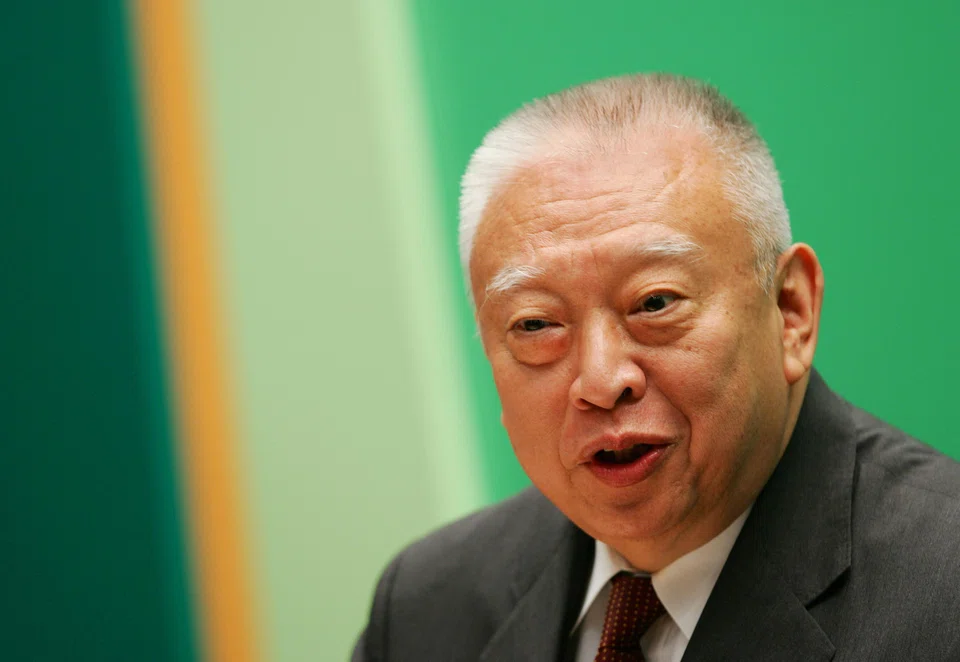
[HONG KONG] Tung Chee Hwa, a shipping tycoon who became Hong Kong’s first leader after the transfer of power from British to Chinese control in 1997 and resigned eight years later after the city had been battered by the Asian financial crisis, the Sars epidemic and mass protests, has died at 89.
His death on Tuesday (Sep 8) was announced by his office, but no other details were immediately available.
The 1997 handover officially returned Hong Kong to Chinese rule under a “one country, two systems” arrangement that promised Hong Kong a high degree of autonomy and allowed it to keep its capitalist system and many of its freedoms.
Much of the implementation of that policy was left to Tung. He had to carve out a path between two masters – the Chinese government and the people of Hong Kong – but his administration left no doubt that the Communist Party in Beijing was the ultimate authority, fuelling public discontent in a city that cherished its civil liberties.
As a relative unknown outside the world of shipping, Tung was seen as a long shot to become Hong Kong’s first Chinese leader after more than 150 years of British colonial rule.
He served on the Chinese government’s top advisory body and in the Cabinet of the last British governor, Chris Patten, who considered him a polite but unrelenting advocate of China’s interests.
In Hong Kong, he was far less popular than the handful of top officials seen as favourites for the chief executive post, but the choice was Beijing’s to make.
Beijing signalled its preference in early 1996, when China’s leader, Jiang Zemin, singled out Tung among a delegation from Hong Kong and shook his hand, an interaction that was shown prominently in mainland state media.
He dominated a tightly controlled selection process later that year and took office when the territory was handed over to Chinese sovereignty on Jul 1, 1997.
Almost immediately, Tung faced tumult. The Asian financial crisis began the day after he took office when Thailand devalued its currency, and led to precipitous stock sell-offs, attacks on the Hong Kong dollar and the bursting of a speculative bubble in the city’s apartment prices.
The Hong Kong government bought billions of dollars’ worth of shares in local companies in August 1998 to support the stock market and punish speculators. The economy began to recover, but housing prices fell for more than six years. By 2003, more than one in five apartments in Hong Kong were worth less than the mortgage on it.
In spring 2003, Hong Kong was battered by the Sars outbreak; the reported death toll of 299 accounted for nearly 40 per cent of the worldwide deaths from the disease. The city also recorded some of the earliest documented human cases of H5N1 bird flu.
Political unrest broke out that summer. Hundreds of thousands of residents joined protests against a government effort to pass a package of security laws.
Among other provisions, the laws would have allowed Hong Kong to ban any organisation linked to an organisation outlawed by Beijing, a threat that struck fear among the city’s Catholic and Protestant leaders.
The government ultimately abandoned the Bill, but the protests emboldened an active opposition movement. The movement remained a powerful force until a sweeping crackdown began in 2020, when China imposed its own tough security law on Hong Kong.
Tung, his popularity badly wounded by the protests, stepped down in 2005, two years before the end of his second five-year term in office. He cited the effects of working long hours on his health.
Born into shipping
Tung was born in Shanghai on Jul 7, 1937. His father, Tung Chao-yung, was a shipping magnate who turned a single tramp steamer into one of the world’s largest shipping fleets, Orient Overseas International. The family fled to Hong Kong in 1949 as Mao Zedong and the Communist Party took control of China.
In Hong Kong, Tung Chee Hwa’s family lived in the wealthy Kowloon Tong neighbourhood, and he attended an international school in the expectation he would study abroad. To The South China Morning Post in 2017, he recalled his father telling him he did not have the “intellect” to attend the city’s premier school, the University of Hong Kong.
Instead, Tung went to England and studied engineering at the University of Liverpool. After graduation, he worked in Boston, New York and San Francisco, first for General Electric and then for his father’s shipping firm.
In 1961, he married his teenage sweetheart, Betty Chiu, a nurse and daughter of a Hong Kong developer. They had three children.
Before taking office, Tung called for unity in Hong Kong. “Our society has become too politicised in recent years,” he said after his selection in 1996. But division and discontent grew during his tenure.
Tung became the focal point of public anger over the government’s unmet promises to expand direct elections. A plan to build more housing fed a glut that depressed prices, angering homeowners. Later governments were so spooked by the mess that they severely restricted home-building, driving apartment prices beyond the reach of most residents.
Patten described Tung as “not at all a bad man” but one who was “too malleable” to the wishes of Beijing. “He combined a curious mix of indecision and stubbornness,” Patten wrote in his 2022 book, The Hong Kong Diaries.
“He was also politically tone-deaf,” Patten added, noting Tung’s effort to push through the security bill that he was forced to withdraw.
Tung’s supporters described him as the victim of difficult times, troubled by problems largely not of his own making. NYTIMES
Decoding Asia newsletter: your guide to navigating Asia in a new global order. Sign up here to get Decoding Asia newsletter. Delivered to your inbox. Free.
Share with us your feedback on BT's products and services






