

UK defence plan leaves US$6.5 billion hole in Burnham’s first Budget
The lack of 10-year funding forces the government to backload key defence decisions for the next premier
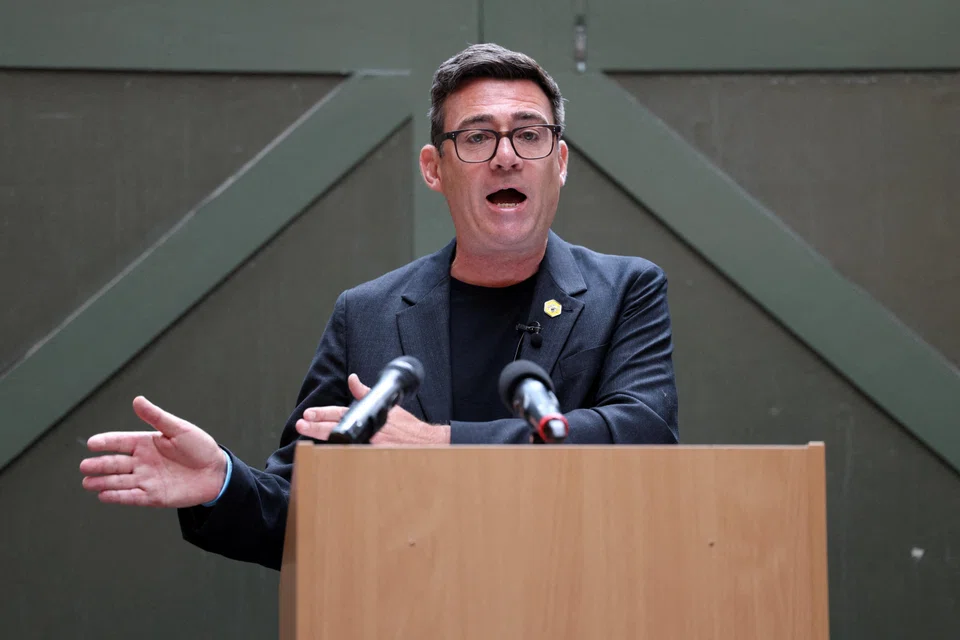
[LONDON] The UK’s long-awaited Defence Investment Plan (DIP) leaves several hard choices for Andy Burnham to make if he becomes prime minister, including how to close an almost £5 billion (US$6.5 billion) hole in his first Budget.
The plan, unveiled by outgoing Prime Minister Keir Starmer on Tuesday (Jun 30), commits an additional £15 billion to overhaul a depleted British military and quiet American demands for greater military spending by allies.
But, the programme promises only to spend the equivalent of 2.7 per cent of economic output by the end of the decade, short of the 3 per cent sought by former defence secretary John Healey.
10-year road map
Moreover, the 10-year plan has only been funded for four years – at a cost of £298 billion – leaving uncertainty over how the remaining years will be paid for.
Some £4.7 billion of the £15 billion of new money will need to be found in the Labour government’s next Budget, which appears set to be Burnham’s first as prime minister.
“The government has not set out how it will pay for around a third of this increase – an average of £1.2 billion each year – leaving this decision to be made at the Budget later this year,” said Max Warner, a senior research economist at the Institute for Fiscal Studies.
“This means there will be further impacts on other areas of spending, tax or borrowing on top of those set out in today’s announcements – implying one key early decision for the next prime minister.”
The DIP has been delayed for 10 months, amid intense wrangling between Chancellor of the Exchequer Rachel Reeves’ Treasury and the Ministry of Defence (MOD).
Healey resigned in June, accusing Starmer and Reeves of failing to provide “the resources that the nation needs to defend the country at this time of rising threats”.



How Burnham will approach defence is a topic of intense speculation, as Westminster prepares for him to assume leadership of the governing Labour Party as soon as Jul 17.
While Starmer’s two-year tenure has been consumed by foreign crises, including wars in Eastern Europe and the Middle East, and US President Donald Trump’s public questioning of Nato, Burnham has limited diplomatic experience and has said little of his foreign policy plans.
“Can the secretary of state tell us if the putative prime minister has been consulted on the DIP, and most importantly, has he given it his blessing?” James Cartlidge, the defence spokesperson for the opposition Conservative Party, asked in Parliament.
“If not, is the DIP even worth the paper it’s written on?”
In a speech at a drone company in Berkshire, Starmer said that the plan was a “platform on which I know my successor will build”. A spokesperson for Burnham declined to comment on the specifics of the plan.
Matt Bunny, Bloomberg Economist, noted: “By shifting money away more productive projects, the move risks damping the benefit of the capital spending boost announced in the first Budget of the parliament.
“It’s also another reminder for Starmer’s most likely successor, Andy Burnham, of the fiscal constraints facing the UK. Promises to spend big will carry little credibility without a clear plan for how they will be funded.”
Investment challenges, cut programmes
Choices made to resolve the plan includes £10.7 billion in “efficiency savings” through cutting the MOD’s civil service workforce, money spent on consultants and greater use of technology such as artificial intelligence.
In addition, a number of programmes are being cut, pushed back or retired early.
Bloomberg reported on Monday that the plans for a Type 83 destroyer would no longer go ahead, and the purchase of 12 new US-made F35-A jets able to carry tactical nuclear weapons would be pushed back.
Programmes to recruit new cadets and refurbish military accommodation would be slowed down, Bloomberg noted.
The Type 32 frigate will also not go ahead, making way for a new “hybrid navy” coupling other warships with uncrewed vessels.
Britain’s Shadow R1 surveillance aircraft, some Wildcat Battlefield Reconnaissance helicopters, the oldest model of its Chinook helicopters and its older Type 23 Frigates would also be retired earlier, as is already underway.
The UK’s multi-role strike ship programme to build up to six amphibious warfare ships has also been cancelled, with Britain choosing to look for opportunities with the Dutch-led Amphibious Transport Ship Programme instead.
The plan “provides much-needed clarity for industry and a clear strategic direction for our armed forces,” BAE Systems CEO Charles Woodburn said in a statement, echoing other industry figures.
Some, however, said that it was not enough.
“The additional funding is welcome, but it does not match the scale of the investment challenge facing the UK,” said John Godfrey, managing director of policy and research at TheCityUK.
“ (The) government must do more to send clear, strong and consistent demand signals in order to unlock private finance.”
The government is also cancelling plans to procure a new narrow-band satellite system, instead choosing to extend its current constellation of four military communications satellites.
The UK will also pivot from investing in the storm shadow long-range missiles, that Ukraine has relied on against Russia, to MBDA’s next-generation Stratus missiles, which it said would allow it to buy more missiles at a reduced overall cost.
Some of the nation’s compromises on defence have been left for the next premier to decide as a result of not yet funding the full 10-year plan, essentially forcing the government to backload certain key decisions.
The government could not say when exactly it would buy the F35-A planes, how many uncrewed vessels would be procured for its more autonomous naval fleet and how many Stratus missiles it would buy and on what timescale, instead pointing to future reviews and decisions.
Military budget allocation
Still, £790 million has been allocated for new integrated air and missile-defence systems.
Some £3.2 billion will be spent on space capabilities, £2.5 billion on cyberdefence, £330 million on the protection of critical underwater infrastructure and £11.1 billion on munitions and weapons, including a £400 million boost to the £6 billion promised to build a series of munitions factories.
Despite concerns around the Ajax fighting vehicles, following a review into reports that soldiers became sick after training in them, the programme will receive £1.1 billion over the next four years.
The plan also commits to investing more than £63 billion on Britain’s nuclear deterrent and other nuclear programmes.
That includes the Aukus submarine programme, though the government does not set out what precise money it was spending on the project because of national security sensitivities.
The GCAP fighter jet project with Italy and Japan gets £8.6 billion over the next four years, more than expected.
Healey’s replacement as defence secretary, Dan Jarvis, was able to persuade the Treasury to hand him £15 billion in additional funding for the plan – £1.5 billion more than what Healey was offered.
The Treasury said that includes reducing departmental capital budgets by 1 per cent, selling certain assets, enforcing more efficient procurement and cuts to both the Transport and Energy departments.
The remaining £3.4 billion is as a result of the Treasury now holding responsibility for a series of potential future costs, for example security guarantees for Ukraine. BLOOMBERG
Decoding Asia newsletter: your guide to navigating Asia in a new global order. Sign up here to get Decoding Asia newsletter. Delivered to your inbox. Free.
Share with us your feedback on BT's products and services
TRENDING NOW

DBS, OCBC, UOB rout lops billions off STI as inflation, rate concerns spook investors

Grab CEO’s wife Chloe Tong on life with Anthony Tan and finding her purpose

OCBC sheds S$8 billion in value as shares close nearly 6% down; analysts cautious on banks

Deal between tycoon friends sparks scrutiny of Philippine power sector

