
UK exam crisis deepens as Johnson faces another week of chaos
 Add BT as a preferred source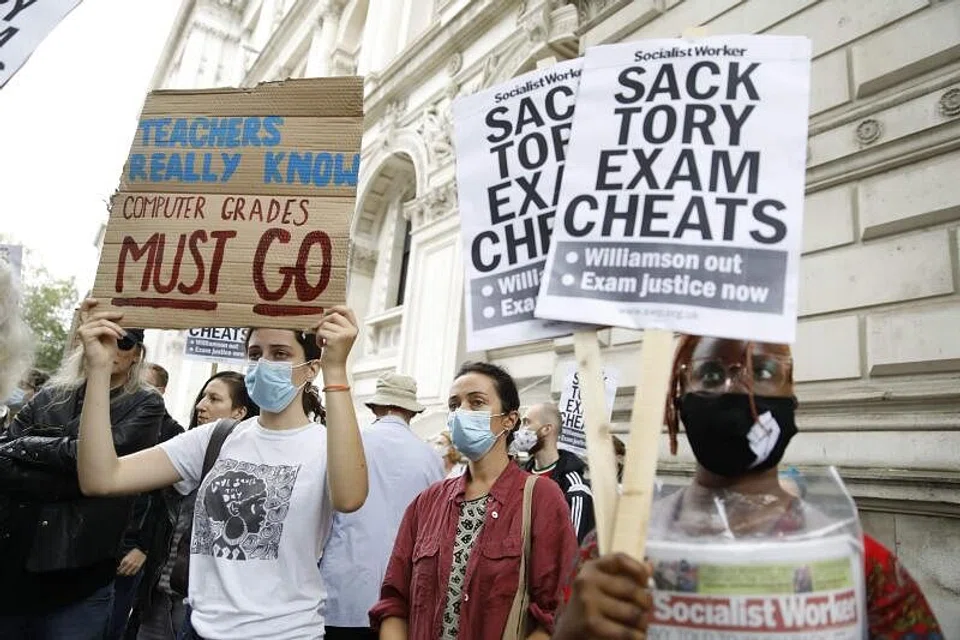
[LONDON] The UK government is facing an exam crisis after its handling of school leavers' test results during the Covid-19 pandemic sparked public outrage.
That in turn prompted a backlash against Boris Johnson's government, with many complaining young people from economically disadvantaged places were harder hit by the changes. More criticism may come this week, when thousands of 16-year-olds get the results of exams known as GCSEs on Thursday.
Here's a rundown of the crisis so far:
Why are people furious?
The nation's lockdown meant pupils were unable to sit their usual exams, which are used for job and university applications. Instead, the government said grades would be based on an algorithm that took into account teachers' predictions, previous test scores, and past results.
When A-level results were released on Thursday, social media and television channels were full of stories of students receiving results well below their expectations. With UK universities making their offers conditional on students achieving particular A-level grades, that put pupils' plans for further study -- and future careers -- in jeopardy.
Navigate Asia in
a new global order
Get the insights delivered to your inbox.
Because of the nature of the algorithm, those from more disadvantaged, state-run schools appeared to be the most impacted, fuelLing criticism of Johnson's government.
What is this algorithm exactly?
The government's algorithm combined teachers' predictions, their past test scores, and the results achieved by previous students at the same schools. The last criteria proved the most controversial because it appeared to drag down the results of stand-out students from less well-off areas.
The Office of Qualifications and Examinations Regulation said the downgrades were undertaken because the estimates provided by teachers were too optimistic, and would have led to unprecedented grade inflation had they stood.
How are people responding?
Students protested outside the government's headquarters in London on Friday calling for Education Secretary Gavin Williamson to resign. Some parents are weighing lawsuits, according to the Sunday Times, while the issue continued to dominate the front papers of UK newspapers on Monday.
There had already been a backlash against how the policy was applied in Scotland, which has a separate examination system. The Scottish government later ordered a reversal of the downgrading, and awarded affected students the results estimated by their teachers instead.
The Telegraph reported late Sunday that some top figures at Ofqual want the government to follow Scotland's lead and give pupils their predicted grades. There have also been calls for officials to delay the publication of this week's GCSE results.
What's being done?
On Friday, the day after the exam results were released, Williamson announced that the government will make the appeals process free of charge so teachers wouldn't be deterred from making them. The fees are usually paid by schools.
The appeals process was due to begin Monday, but this weekend the new criteria for appealing was suspended hours after their publication. Those new guidelines seemed to allow more leeway for raising grades. Still, even successful appeals could come too late for students to attend university this fall -- with places likely full up, they may be forced to wait a year before starting their courses.
"We have been clear that we want to build as much fairness into the appeals process as possible to help young people in the most difficult cases and have been working with Ofqual to achieve that," a Department for Education spokesperson said Sunday. "Ofqual continues to consider how to best deliver the appeals process to give schools and pupils the clarity they need."
Some admissions tutors have taken matters into their own hands. Oxford University's Worcester College has said it will honor all its offers to UK students, regardless of what A-level results they were awarded, while other institutions have made similar decisions.
What's the political fallout?
Exam results often spark controversy in the UK, with critics claiming improving results are a sign of unnecessary grade inflation. However, this year's crisis threatens to be more damaging.
Even those in Mr Williamson's own party have voiced their disapproval. The Times reported Tory lawmakers are urging Mr Johnson to get a grip on the crisis, while the former Leader of the Scottish Conservatives, Ruth Davidson, told Times Radio: "This will absolutely be one of the things that even people who don't even pay attention to politics will be all over because this is their child's future."
Longer term, the apparent disproportionate impact on poorer students risks perpetuating existing narratives around the mainly-privately educated government, and may exacerbate the Conservatives' lack of appeal for younger voters.
How else has Covid-19 affected schools?
Education has proved a thorny issue for the government during the pandemic. Pupils have been away from classrooms for months, and ministers are already under fire over plans to get schools reopened full-time in September.
The government sees this as a critical issue for reopening the economy, partly because keeping students at home makes it more difficult for parents to go to work, and also because of the damage closures threaten to do to the education of a generation of children.
Still, teachers' unions and other authorities aren't sure whether it's safe to restart classes. The public is also divided. A YouGov survey on Aug 4 found that while 57 per cent of Britons thought schools should reopen in full in September, 25 per cent disagreed and 18 per cent weren't sure.
BLOOMBERG
Decoding Asia newsletter: your guide to navigating Asia in a new global order. Sign up here to get Decoding Asia newsletter. Delivered to your inbox. Free.
Share with us your feedback on BT's products and services

