

Unemployment spikes for key Chinese age group as AI use spreads
Data reveals the jobless rate for 25- to 29-year-olds climbs to 7.7% in March
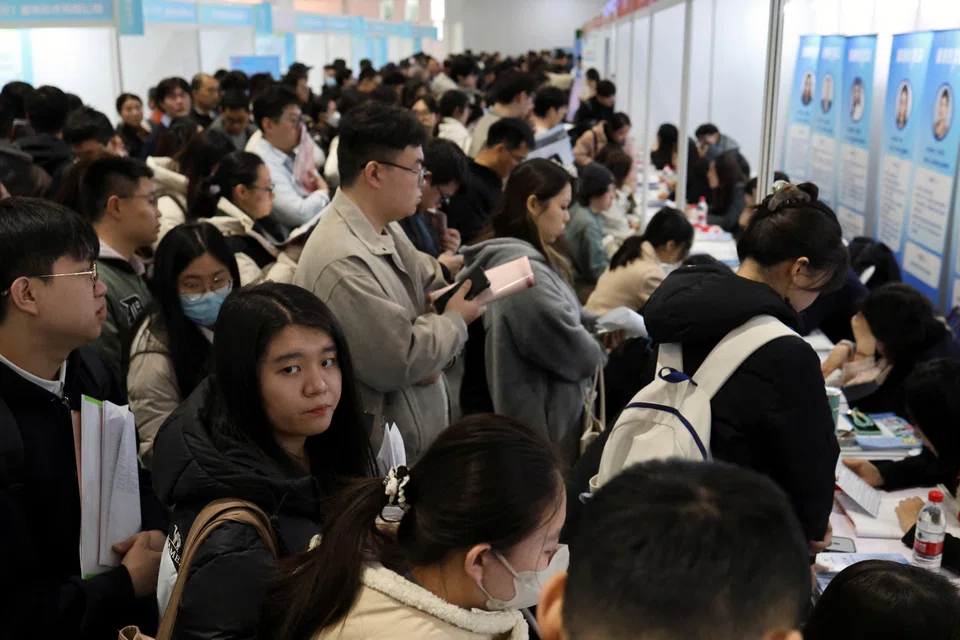
[BEIJING] An unexpected deterioration in China’s labour market has reached the key demographic of early-career workers, as seasonal pressures amplified spillovers from the war in Iran while wider use of artificial intelligence raises risks for employment.
The latest batch of official statistics this week revealed the jobless rate climbed to 7.7 per cent in March for 25- to 29-year-olds. That is up from 7.2 per cent a year ago and the highest since the National Bureau of Statistics revamped its employment data more than two years ago and started to treat that age group as a separate category.
The data adds to signs of growing distress in China’s labour force of over 700 million – the world’s biggest – after overall unemployment saw a surprise uptick last month and wage incomes expanded at their slowest rate since late 2022. Though pressure on jobs typically increases around the Lunar New Year, and the holiday’s later-than-usual timing this year may have worsened the pain in March, other factors are increasingly coming into play.
The conflict in the Middle East, now in its eighth week, has caused a massive disruption for energy exports from the Persian Gulf, scrambling trade flows and squeezing profitability. Younger job seekers are also having to contend with what Citigroup has called China’s “widespread but still shallow” adoption of AI, a transformation that eventually threatens to displace an estimated 70 million workers in the country.
“The uncertainties on costs brought by the Iran war might have disturbed hiring plans and led to a worsening of labour market indicators in March, after they showed some improvements in earlier months,” said Ernan Cui, a consumer analyst at the research firm Gavekal Dragonomics.
Unemployment increased in nearly every pocket of the labour market in March, reaching nearly 17 per cent for those aged 16 to 24. The overall jobless rate climbed to 5.4 per cent, the highest in a year, and went up for 31 big cities.
But the 25-to-29 cohort stands out for being more vulnerable to the potential shock from AI on the labour market. It’s a group that was traditionally appealing for employers, encompassing new job entrants transitioning from school to work.
Poorer outcomes for people at the onset of their careers could represent the culmination of pressures on younger workers that have been building in China since the pandemic in 2020 and are now made worse by AI-powered systems – especially when it comes to the prospects for entry-level positions.
Joblessness early in life risks leaving long-lasting scarring effects and might threaten future employment, studies have shown.



Without a turnaround, China could find it hard to escape jobless growth as it relies more heavily on manufacturing, an industry that’s become far more automated over the past decade. Even in the southern economic powerhouse of Guangdong, many factory workers are struggling as labour-intensive sectors lag high-tech businesses in export growth.
The industrial sector accounts for around 30 per cent of China’s gross domestic product but only 20 per cent of employment, according to Julian Evans-Pritchard, head of China economics at Capital Economics.
“Industry, which outperformed in the first quarter, is less labour-intensive than other sectors of the economy,” Evans-Pritchard said in a report Friday, adding that hiring in services and construction softened. “This doesn’t bode well for the consumption outlook.”
A frail labour market has already been a major obstacle to reviving household spending and the housing market. Retail sales weakened more than expected in March, leaving the economy more dependant on exports and resulting in lopsided growth that’s heightening trade tensions abroad.
And in a sign of growing consumer caution at home, household savings as a share of disposable incomes rose to 38 per cent in the first quarter, the highest level in three years for the period, according to Bloomberg calculations based on official data.
Gauging the health of the labour market has long been a challenge for economists, many of whom have criticised China’s unemployment statistics as underestimating the real picture due to flaws in their methodology.
Many migrant workers who lose their jobs and return to their hometown in the countryside likely won’t register in state statistics, and the official figures have tended to be relatively stable despite drastic growth swings in the economy at times.
The rise of gig work – which accounts for nearly half of urban jobs – also became a significant buffer against unemployment in recent years.
The NBS revamped its method of surveying joblessness for different groups in early 2024, after youth unemployment hit a record high. Until the overhaul, it did not differentiate the 25-29 cohort from the age group of 25 to 59 years.
In a statement released at the time, the statistics service said rising education levels mean most young people graduate around age 24 and may face initial job instability, while employment generally stabilises by 29.
While it’s not yet clear if the growing unemployment rate is a seasonal blip or marks the start of a sustained trend upward, Citigroup has warned China may be near “a tipping point” in its adoption of AI, based on the bank’s survey of 1,800 people in March.
While the technology’s formal use in the workplace remains limited, Citi economists said in a report last week that “AI-driven labour displacement” is adding a “structural headwind” to a weak consumer economy. BLOOMBERG
Decoding Asia newsletter: your guide to navigating Asia in a new global order. Sign up here to get Decoding Asia newsletter. Delivered to your inbox. Free.
Share with us your feedback on BT's products and services
TRENDING NOW

LTA proposes combining car COE categories, adding rebate-surcharge system

StarHub to acquire MyRepublic’s mobile business amid ongoing telco consolidation

DBS, OCBC, UOB rout lops billions off STI as inflation, rate concerns spook investors

Grab CEO’s wife Chloe Tong on life with Anthony Tan and finding her purpose

