

US bans imports of solar panel material from Chinese company
 Add BT as a preferred source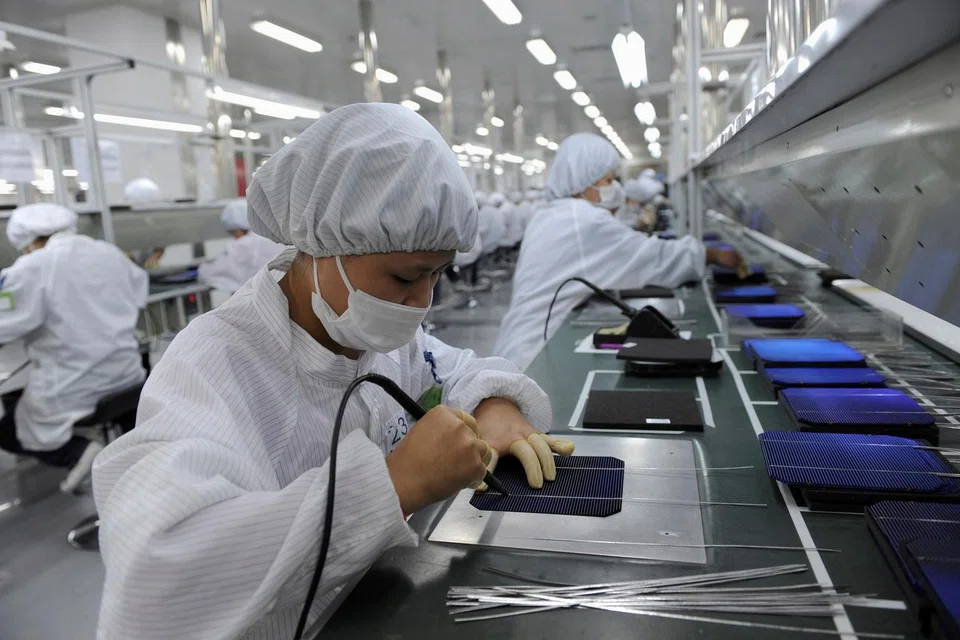
[WASHINGTON] The Biden administration on Wednesday ordered a ban on US imports of a key solar panel material from Chinese-based Hoshine Silicon Industry over forced labor allegations, said two sources briefed on the matter.
The US Commerce Department separately restricted exports to Hoshine, three other Chinese companies and the paramilitary Xinjiang Production and Construction Corps (XPCC), saying they were involved with the forced labour of Uyghurs and other Muslim minority groups in Xinjiang.
The three other companies added to the US economic blacklist include Xinjiang Daqo New Energy, a unit of Daqo New Energy; Xinjiang East Hope Nonferrous Metals, a subsidiary of Shanghai-based manufacturing giant East Hope Group; and Xinjiang GCL New Energy Material, part of GCL New Energy Holdings.
The Commerce Department said the companies and XPCC "have been implicated in human rights violations and abuses in the implementation of China's campaign of repression, mass arbitrary detention, forced labour and high-technology surveillance against Uyghurs, Kazakhs and other members of Muslim minority groups in" Xinjiang.
At least some of the companies listed by the Commerce Department are major manufacturers of monocrystalline silicon and polysilicon that are used in solar panel production.
The companies or their parent firms did not immediately respond to requests for comment, or could not immediately be reached. XPCC could not immediately be reached for comment.
Navigate Asia in
a new global order
Get the insights delivered to your inbox.
The immediate effect of the restrictions would be limited as the companies named do not have "vast contracts" with US based wafer companies, Dennis Ip, Regional Head of Power, Utilities, Renewables & Environment (Pure) Research at Daiwa said in a note to clients.
"However, we see possibility for the ban to gradually extend to include restrictions on all solar modules which contain Xinjiang-produced polysilicon," he said.
Chinese module producers could still use polysilicon from Inner Mongolia and Yunnan for their US-bound module shipments, he added.
About 45 per cent of all polysilicon used in solar module production is produced in Xinjiang, with 35 per cent produced in other parts of China. The remainder comes from outside China.
The global solar energy supply chain has been squeezed by record high costs for polysilicon, labour and freight.
When asked for comment, China's embassy in Washington referred to remarks on Tuesday by Chinese Foreign Ministry spokesperson Zhao Lijian who dismissed accusations of genocide and forced labour in Xinjiang as "nothing but rumours with ulterior motives and downright lies".
The "Withhold Release Order" by US Customs and Border Protection only blocks imports of the material from Hoshine. A source familiar with the order said it does not impact the majority of US imports of polysilicon and other silica-based products.
A second source said the move does not conflict with President Joe Biden's climate goals and support for the domestic solar industry.
The Biden administration in March announced a target to cut the cost of solar energy by 60 per cent within the next 10 years.
President Biden has set a goal of a 100 per cent clean electricity grid by 2035.
The sources said the United States is continuing to investigate allegations of forced labour by Chinese companies who supply polysilicon.
The Xinjiang region accounts for approximately 45 per cent of the world's solar-grade polysilicon supply, a report by solar industry analysts found.
The two sources familiar with the policy said the White House sees the actions as a "natural continuation" of the G-7 agreement earlier this month to eliminate forced labour from supply chains.
"We view these three actions as putting that commitment into action," one of the sources said. "We believe these actions demonstrate a commitment to imposing additional costs on the PRC for engaging in cruel and inhumane forced labor practices."
The XPCC, a paramilitary organisation sent to Xinjiang in the 1950s to build farms and settlements, remains powerful in the region's energy and agriculture sectors, operating almost like a parallel state.
Foreign governments and human rights activists say it has been a force in the crackdown and surveillance of Uyghurs in the region, running some detention camps.
The US Treasury Department last year sanctioned XPCC for "serious rights abuses against ethnic minorities".
REUTERS
Decoding Asia newsletter: your guide to navigating Asia in a new global order. Sign up here to get Decoding Asia newsletter. Delivered to your inbox. Free.
Share with us your feedback on BT's products and services
TRENDING NOW

On the board but frozen out: The Taib family feud tearing Sarawak construction giant apart
Singapore developer in limbo after Timor-Leste scraps major township project

That ‘cheap’ Malaysia condo could cost Singapore buyers far more than they think

Gojek founder Nadiem Makarim faces 18-year jail demand in Indonesia laptop graft trial

