US cannot disengage itself from Asia: PM Lee
Washington
THE United States cannot disengage itself from Asia, Prime Minister Lee Hsien Loong said, as it has a key role in ensuring the region's peace and stability.
He added that how America responds to the changing strategic landscape will affect the global balance of power and international order. "The Chinese are influential, growing more so, and need to be accommodated in a stable and constructive way into the regional and global system," he said.
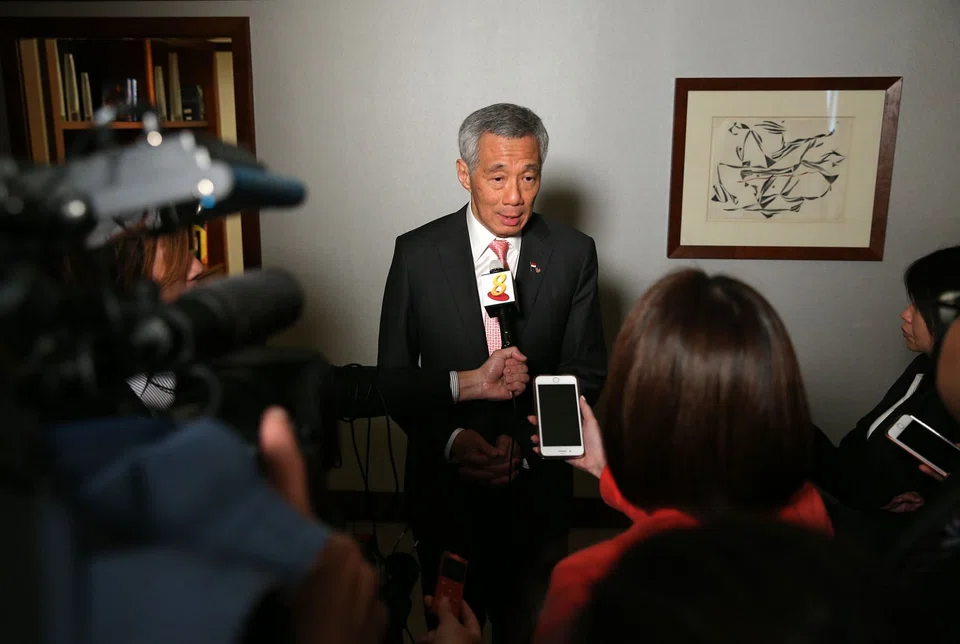
He was speaking at a dialogue at the Council on Foreign Relations (CFR) on Wednesday, where he spoke about Singapore's hopes for the new administration and offered his thoughts on Sino-US ties.
He said that even as the US stays involved in the region, it had to work on its relationship with China and ensure that it stays constructive and not tense.
Citing North Korea, he said of the US' role: "It is not going to be easily solved, but certainly it will never be solved if you're not there and actively a participant."
He noted the US had opened its markets and provided peace and security in Asia in the last 75 years, and that as it faces internal pressures to turn inward, it must be conscious of its role and responsibilities.
"With a rising set of players on the west coast of the Pacific, where does America want to go? Do you want to be engaged, do you want to participate more, do you want to deepen your economic relations? Or do you want to find some other balance, which really will leave the determination of affairs to other participants in the region?"
The CFR dialogue, PM Lee's second at the think-tank in four years, was led by New Yorker magazine's staff writer Evan Osnos, who writes on foreign affairs.
Mr Lee said that, for countries in the region, the US-China relationship matters, he said. "If you're able to work with them on a stable, gradually-evolving relationship which gives them the space to grow their influence, but in a benign way, then we're fine. We remain friends with both. If you have a tense relationship, and one or both (sides) say, 'You're either with me, or you're against me', then we're in a difficult spot.
"It could happen."
Asked about China's recent 19th party congress, Mr Lee noted that President Xi Jinping had consolidated his position, and signalled the start of a new era for China.
Mr Xi envisages this extending to 2050, taking China to 100 years after the 1949 revolution.
"The Chinese say that with Mao, China stands up (zhan qi lai); with Deng, fu qi lai, they have gotten wealthy; and now with Xi, qiang qi lai, they are strong," he said.
"What does strong mean? That's what everybody will be watching carefully."
PM Lee noted Mr Xi had set out several significant essentials - that the party must be fully in charge, the economy must grow, along with the country's international strength, including having a strong armed forces - what "any normal great power would have to pay attention to".
"What we don't know is the balance, the tone and the wisdom with which these elements will unfold, and we have to wait and see."
As for the Chinese economy, PM Lee said it has "a lot of energy and vibrance". While it may not have companies such as Google or Facebook, there is Tencent, Alibaba and Huawei.
The question is whether the top political leaders can make the tradeoffs "to stage and manage very delicate transformations which economically are critical, but politically very hard to do".
When asked for his near-term expectations of Sino-US ties, he said he hoped both sides would begin to establish a mutual understanding that would enable them to work things out over time.
He noted that when Mr Xi met Mr Trump at his Mar-a-Lago estate in Florida in April, naysayers thought it was unwise. But it has given both leaders a basis on which to talk about other issues.
"I understand they ring up each other quite frequently. There is a line - you need that line," he said. THE STRAITS TIMES