

US, China must be mindful of perception of their policies, progress: Ng
He said both sides should strive to offer moral justification for acceptance by all nations
Singapore
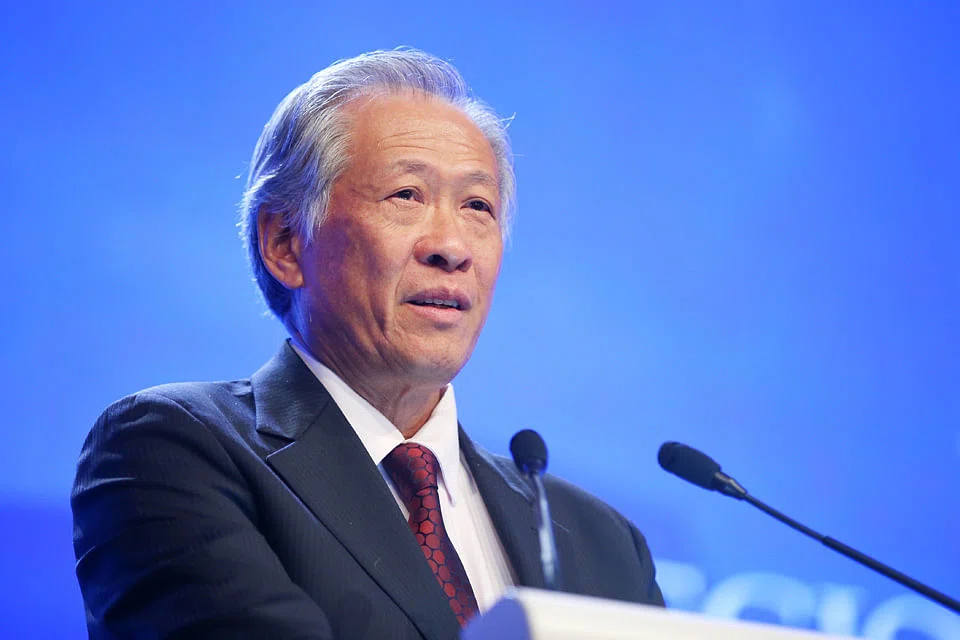
THE acceptance of the United States' or China's dominance will be diminished if their policies or progress are perceived to be lopsided against the national interests of other countries or the collective good, said Defence Minister Ng Eng Hen on Sunday.
China will hedge first in trade ties, and later inevitably in security alliances, he added, citing examples of the Trans-Pacific Partnership (TPP), in which 11 nations chose to proceed after the US pulled out.
The Japanese and Australians later led the effort to establish the Comprehensive and Progressive Agreement for Trans-Pacific Partnership (CPTPP).
Even China has not said no to joining the CPTPP, said Dr Ng in a speech on the third and final day of this year's Shangri-La Dialogue.
For the European Union (EU), he said, if it perceives that the US' terms for trade are too onerous to bear, it is not inconceivable that the EU might even increase its engagement with China, or seek other partners.
"Worse still, is the situation where individual countries have to choose between the US or China... That will be the ultimate losers' game and a race to diminishing benefits for all concerned," said Dr Ng.
He was speaking at a session on the topic "Ensuring a Resilient and Stable Region". Other speakers present were New Zealand's Defence Minister Ron Mark, and Indonesia Defence Minister Ryamizard Ryacudu.
The landmark 11-nation CPTPP came into force in December 2018, bringing steep tariff cuts to the first six countries that ratified the pact, including Japan and Singapore.
The trade deal retained all but 22 of the more than 1,000 provisions in the original TPP that had to be renegotiated after the US pulled out in January 2017.
Dr Ng said the challenge for both the US and China, amid their bilateral struggle as dominant powers in Asia, is to offer that "inclusive and over-arching" moral justification for acceptance by all countries, big and small, of their dominance beyond military might.
Earlier in his speech, he said that many at the Shangri-La Dialogue had cautioned against this outright rivalry between the two leading economies and militaries of the world.
"Even so it has come to pass, with potential for great harm on all countries here and beyond. How did we get here?" he said.
When the Shangri-La Dialogue was first launched in 2002, a decade or so had passed since the US and its allies had won the Cold War, Dr Ng noted. But economic prosperity was not one of the direct "peace dividends" to be reaped by the US and Europe.
Neither was there prolonged peace for the US and its allies, said Dr Ng, and their military deployments in the Middle East have been the longest since World War II, with the bill for the war on terror since 2001 estimated to have cost Washington US$1.5 trillion.
"In contrast, it was China - after Deng Xiaoping lifted the Bamboo Curtain to focus on economic growth - that flourished as a dazzling debutante in the globalised ball, and with it much of Asia," he said.
It was with this ascendant China that President Xi Jinping took office in 2013, and pushed for the country to play a larger role in global affairs.
Defence expenditure increased "exponentially" from 2000 to 2015, and China has also become more assertive in its position in the South China Sea, said Dr Ng.
"The new trajectory is now that of a US foreign policy to redress the perceived imbalances accumulated over the past two decades - encapsulated in America First, and according to this narrative, an America that had been taken advantage of. We can understand, even appreciate the underlying motivations but the implications are as troubling as they are unpredictable.
"It is, in essence, a disruptive change, not only for the US and its allies, but indeed the world," he added, noting that one thing for sure is that few think the world will grow at a faster pace in the near future.
TRENDING NOW

First Resources blames El Nino, outside fires for Kalimantan hotspots amid haze scrutiny

High Court rules against Julius Baer’s Singapore trust arm in US$50 million family trust dispute
Singapore key exports jump by higher-than-expected 68.4% in September, led by non-electronics

MSCI proposes downgrading Indonesia to standalone market status

