US economy ends 2021 on firmer footing; weekly jobless claims fall
 Add BT as a preferred source
THE US economy’s rebound from the pandemic was more robust than previously thought, bolstered by firmer consumer spending on big-ticket items and services.
Beginning with an upward revision for the third quarter of 2020, when the economy was starting to escape the clutches of Covid lockdowns, growth was marked higher in most quarters till 2021.
That left inflation-adjusted gross domestic product (GDP) 1 per cent higher, or about US$200 billion, at the end of last year than previously reported, according to the annual update of the national economic accounts released on Thursday (Sep 29) by the Bureau of Economic Analysis.
The data also showed that the contraction in economic activity at the start of the pandemic was slightly less severe than previously reported, with GDP shrinking an annualised 29.9 per cent in the second quarter of 2020 compared to the previously reported 31.2 per cent decline.
A look at industry statistics showed upward revisions in wholesale trade, healthcare and accommodation, and food services in the subsequent recovery. With the revision, the value added by hotels and restaurants had recovered to its pre-pandemic level by the end of last year.
The difference between the government’s 2 main gauges of economic activity – GDP and gross domestic income (GDI) – narrowed sharply in the latest revisions.
While GDP measures the total value of all goods and services produced in the economy, GDI is a snapshot of the income earned from that production. The 2 measures should be roughly similar, but in earlier estimates they often diverge significantly.
With the latest updates, the change in real GDI in 2021 was revised down to 5.5 per cent from a previously reported 7.3 per cent. That is more in line with the 5.9 per cent growth in GDP for all of last year, which was revised up from 5.7 per cent.
Meanwhile, the number of Americans filing new claims for unemployment benefits unexpectedly fell last week as the labour market remains resilient, despite rising headwinds from the Federal Reserve’s stiff interest rate increases and slowing demand.
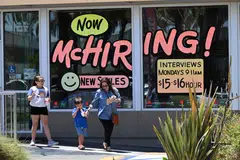
Initial claims for state unemployment benefits dropped 16,000 to a seasonally adjusted 193,000 for the week ended Sep 24, the Labor Department said on Thursday (Sep 29). Data for the prior week was revised to show 4,000 fewer applications filed than previously reported. Economists polled by Reuters had forecast 215,000 applications for the latest week.
While there have been reports of some companies laying off workers, claims have remained at the lower end of their 168,000 to 252,000 range for this year. Economists say most employers are hoarding workers after experiencing difficulties hiring in the past year as the Covid-19 pandemic forced some people out of the workforce, in part because of prolonged illness caused by the virus.
They expect companies to pull back on hiring before resorting to widespread job cuts.
The US central bank last week raised its policy interest rate by 75 basis points, its third straight increase of that size, and signalled more large increases to come this year. Since March, the Fed has hiked its policy rate from near zero to the current range of 3.00 per cent to 3.25 per cent.
There were 11.2 million job openings at the end of July, with 2 jobs for every unemployed person.
The claims report showed the number of people receiving benefits after an initial week of aid fell 29,000 to 1.347 million in the week ending Sep 17. The so-called continuing claims data – a proxy for hiring – covered the week that the government surveyed households for August’s unemployment rate.
Continuing claims fell between the July and August survey periods. The jobless rate rose to 3.7 per cent in August from 3.5 per cent in July. The Fed last week raised its median forecast for the unemployment rate this year to 3.8 per cent from its previous projection of 3.7 per cent in June. It boosted its estimate for 2023 to 4.4 per cent from the 3.9 per cent projected in June.
The strong labour market is helping to keep the economy afloat. While a separate report from the Commerce Department on Thursday confirmed that the economy contracted in the first half of this year, it is not in recession, with the income side of the growth ledger expanding moderately.
Decoding Asia newsletter: your guide to navigating Asia in a new global order. Sign up here to get Decoding Asia newsletter. Delivered to your inbox. Free.
Share with us your feedback on BT's products and services