US factory headcount falling despite Trump’s promised manufacturing boom
Overall, hiring has been narrowly focused, with a measure of hiring breadth showing more industries shedding employment than adding
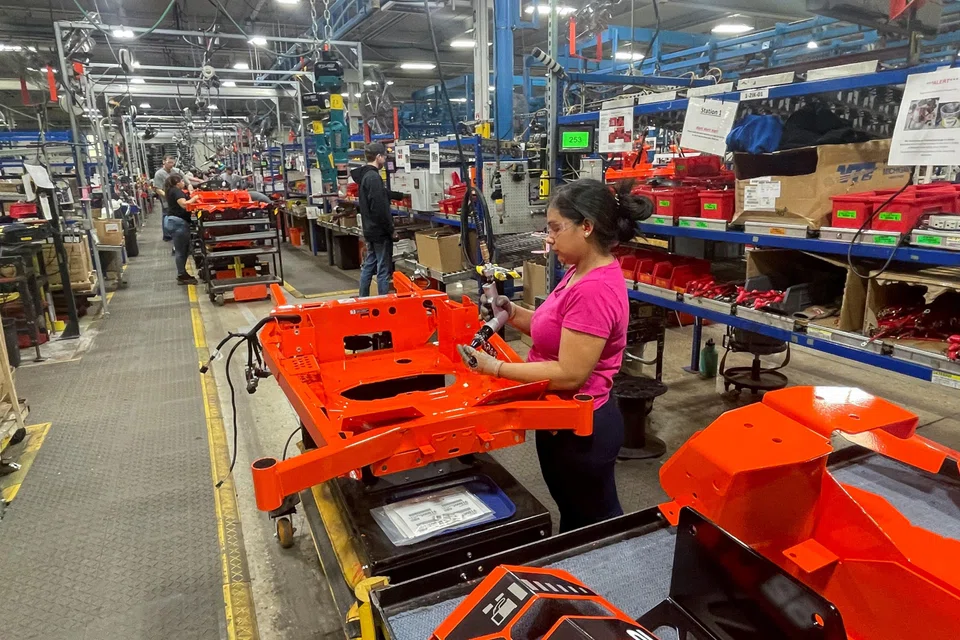
[WASHINGTON] US manufacturing jobs in December continued an eight-month skid that began last spring after US President Donald Trump rolled out aggressive import taxes that he pledged would lead to a resurgence of blue-collar jobs by reshuffling world trade to favour US workers.
The reshuffling has certainly occurred, with the US collecting around US$30 billion a month in tariff revenue, spread among US consumers, importers, and overseas exporting firms, and as firms first frontloaded goods abroad to stock their shelves with tariff-skirting inventory, then slowed their purchases and brought down US import levels.
But the blue-collar jobs boom has not materialised, adding to the soured sentiment about Trump’s economic policies among households concerned about still-rising prices and uncertainty about the labour market.
Data released on Friday showed the unemployment rate fell slightly to 4.4 per cent in December from 4.5 per cent in November, though estimates of job creation in prior months were revised lower, presenting US Federal Reserve officials with a mixed message of a jobless rate that remains low by historic standards, but hiring trends that seem weak and job growth that seems narrow.
The latest data “is very much in line with the businesses I am talking to, which is that the low-hire environment continues. Some of it is uncertainty. A lot of it is productivity”, Richmond Fed president Tom Barkin said. “It is hard to find businesses outside of the AI ecosystem or healthcare that are talking about hiring.”
Just ask JB Brown, CEO of BCI Solutions, a small metal foundry in Bremen, Indiana, that sells to a range of agriculture and heavy equipment makers.
“Every time, I hear that manufacturing is booming, I scream at the TV,” Brown said. His workforce is down to 130 from 240 people over the past 27 months. That’s the fewest the family-owned business has had since at least 1993, when he joined the company.
Brown said he eliminated a shift in September 2023 and has let attrition steadily reduce numbers since then. He said he could cut another 5 per cent of his workers, if necessary, but he’s trying to avoid that to keep ready for the eventual upturn in orders. His capacity now stands at 52 per cent, another low point.
“I have never been below 70 to 65 per cent,” he said. “This is our first time experiencing that.”
SEE ALSO






Manufacturing employment lower than in Trump’s first term
The pace of job creation in the first year of Trump’s second term has fallen more than two-thirds from what it was in the final year under president Joe Biden, to an estimated 49,000 per month in 2025 versus 168,000 per month the prior year.
The unemployment rate has increased only modestly because the number of people looking for jobs has remained flat under Trump, with tougher immigration and deportation rules and enforcement curbing what had been steady labour force growth under Biden’s looser immigration policies.
“The healthcare sector is the only sector that is adding jobs right now, and it always does. It’s completely insensitive to the economic cycle,” Luke Tilley, chief economist at Wilmington Trust, said at a Maryland Bankers Association event on Friday.
Some parts of the economy have felt the pressure more than others. The Black unemployment rate has risen from 6.2 per cent as at January, when Trump resumed office, to 7.5 per cent the past two months. The white unemployment rate by contrast, has been between 3.5 and 3.8 per cent since April of 2024, and was below that for more than two years prior.
Hiring in manufacturing, meanwhile, has been in the doldrums. The sector lost another 8,000 jobs in December, the Bureau of Labor Statistics estimated, and factory employment has dropped more than 70,000 since April to 12.7 million as of last month, the lowest reading since March of 2022. Construction jobs by contrast, while dropping in December, have continued the slow but steady growth seen throughout the post-pandemic era, goaded along recently by a boom in data-centre investment.
The much smaller mining and logging industry has also been losing jobs, down to 608,000 as at December, versus 626,000 in April.
That was the month Trump rolled out the “Liberation Day” tariffs that, while quickly scaled back after a brutal market reaction, set the stage for an upheaval in world trade and investment patterns that is still unresolved.
The US Supreme Court is expected to rule soon on a case that challenged the legality of many of the tariffs imposed under national security laws but touted by Trump as a source of revenue and meant to reclaim US manufacturing supremacy.
The path of employment since the new strategy was put in place, however, shows if anything how difficult it is to reshape labour market dynamics in a US$30 trillion economy whose population is ageing and in need of ageing-related services, where growth is dependent on consumer spending that tends to be concentrated on services such as education, healthcare, leisure, and restaurants, and whose workers command a wage premium that causes firms and managers to invest in productivity so they can make goods with fewer man-hours.
Manufacturing employment in the US is now lower than it was for much of Trump’s initial term, which ran from 2017 until his loss to Biden in the 2020 election.
Overall, hiring has been narrowly focused, with a measure of hiring breadth showing more industries shedding employment than adding.
The economy is generating jobs based on what people want to buy and what firms can profitably sell, and so hiring patterns have not shifted all that much.
“Nothing in the...data points towards significant, near-term change to this now familiar pattern,” Laura Ullrich, director of economic research in North America at the Indeed Hiring Lab, wrote after the release of the December employment data. “That said, a low-hire/low-fire environment can’t last forever in a growing economy. While a long-stagnant labour market might not be as directly alarming as an obviously broken one, it can still feel quite broken for many job seekers.” REUTERS
Decoding Asia newsletter: your guide to navigating Asia in a new global order. Sign up here to get Decoding Asia newsletter. Delivered to your inbox. Free.
Share with us your feedback on BT's products and services