

US fighter jet shot down over Iran; one crew member rescued
US forces continue search-and-rescue operations for other crew member
 Add BT as a preferred source
[WASHINGTON] Iran has shot down a US fighter jet over the country, US officials and Iranian state-affiliated media said on Friday (Apr 3).
US media reported that American special forces have tracked down and rescued one crew member. Iran had earlier shown footage of the wreckage of what appears to be an F-15 jet.
The New York Times and Wall Street Journal identified the downed plane as an F-15E fighter, which is crewed by a pilot and a weapons-systems officer in the back seat.
US Central Command keeps multiple task forces set up near Iran for search-and-rescue operations in the event that US warplanes are shot down, including in both Iraq and Syria, the officials said.
But such an operation is highly difficult because Iran has demonstrated its ability to launch strikes, particularly at slow-moving helicopters that might be involved in such an operation.
The warplane was shot down the same day that US President Donald Trump celebrated the US bombing of an Iranian highway bridge and warned on social media that there was “much more to follow”.
The American attack on the B1 bridge between Teheran and the shores of the Caspian Sea killed eight people and wounded 95, Iranian news media reported.
A US military official said that American forces had struck the bridge twice, eliminating what the official called a planned military supply route for Iran’s missile and drone forces.
The officials all spoke on the condition of anonymity to share operational details.
SEE ALSO

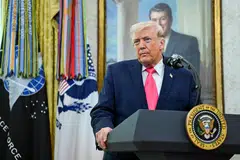

The latest situation creates a military and diplomatic challenge for the US, as President Donald Trump has called in recent days to bombard Iran “back to the Stone Ages”.
Over the past 24 hours, the US and Iran have been trading attacks on military and civilian infrastructure in the region.
Kuwait Petroleum Corp said drones had struck the Mina al-Ahmadi refinery, without saying where the attack came from.
In a separate incident, the Kuwaiti government said Iran had damaged a power and water desalination plant in the country. In Abu Dhabi, the capital of the United Arab Emirates (UAE), authorities said falling debris from an air defence interception started a fire at a major gas field, halting operations there.
On Thursday, the US struck a highway bridge near the capital, Teheran, killing eight people, Iranian news outlets reported.
Energy attacks
Since the war started on Feb 28, Iran has attacked refineries, oil tankers, storage sites and other energy infrastructure across the region, while Israel has hit some similar sites in Iran.
Intentionally targeting energy infrastructure could constitute a war crime under international law.
The strikes and Iran’s blockade of the Strait of Hormuz, the conduit for around a fifth of the world’s oil, have sent global oil prices soaring. Markets in the US were closed for Good Friday.
Trump has threatened further strikes on energy infrastructure, warning that if Iran does not reopen the strait, the US military will destroy the country’s power plants.
“Bridges next, then electric power plants!” he wrote on social media late on Thursday. “New regime leadership knows what has to be done, and has to be done, FAST!”
Iranian leaders have been defiant in the face of the repeated threats from Trump this week. Esmail Baghaei, a spokesperson for Iran’s foreign ministry, said in a statement Thursday that negotiations with Washington were impossible under current conditions.
Russia, China and France on Thursday effectively stymied a push by Arab countries to get the United Nations Security Council to authorise military action against Iran to reopen the Strait of Hormuz.
The vote on the resolution was expected to be scheduled for Friday. But it remained unclear whether extra hours of diplomacy would bring the three veto-holding countries on board.
High costs, death tolls
Some estimates suggest the war could cost the US as much as US$1 billion a day, a total that underscores the economic trade-offs the Trump administration faces, as the president had promised to focus on lowering consumer costs and other domestic issues.
The Human Rights Activists News Agency said at least 1,606 civilians, including 244 children, had been killed in Iran as at Thursday. Lebanon’s health ministry said at least 1,345 Lebanese had been killed as at Thursday, since the latest fighting between Israel and Hezbollah began.
In attacks blamed on Iran, at least 50 people have been killed in Gulf nations. In Israel, at least 17 people had been killed as at Friday. The American death toll stands at 13 service members, with hundreds of others wounded. NYTIMES
Decoding Asia newsletter: your guide to navigating Asia in a new global order. Sign up here to get Decoding Asia newsletter. Delivered to your inbox. Free.
Share with us your feedback on BT's products and services
TRENDING NOW
DBS completes US$1 billion significant risk transfer deal, a first for Singapore bank

Malaysian tycoon Vincent Tan’s sell-downs point to pruning rather than an exit plan

Singapore private housing is ‘decoupling’ from HDB market as buyer pools diverge: NUS survey

Not in education, employment or training: Why more Hong Kong youths are opting out of work

