US identifies 52 sites to hit if Iran retaliates
Trump's tough talk late on Sat follows Teheran's threat of a protracted response to Qassem Soleimani's assassination; Gulf states that are possible targets for reprisal urge calm
 Add BT as a preferred source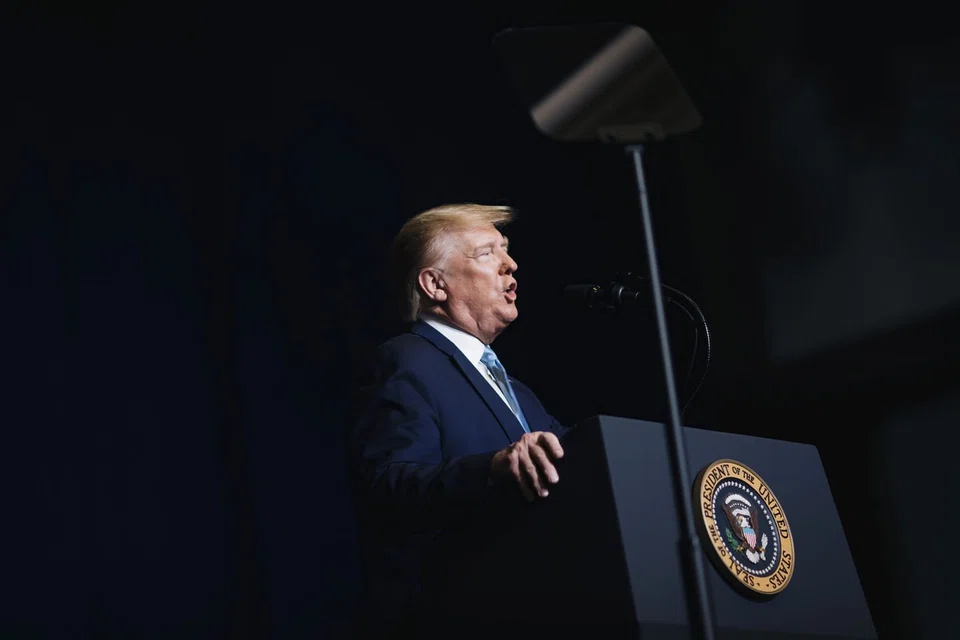
Washington
PRESIDENT Donald Trump said the United States has identified 52 Iranian sites it would hit if Teheran retaliates against the assassination of Iranian General Qassem Soleimani, stepping back from more conciliatory comments he made after the drone strike on the Islamic Republic's most powerful military commander.
Mr Trump's tough talk late on Saturday followed Teheran's threat of a protracted response, and eclipsed his assertion a day earlier that the US hadn't launched the attack near Baghdad airport on Thursday to "start a war". It also seemed to reverse the efforts of Secretary of State Michael Pompeo, who in the past two days has repeatedly reaffirmed that the US remains committed to defusing tensions with Iran as he talked with officials across the Middle East and Russia. Stocks in the Gulf went into retreat.
Gen Soleimani's body arrived in Iran on Sunday, and thousands of mourners poured into the southwestern city of Ahvaz to attend services and sermons, according to footage on state TV. The body will be taken to funeral processions across the country before his burial, expected on Tuesday, in his south-eastern hometown of Kerman, state TV said.
In Baghdad on Saturday, thousands attended memorial services for the general and a powerful Iraqi militia commander also killed in the strike.
The Middle East has been girding for vengeance and a possible escalation of the proxy war between the US and Iran that's been playing out for years. Iranian President Hassan Rouhani vowed on Saturday that the US will witness the effects of their mistake for "many, many years to come," and another Iranian official told the state broadcaster that three dozen US military bases and facilities are within reach of Iran's defense forces, the closest in Bahrain.
Gulf states that are possible targets for Iranian reprisal urged calm as the prospect of a new conflict in the world's top energy-exporting region loomed. Teheran's capacity for retaliation may be crimped, however, by the dire condition of the Iranian economy, which has been clobbered by American sanctions reimposed after Mr Trump withdrew from the landmark nuclear accord in 2018.
Moreover, months of anti-government protests have challenged the regime's dominance at home, as well as in Iraq and Lebanon, where Gen Soleimani worked with proxy militias that extended Iran's reach across the Middle East.
There was some immediate fallout, however. Rockets slammed on Saturday into Baghdad's Green Zone, which contains the US Embassy and an airbase that houses American troops. No coalition casualties were reported.
Mr Trump said he approved the strike in Iraq because Gen Soleimani was plotting "imminent and sinister attacks" against American diplomats and military personnel, though he provided no evidence to back up that claim. Some 3,500 additional US troops were ordered dispatched to the region after Gen Soleimani's assassination, to join more than 50,000 personnel already there.
The killing sent global markets reeling. Oil futures in London and New York at one point surged by more than 4 per cent, gold hit the highest in four months and 10-year Treasury yields headed for the biggest drop in three weeks. The S&P 500 Index declined. On Sunday, Gulf stocks dropped and Saudi Arabia's default risk jumped.
Gen Soleimani, who headed the unit responsible for the foreign operations of the powerful Islamic Revolutionary Guard Corps, was a household name in Iran where he's celebrated for helping to defeat Islamic State in Iraq and Syria and countering US influence. He'd been sanctioned by the US since 2007, and in May, Washington designated the Guards a foreign terrorist organisation.
Iran named Esmail Ghaani, another veteran of Middle East conflicts, as Gen Soleimani's replacement.
Preceding US administrations had baulked at assassinating the general, wary of the repercussions despite his responsibility for hundreds of US fatalities. Democratic lawmakers have criticised Mr Trump for acting without notifying Congress.
Ever since the US pulled out of the Iran nuclear deal in 2018, then doubled down with a campaign to cripple the Iranian economy through sanctions, hostility between the countries has threatened repeatedly to erupt into a broader confrontation. A defiant Iran has revved up its nuclear fuel programme, and is blamed by Washington for attacks on oil tankers in the Persian Gulf, and for a strike on Saudi Arabian facilities that briefly knocked out 5 per cent of global crude supply.
Iran has denied responsibility for those attacks.
Gen Soleimani's assassination has set off a flurry of diplomacy, with European allies urging Mr Trump to ease tensions with Teheran and warning of the risks of tit-for-tat reprisals. Turkey and Russia have both spoken with Iranian officials to discuss developments. BLOOMBERG
READ MORE:
Share with us your feedback on BT's products and services