
US job gains accelerate while wage growth slows
 Add BT as a preferred source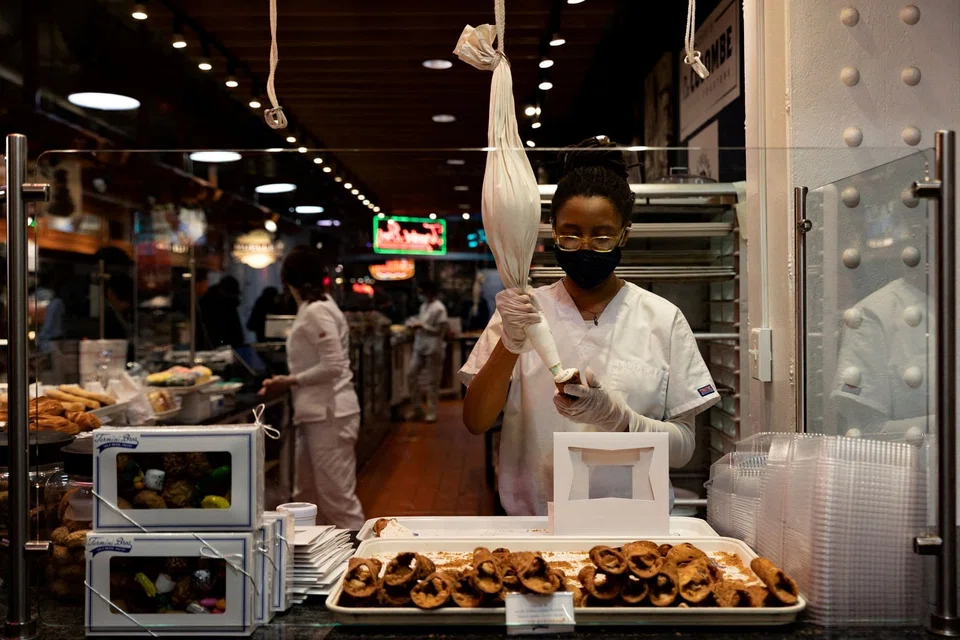
[WASHINGTON] US hiring boomed in February while wage growth slowed, showing a strong labour market that likely keeps the Federal Reserve on track to raise interest rates this month while offering some respite from strong inflationary pressures.
Nonfarm payrolls increased 678,000 last month - the most since July - after upward revisions in the prior two months, a Labor Department report showed Friday. The advance was broad-based across sectors. The unemployment rate edged down to 3.8 per cent, and average hourly earnings were little changed from the prior month.
The median estimate in a Bloomberg survey of economists called for a 423,000 advance in payrolls and for the unemployment rate to fall to 3.9 per cent.
The employment report - the last the Fed will receive before its March 15-16 meeting - highlights a steadily improving, though extremely tight labour market. While declining Covid cases and looser restrictions likely helped boost hiring, employers are still scrambling to fill a near-record number of vacancies, making it tough to meet resilient demand by households and businesses alike.
Labour demand is likely to continue to exceed supply, limiting the pace of job growth and putting upward pressure on wages. Friday's report showed average hourly earnings were little changed in February and up 5.1 per cent from a year ago, a deceleration from the prior month. The average workweek ticked up to 34.7 hours.
Traders focused on the flat average hourly earnings figure, sending the yield on the 10-year Treasury note lower. S&P 500 futures remained lower.
Navigate Asia in
a new global order
Get the insights delivered to your inbox.
Even though wage growth lagged expectations, strong hiring and the lower unemployment rate support the Fed's plan to raise rates this month. Chair Jerome Powell reaffirmed that plan this week after Russia's invasion of Ukraine, which has led to a surge in oil, metals and grain prices and clouded the US economic outlook. He said he favours a 25 basis-point increase to kick off an expected series of hikes this year.
The labour force participation rate - the share of the population that is working or looking for work - ticked up to 62.3 per cent, and the rate for workers ages 25-54 rose to the highest since March 2020. While improved, a combination of factors like child care challenges, Covid-19 concerns and early retirements have whittled down America's workforce. Before the pandemic, the overall rate was over a percentage point higher.
In testimony to lawmakers Wednesday, Powell noted the decline in labour force participation is "certainly something that's now contributing to wage inflation and actual inflation and to the labour shortage that we're currently seeing." He also said the US is "at least" at maximum employment, defined as the highest level that's consistent with price stability.
Some of the sectors hit hardest by the pandemic saw strong job gains in February, including restaurants and health care. Professional and business services also advanced, while construction payrolls gained by the most since March. BLOOMBERG
Decoding Asia newsletter: your guide to navigating Asia in a new global order. Sign up here to get Decoding Asia newsletter. Delivered to your inbox. Free.
Copyright SPH Media. All rights reserved.

