

US offers US$710 million in loans for EV technology projects
 Add BT as a preferred source
THE US Energy Department said on Thursday (Feb 22) it gave preliminary approval for nearly US$710 million in loans to electric vehicle (EV) technology manufacturing ventures, although the Biden administration still has US$221.8 billion in loan capacity to fund clean-energy projects.
South Korean company SK Siltron is set to receive US$544 million to expand a plant in Bay City, Michigan that produces high power silicon carbide wafers used in electric vehicles. Those components are critical EV drivetrains, including inverters, and electrical distribution systems, the department said.
About 200 jobs each in the construction and production sectors could be created to handle the plant expansion, the department said in a statement.
“This project is an important step towards ensuring a resilient and robust supply chain in the US, and we are proud to bolster domestic semiconductor manufacturing,” said SK Siltron CSS CEO Jianwei Dong.
President Joe Biden visited the Bay City factory in November 2022 touting the fact that it produces material for chips that power “smartphones, washing machines, hospital equipment, automobiles – just to name a few.”
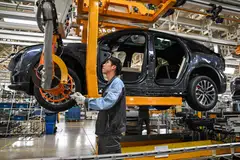
American Battery Solutions separately received conditional approval for a US$165.9 million loan to expand its EV battery pack assembly operations in Springboro, Ohio and Lake Orion, Michigan. Both facilities could employ up to 460 people.
Navigate Asia in
a new global order
Get the insights delivered to your inbox.
Jigar Shah, director of the energy department’s loan programme office, told Reuters in Detroit that applications for US$80 billion in financing have come to his office within the past two months from “very sophisticated players.”
In total, the department has disbursed US$34.43 billion, as of Dec 31, 2023. It received applications for US$263.1 billion in loans, as of end-January.
The projects and the jobs depend on the companies closing the loans and deploying the money. The US Energy Department finalised in December 2022 a US$2.5 billion loan to finance battery plant construction by a venture formed by General Motors and LG Energy Solution. But Ford and battery partner SK On have not finalised a proposed US$9.2 billion energy department loan to build three US battery plants.

“We’re fully anticipating they are going to close the loan,” Shah said.
Energy Secretary Jennifer Granholm said last August that the agency would offer US$10 billion in loans and another US$2 billion in grants to help convert factories to build electric vehicles.
“We hired specific people ... to go beat the bushes to get people to use that,” Shah said. Many potential applicants are waiting in hope that they can win grants, he said.
The clean technology sector, including EVs, tumbled from euphoric levels of investment in 2021 and 2022 to “clearly a discipline year” in 2023, Shah said.
But he said his office will “lean into good risks,” such as lending to projects aimed at producing critical minerals used in batteries and electronics – a sector dominated by China.
“China is clearly oversupplying the market. Prices are down,” Shah said. But the government’s advisers believe “we are going to be short capacity of critical minerals in 2027.” REUTERS
Decoding Asia newsletter: your guide to navigating Asia in a new global order. Sign up here to get Decoding Asia newsletter. Delivered to your inbox. Free.
Share with us your feedback on BT's products and services
TRENDING NOW

Malaysia’s 8th richest man Jeffrey Cheah wants Sunway business to last 10 generations
How China’s young workers are securing their future even as AI disrupts job market, triggers pay cuts
Inside Indonesia’s trial of Gojek co-founder: How a Google laptop deal became a multitrillion-rupiah case

Middle East-linked energy supply shocks put Asean Power Grid back in focus

