Trump demands other countries help secure vital Strait of Hormuz
Allies Japan and Australia, however, say they are not planning to send navy vessels to escort ships through the waterway
[TOKYO] US President Donald Trump’s demands for a coalition to help reopen the Strait of Hormuz appeared to fall on deaf ears on Monday (Mar 16).
Allies Japan and Australia said they were not planning to send navy vessels to the Middle East to escort ships through the vital waterway.
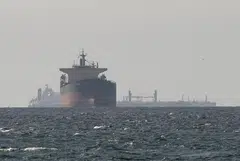
With the US-Israel war on Iran creating turmoil in the region and shaking up global energy markets in its third week, Trump insisted on Sunday that the nations relying heavily on oil from the Gulf have a responsibility to protect the strait – through which 20 per cent of the world’s energy transits.
Markets in Asia reacted cautiously, with Brent crude rising more than 1 per cent above US$104.50 a barrel and regional share markets mostly weaker – amid concerns about the risk to Middle East oil facilities and after Trump’s request for allies to get more involved.
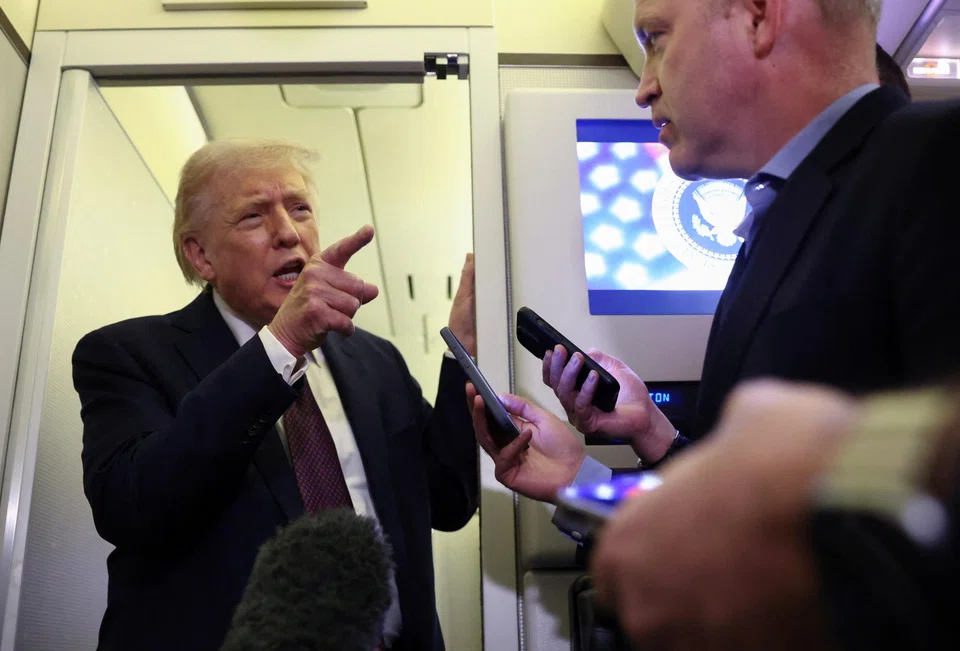
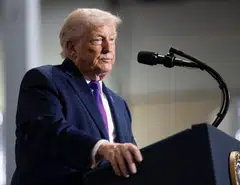
Aboard Air Force One on the way from Florida to Washington, Trump told reporters: “I’m demanding that these countries come in and protect their own territory because it is their territory. It’s the place from which they get their energy.”
He said his administration already contacted seven countries, but he did not identify them.
In a weekend social media post, he said he hoped China, France, Japan, South Korea, Britain and others would participate.
Sanae Takaichi, the prime minister of Japan and a staunch Trump supporter, said on Monday her country, constrained by its war-renouncing Constitution, has no plan to dispatch naval vessels to escort ships in the Middle East, which it gets 95 per cent of its oil from.
She told parliament: “We have not made any decisions whatsoever about dispatching escort ships. We are continuing to examine what Japan can do independently and what can be done within the legal framework.”
SEE ALSO

Australia, another key Indo-Pacific security ally to the US that also relies heavily on fuels made with Middle Eastern crude, said it will not send naval ships to assist in reopening the strait, either.
Catherine King, a member of Prime Minister Anthony Albanese’s Cabinet, told state broadcaster ABC: “We know how incredibly important that is, but that’s not something that we’ve been asked for or that we’re contributing to.”
Trump may delay Beijing visit without China support
Trump told the Financial Times on Sunday he was expecting China to help unblock the strait before his scheduled meeting with Chinese President Xi Jinping in Beijing at the end of March, and might postpone his trip if it did not provide assistance.
“I think China should help too because China gets 90 per cent of its oil from the straits,” he said.
“We may delay,” he added in reference to his visit, if China did not offer support in the Gulf.
The Chinese foreign ministry did not immediately respond to a Reuters request for comments.
He also ratcheted up pressure on European allies to help protect the strait, warning that the North Atlantic Treaty Organization faces a “very bad” future if its members fail to come to Washington’s aid.
European Union foreign ministers will discuss on Monday about bolstering a small naval mission in the Middle East. However, they are not expected to decide on extending its role to the choked-off strait, diplomats and officials say.
British Prime Minister Keir Starmer discussed the need to reopen the strait with Trump and with Canadian Prime Minister Mark Carney, a Downing Street spokesperson said on Sunday.
South Korea said it would carefully review Trump’s request.
With global air travel remaining severely disrupted due to the Iran war, key Middle Eastern hubs have been closed or restricted, including Dubai, Doha and Abu Dhabi.
It has forced airlines to cancel thousands of flights, stranding tens of thousands of passengers.
Supplies of jet fuel are also becoming a concern, with authorities in Vietnam warning the country’s aviation industry to prepare for potential flight reductions from April, after China and Thailand halted exports of jet fuel due to the Iran war.
Drones cause fire, disrupt traffic at Dubai airport
The disruption to energy markets caused by the Iran war is an “abject lesson” in the risks of relying on fossil fuels, said the United Nations climate secretary.
“Fossil-fuel dependency is ripping away national security and sovereignty, and replacing it with subservience and rising costs,” said Simon Stiell, the executive secretary of the UN climate-change arm, the UN Framework Convention on Climate Change.
He was speaking at an event in Brussels on Monday, attended by EU officials and government ministers.
Although some Iranian vessels have continued to pass and a few ships from other countries have successfully made the crossing, the passage has been effectively closed for most of the world’s tanker traffic since the US and Israel attacked Iran on Feb 28.
Israel continued to launch strikes on Iran as well as Lebanon and Gaza, targeting militants from the Iran-backed Hizbollah and Hamas.
The Israeli military said on Monday its troops had begun limited ground operations against positions in southern Lebanon held by Hizbollah.
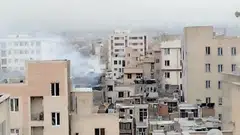
Despite repeated claims from US authorities about having destroyed Iran’s military capabilities, drone attacks continued to threaten Gulf states on Monday.
Dubai authorities said they had contained a fire, but temporarily suspended flights at the airport after a drone attack hit a fuel tank.
Saudi Arabia intercepted 34 drones in its eastern region in one hour, state media said. No injuries were reported in either incident.
US officials, responding to economic uncertainty over high oil prices, predicted on Sunday that the war on Iran would end within weeks and that a drop in energy costs would follow.
This is despite Iran’s assertion that it remains “stable and strong” and ready to defend itself.
Trump, who threatened more strikes on Iran’s main oil-export hub Kharg Island on Saturday, has said previously that Iran wants to negotiate and that the US was talking to the country.
However, early on Sunday, Iranian Foreign Minister Abbas Araghchi disputed that claim.
“We have never asked for a ceasefire, and we have never even asked for negotiations,” he told US broadcaster CBS’ Face the Nation programme. “We are ready to defend ourselves for as long as it takes.” REUTERS
Decoding Asia newsletter: your guide to navigating Asia in a new global order. Sign up here to get Decoding Asia newsletter. Delivered to your inbox. Free.
Share with us your feedback on BT's products and services