

US releases new data on Moderna vaccine, paving way for approval
 Add BT as a preferred source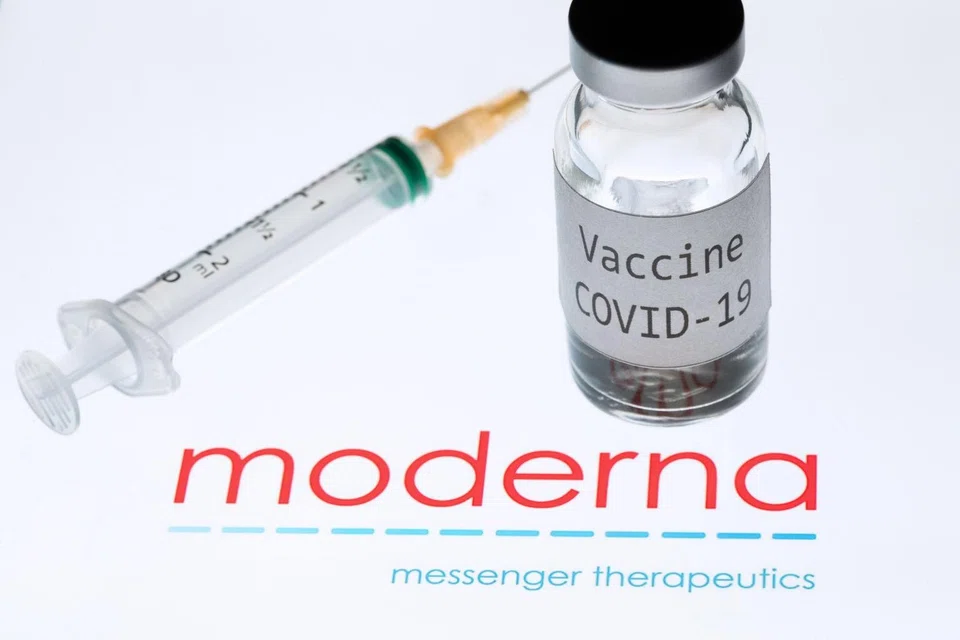
[WASHINGTON] The US regulator on Tuesday released new data confirming Moderna's Covid-19 vaccine was safe and effective, a strong sign that it could receive emergency approval in days and be ready to roll out by next week.
The Food and Drug Administration said there were "no specific safety concerns identified that would preclude issuance of an EUA (emergency use authorization)" and confirmed an overall efficacy of 94.1 per cent.
Distribution of the Pfizer-BioNTech vaccine began on Monday and if the FDA green lights Moderna's, rollout of some six million doses could start next Monday.
That would represent a powerful second weapon in the country with the world's biggest outbreak of the virus, where more than 300,000 people have died and a winter surge is raging.
Also Tuesday, the FDA announced it had approved the first at-home rapid Covid-19 test, which will be available without prescription and return results in about 20 minutes.
But supply of the test, made by California-based Ellume, will initially be limited, with just three million units expected in January.
Navigate Asia in
a new global order
Get the insights delivered to your inbox.
STOPS SEVERE CASES
The FDA document on the Moderna vaccine offered the clearest look yet into the two-dose regimen, co-developed with the National Institutes of Health (NIH).
Moderna began working on the vaccine in January and has received US$2.5 billion in federal funds.
On Thursday, an independent group of scientists will convene to debate everything known so far about the product.
The panel is expected to vote in favor of an EUA, and the FDA normally heeds its recommendations.
According to the new data, the shots protected younger people slightly better than older people.
In a clinical trial of 30,400 people, 196 fell ill with Covid-19 by November 21 - 11 in the vaccine group and 185 in the placebo group.
Efficacy was 95.6 per cent for people aged 18-65; 86.4 per cent among those aged 65 and older; and 94.1 per cent overall.
Importantly, of 30 cases of severe Covid-19, all occurred in the placebo group.
The FDA also looked at detailed safety data at a median of nine weeks after participants received the second shot, 28 days after the first.
CUTTING-EDGE TECHNOLOGY
The most common side effects associated with the drug, called mRNA-1273, were injection site pain in roughly 90 per cent of cases; fatigue in 70 per cent, headache in 60 per cent, muscle pain in 60 per cent, joint pain in 45 per cent and chills in 45 per cent.
Few of these effects were classed as "severe" and, when they were, that tended to occur more in the young than in the old.
Lymphadenopathy, or swollen lymph nodes, occurred in 1.1 per cent of the vaccine group against 0.6 per cent of the placebo group.
There was an imbalance in allergic reactions, which occurred in 1.5 per cent of the vaccinated population compared to 1.1 per cent of the non-vaccinated.
But none were classed as severe or anaphylactic.
The frequency of life-threatening events was low, around one per cent in each group, with no suggestion the vaccine was the cause.
To date, there have been three reports of Bell's palsy - a facial paralysis condition, most often temporary - in the vaccine group and one in the placebo group.
The Pfizer trial saw four people get Bell's palsy in the vaccine group, and none in the placebo group.
The FDA said there was insufficient information to determine that either vaccine was the cause.
Andrew Morris, a University of Toronto professor of medicine who has studied the condition, said "it is becoming increasingly likely that there is an important relationship with Bell's (facial) palsy."
However, "the absolute risk - in light of the risks associated with Covid-19 - is small," he stressed.
Both the Pfizer and Moderna vaccines use mRNA (messenger ribonucleic acid) molecules to cause human cells to express a surface molecule of the new coronavirus.
This simulates an infection and trains the immune system to be ready in case it encounters the real virus.
The mRNA is encased inside fatty particles.
Both companies used a slightly different formulation resulting in different cold-storage requirements: -70 deg C for Pfizer; -20 deg C for Moderna.
Moderna has applied for approval in over-18s, while Pfizer's approval is for over-16s.
AFP
Decoding Asia newsletter: your guide to navigating Asia in a new global order. Sign up here to get Decoding Asia newsletter. Delivered to your inbox. Free.
Share with us your feedback on BT's products and services
TRENDING NOW

Thai and Vietnamese farmers may stop planting rice because of the Iran war. Here’s why

US-China rivalry and the Kindleberger Trap: Why inaction – not escalation – is the biggest risk

Middle East-linked energy supply shocks put Asean Power Grid back in focus

As more Asean states turn to Russia for fuel, will Moscow boost its influence in the region?

