

US top brass to meet South Korean president
Gen Dunford's Asia visit come amid fears that a war of words between Trump and N Korean leader Kim will lead to an actual military conflict
Seoul
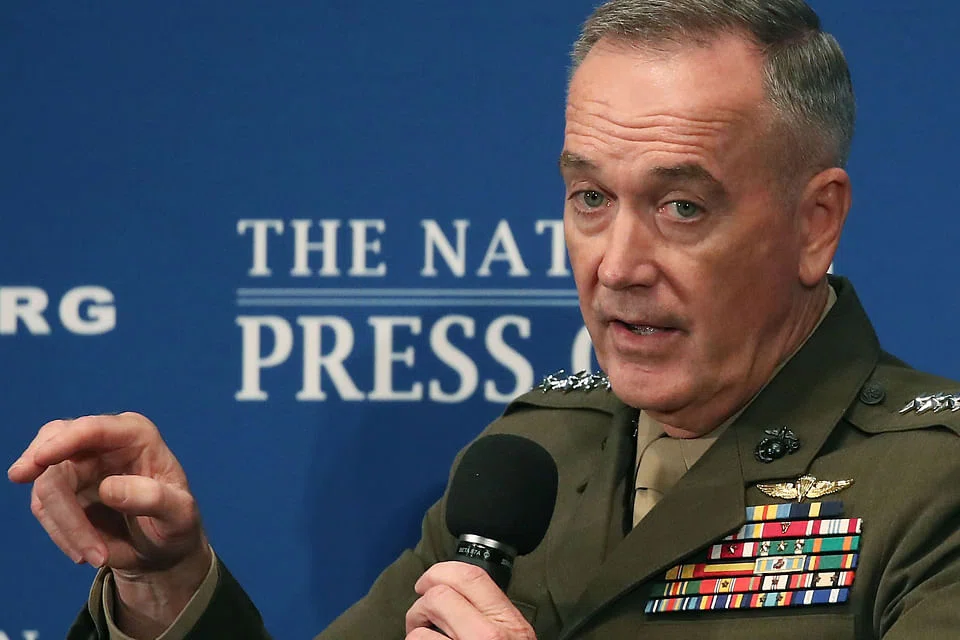
AMERICA'S top general plans to meet South Korean President Moon Jae In on Monday, just days after US President Donald Trump said that military options against North Korea were "locked and loaded".
Joseph Dunford, chairman of the US Joint Chiefs of Staff, will meet senior military officials along with Mr Moon, according to an official with South Korea's Blue House who asked not to be identified.
He will head to China next on the previously scheduled visit, Yonhap News Agency reported, citing an unidentified military official.
Gen Dunford's Asia visit comes as fears grow that a war of words between Mr Trump and North Korean leader Kim Jong Un will lead to a miscalculation that sparks an actual military conflict. In a call with Mr Trump on Saturday, Chinese President Xi Jinping called for all sides to maintain restraint and avoid inflammatory comments.
The US hasn't taken any public steps to prepare for hostilities such as evacuating Americans from Seoul, which is within range of North Korean artillery, or moving ships, aircraft or troops into position for an imminent response. The US has about 28,500 troops stationed in South Korea.
Following Mr Trump's vow to unleash "fire and fury" on North Korea, Mr Kim's regime threatened to fire four Hwasong-12 missiles over Japan into waters near Guam, home to US military bases in the region. The US and its allies warned Mr Kim against such a move, and Japan deployed four Patriot missile interceptors into the western part of the country.
Some analysts expect further escalation in the coming days as both North and South Korea celebrate the Aug 15 anniversary of the end of Japan's occupation of the Korean peninsula, and the latter conducts joint military exercises with the US from Aug 21. Japan is also holding annual military drills with the US over the next few weeks.
North Korea's state-run media on Sunday condemned the planned military drills and said that the US is "letting out dangerous war rhetoric". The Korean Central News Agency added that Mr Trump's "wild remarks" are causing concern and anger in South Korea.
Mr Moon's administration has pushed to start talks with North Korea even while looking to strengthen its defences after North Korea test-fired two intercontinental ballistic missiles in July. On Sunday, Deputy Unification Minister Chun Hae Sung said South Korea was seeking to ease tensions and the door for dialogue with North Korea was still open.
Recent comments from Mr Trump have raised concerns that the US would be willing to accept collateral damage among its Asian allies to protect the American homeland.
General Dunford said last month that it was "unimaginable" to allow North Korea to develop the capability to strike a US city with a nuclear weapon. South Carolina Senator Lindsey Graham, a Republican, told NBC News that Mr Trump told him that "if thousands die, they're going to die over there".
More recently, Defense Secretary James Mattis has sought to reassure US partners in the region. He said on Thursday that the US works closely with its allies to ensure that any military response wouldn't be unilateral, warning that the impact of a conflict "would be catastrophic".
Mr Trump has continued to take an aggressive tone on North Korea. On Friday, Trump said that if Mr Kim makes any "overt threat" or strike at a US territory or ally, "he will truly regret it and he will regret it fast". Mr Trump also said the US was considering tighter sanctions against North Korea.
China, North Korea's main benefactor, agreed to harsh United Nations sanctions earlier this month even while calling on all sides to take a step back and negotiate a solution. Beijing is reluctant to put so much pressure on the regime that it risks collapse, in part to avoid a scenario that could lead to a unified Korea and push US troops right up to China's border.
Mr Trump has sought to pressure China to do more by linking action on North Korea to better trade terms. On Monday, he plans to take steps that will increase pressure on China over what the US perceives to be theft of intellectual property.
Mr Trump's posture suggested he was trying to dissuade Mr Kim from further provocations rather than setting the stage for a US military strike, according to Terence Roehrig, a national security affairs professor at the US Naval War College in Newport.
"The president's rhetoric could be aimed at China, but largely it is aimed at North Korea, trying to deter," Prof Roehrig said. "North Koreans are not suicidal. They may continue launching missile tests but they don't want a war, and the US doesn't want military action either." BLOOMBERG
TRENDING NOW

South-east Asia has lost Nvidia’s best salesman

Demand, tech capabilities position Apac and AI as Skyscanner’s next growth frontiers: CEO Bryan Batista

Peter Kwee’s Ridley Park bungalow on the market with S$100 million asking price
Beyond the greenback, Vietnam’s big borrowers turn to Asian-currency bonds

