

US would up aid to Ukraine, tax rich under Biden's proposed budget
 Add BT as a preferred source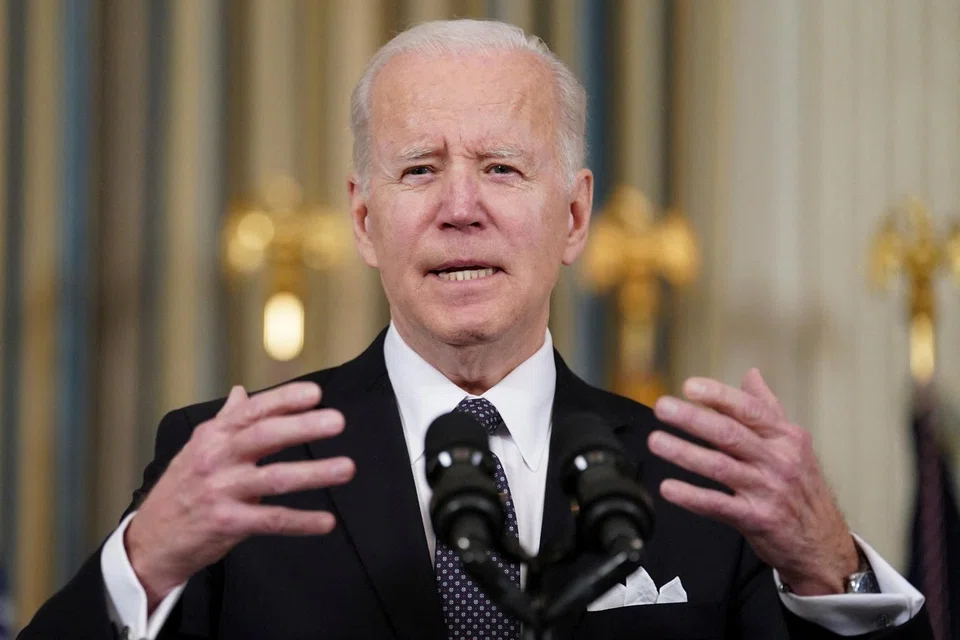
DeeperDive is a beta AI feature. Refer to full articles for the facts.
[WASHINGTON] The United States would allocate billions of dollars in aid to Ukraine, tax the wealthy and lower its deficit under a budget proposal President Joe Biden unveiled on Monday.
The massive US$5.8 trillion plan would pay for many of Biden's policy proposals, as his administration struggles with low approval ratings, a record inflation wave and ongoing uncertainty linked to the Covid-19 pandemic.
The budget must be approved by Congress, which Biden's Democratic party controls by a slim majority, but where lawmakers of both parties are sure to demand changes.
The Democratic left wing is likely to push back against the proposal's sharp four per cent increase in defence spending, for example.
"Budgets are statements of values," Biden said, as he announced the measure.
His administration's plan "sends a clear message that we value fiscal responsibility, safety and security at home and around the world, and the investments needed to continue our equitable growth and build a better America," he added.
Navigate Asia in
a new global order
Get the insights delivered to your inbox.
Among its provisions are a US$6.9 billion infusion of funding for Ukraine to assist in defending against Russia's invasion, as well as to aid Nato.
Another US$1 billion would go towards Washington's efforts to counter Moscow's influence.
The Pentagon's overall proposed budget of US$773 billion highlights the various international challenges facing the United States.
While the Defence Department stressed that Russia through its invasion of Ukraine poses "an acute threat" to the world order, China remains the key strategic risk for the United States, it indicated.
"The fiscal year 2023 budget request remains in line with our strategic approach, and prioritises China as the pacing challenge and recognises the acute threat posed by Russia," vice-chairman of the Joint Chiefs of Staff, US Navy Admiral Christopher Grady, told reporters.
TAX THE RICH
Biden also proposed a minimum tax on the income of taxpayers that make more than US$100 million, satisfying a demand of progressive Democrats who have called for taxing the rich as a way to address inequality.
"This minimum tax would apply only to the wealthiest 0.01 per cent of households - those with more than US$100 million - and over half the revenue would come from billionaires alone," the White House said in a statement.
"It would ensure that, in any given year, they pay at least 20 per cent of their total income in federal income taxes."
Under the plan, Biden said that "the wealthy will finally pay their fair share," pointing to firefighters and teachers who pay higher tax rates than billionaires who take advantage of loopholes.
All told, the proposal would lower the US budget deficit by US$1.3 trillion next year, though the US$24.8 trillion national debt would continue to increase, according to projections published by the White House.
RECOVERING ECONOMY
While the US economy has regained much of the ground it lost to the Covid-19 pandemic since Biden took office last year, his approval ratings have suffered after supply chain snarls, rising oil prices and strong consumer demand sent inflation climbing to levels not seen since the 1980s.
The budget plan was released months after Biden's landmark legislation to spend hundreds of billions of dollars revamping the country's social services and fighting climate change, dubbed Build Back Better, stalled in Congress due to divisions among Democrats.
The budget resurrects a proposal first mulled during negotiations over the bill to raise the corporate tax rate to 28 per cent, reversing legislation passed under Biden's Republican predecessor Donald Trump in 2017 that lowered it to 21 percent in a bid to supercharge businesses.
"While their profits have soared, their investment in our economy did not: the tax breaks did not trickle down to workers or consumers," the White House said, noting the new rate is "still the lowest tax rate faced by corporations since World War II except in the years after the 2017 tax cut."
Less controversial is the proposed US$6.9 billion infusion meant to "enhance the capabilities and readiness of US forces, Nato allies and regional partners in the face of Russian aggression," according to the White House.
Another US$1 billion would go to the departments of defense and state as well as USAID "to counter Russian malign influence and to meet emerging needs related to security, energy, cyber security issues, disinformation, macroeconomic stabilisation, and civil society resilience."
Washington has also backed a deal negotiated under the auspices of the Organisation for Economic Co-operation and Development that would put a 15 per cent minimum tax on corporations globally.
The White House said the budget proposal "contains additional measures to ensure that multinationals operating in the United States cannot use tax havens to undercut the global minimum tax." AFP
Decoding Asia newsletter: your guide to navigating Asia in a new global order. Sign up here to get Decoding Asia newsletter. Delivered to your inbox. Free.
Share with us your feedback on BT's products and services
TRENDING NOW

Shelving S$5 billion office redevelopment plan proved ‘wise’ as geopolitical risks mount: OCBC chairman

China pips the US if Asean is forced to choose, but analysts warn against reading it like a sports result

Beijing’s calculated silence on the Iran war

Middle East-linked energy supply shocks put Asean Power Grid back in focus

