Vientiane Logistics Park – the new kid on the Asean bloc
Sitthi Logistics Lao has a 50-year concession to operate the park’s busy Thanaleng Dry Port
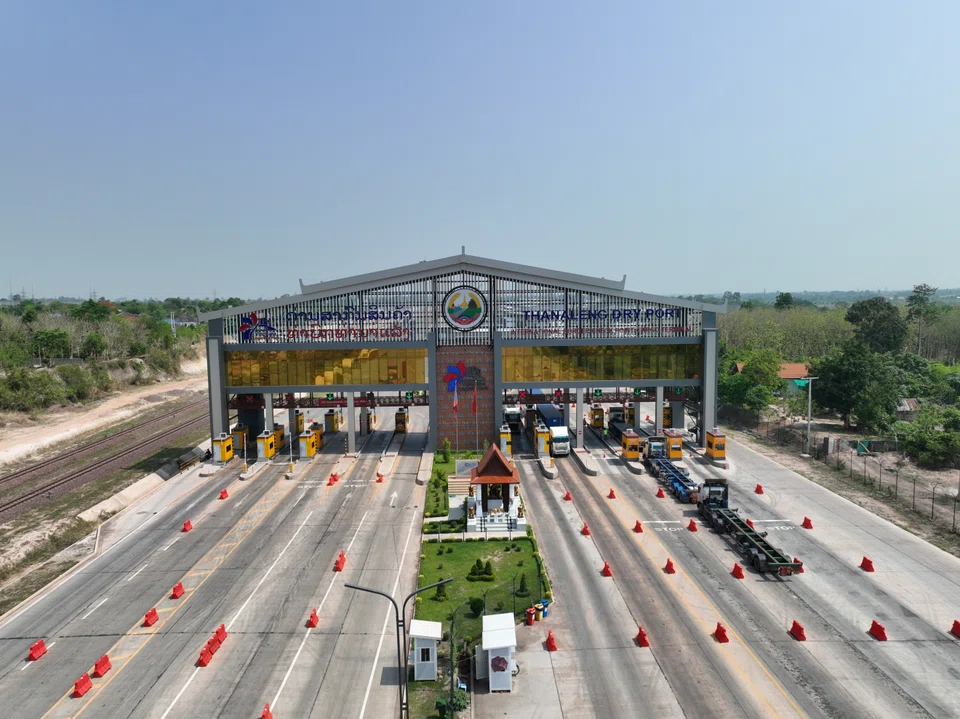
[VIENTIANE] These days, no visit by business or diplomatic delegations to the capital of Laos is complete without a stopover at Thanaleng Dry Port, the beating heart of the country’s economic ambitions.
Situated 15 kilometres east of Vientiane, and less than 1 km from the first Thai-Lao Friendship Bridge crossing the Mekong River (defining the Thai-Laos border), Thanaleng has served as a customs and immigration checkpoint for decades between the two neighbouring countries.
Operations were upgraded significantly in December 2021 with the opening of a fully functional dry port for land-locked Laos.
The unveiling of the dry port came a day after the official launch of the Laos-China Railway, a 440 km medium-speed train link between Boten, on the Laos-China border, and Vientiane.
The US$6 billion railway – a 70:30 joint venture between the Chinese and Lao governments – has gone a long way towards achieving the government’s policy goal of transforming Laos from “a land-locked to a land-linked” country.
Critics of the project, which has added considerably to the country’s sizeable public debt, said the train link would benefit Laos’ economically advanced neighbours China and Thailand more than Laos, a mountainous country of 7.4 million people with few local industries other than hydro-electricity production and mining.
Indeed, much of the cargo is going between China and Thailand, given Laos’ limited exports. In the first eight months of 2023, the railway transported 3.1 million tonnes of cargo, up 138 per cent year on year, Xinhua reported. Laos’ main export to China comprise low-value mineral ores.
But Laos is now benefiting from the transhipment fees and other services it is providing at Thanaleng and from the recent relocation of all customs procedures at the port.
“Now the customs clearance is concentrated at the dry port zone,” said Aphixay Phoumavong, head of corporate banking at French bank BFL Bred.
“This means that the government can now control the customs revenue. I hear the revenue collection from the import tax has trebled because of the dry port, and putting all the customs at one place.”
Bred has committed a “few million dollars” to a syndicated loan to Thanaleng Dry Port, which was led by the International Financial Corp (IFC) and disbursed last December.
“If you can obtain a loan from the IFC, it is quite a success in itself,” said Phoumavong.
IFC has been working on the loan since July 2020, when Sitthi Logistics Lao, a private Lao company, won a 50-year concession to operate Thanaleng Dry Port.
Sitthi Group – which includes Sitthi Logistics, Sitthi Interfreight and Petroleum Trading Lao – is closely connected to the Phongsavanh conglomerate, another private-sector group with diverse holdings in banking, forestry and others.
IFC initially planned to syndicate a loan of US$67 million for the project, but downsized it to US$46 million in response to lower-than-expected revenue collection in the first years of operation.
“The traffic flows, which were very difficult to project before the project was built, turned out to be more complicated than expected, especially with the impact of Covid-19,” said Adam Schwartzman, manager of infrastructure (North-east Asia) at IFC. “So we had to change the scope of the project, and our assumptions on debt capacity, at least for now.”
While the volume of the cargo exceeded expectations, revenue from related services fell short, he added.
IFC downsized the overall cost of the project from US$91 million at the time of commitment to US$82 million at the time of the loan disbursement, of which IFC provided US$20.1 million; the International Development Agency provided another US$20.1 million and “a quasi-equity loan” covered another US$6 million, or a total of US$46.2 million, Schwartzman said.
Sitthi Group will finance the remaining US$36 million from its own pocket and revenues.
The Thanaleng Dry Port is just the first phase of Sitthi Group’s Vientiane Logistics Park, covering 382 hectares, on which are planned an export processing zone, a petrol tank storage facility, warehouses and offices, with a total project cost of US$727 million, company sources said.
IFC intends to seek more financing for the project in line with its future performance.
“This is a relatively big investment in a relatively small country, and in a crucial sector, so the impact is potentially enormous,” said Schwartzman.
IFC’s loan had geopolitical ramifications, in that it has allowed the Thanaleng Dry Port to avoid going to Chinese banks for the loan.
“We want to become an international company,” said Khounthavy Somvangxay, a spokesman for Vientiane Logistics Park. “That’s why we didn’t take a loan from China, even though they offered a low-interest loan to us.”