Wages of workers in unpopular jobs could stay up for good, observers say
If locals continue to shun certain roles, those left holding those jobs will earn more; locals will also earn more from higher skills and automation

Singapore
MORE than a year into the economic hurricane, Singapore faces both a foreign manpower shortage and elevated local unemployment.
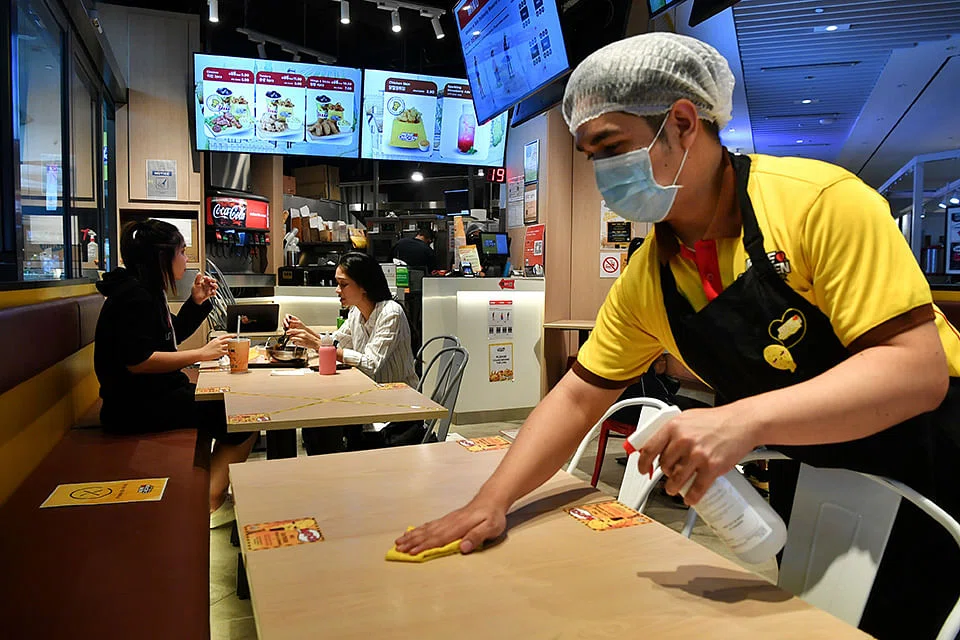
Border curbs have put upward pressure on wages in some rank-and-file jobs typically filled by work permit and S-Pass holders, as migrants command higher pay, and employers woo local staff to plug the gaps.
Andrew Tan, country manager at recruiter Wantedly, said that employers are offering up to 20 per cent more for local hires in service roles, as they can save on foreign-worker levies and enjoy wage support under the Jobs Growth Incentive.
For instance, the median monthly salary for service crew was S$2,000 in Q1 2021, up from S$1,800 the year before, said FastJobs Singapore's general manager Lim Huishan.
Amid what Mr Tan called a "short-term labour crunch", the rising tide in salaries may thus be lifting all boats.
But at least two questions remain unclear at this juncture:
How long wages for mid-skilled jobs and non-professionals, managers, executives and technicians (non-PMETs) will stay up, and how much resident workers will benefit.
The central bank reported in its last macroeconomic review that, while wage growth should stay muted this year, "stronger labour cost pressures could emerge towards the end of the year, and into 2022" if there is stronger-than-expected demand for workers, and companies take longer than expected to shift towards manpower-lean productivity.
To be sure, some players are banking on a retreat in salaries when the pandemic-related crunch eases.
A spokesperson for the Singapore Contractors Association Ltd (SCAL) trade group told The Business Times: "As long as the supply and demand imbalance persists, the situation of higher wages will continue."
This is especially as local workers have been loath to fill certain roles, which limits how much they can mop up vacancies. This reluctance forces bosses to hire from abroad.
Cleaners, construction workers and waiters were among the leading non-PMET positions that went unfilled for at least six months, according to the last job vacancy survey released by the Ministry of Manpower (MOM) in April.
Some vacancies appear to be a result of the pandemic, too. Construction labourers were not among the top 10 in-demand non-PMET roles in 2019, but shot to fifth place in 2020 - even as bosses offered S$800 to S$1,600 a month, MOM data showed.
The spokesperson for SCAL said that, in the migrant-dependent construction sector, both skilled and unskilled wages rose 40 per cent to 70 per cent. He called this "an unprecedented increase in labour costs".
More dramatically, skilled bricklayers can now earn S$250 a day, up from S$60 to S$80 before, said Unicon Construction project director Winston Ang. "We have to retain our old workers, and the only way to do it is monetary benefits."
Yet, even with the higher wages, former Manpower Ministry divisional director of planning and policy Terence Ho, now an associate professor in practice at the Lee Kuan Yew School of Public Policy, told BT that the local labour supply may not be keen or able to do some roles.
"We hear of firms that find it difficult to hire locals for certain jobs even with attractive pay, likely because of the nature of the job or working conditions," he said.
Referring to the MOM report on job vacancies, he added: "Among the top five non-PMET occupations that were hard to fill, low pay was cited as the top reason for only one of them."
Unicon's Mr Ang also noted: "There is definitely a difficulty in getting locals to do the jobs because you need to train them." He said that bricklaying takes six months to learn and two years to master, and tile-laying or plastering takes even longer.
So, although 122,900 residents were unemployed as at mid-2020, Singapore still brought in 70,000 foreigners for services industries such as healthcare and cleaning.
This is even as the salary floor for cleaners ticked up from S$1,300 in 2019 to S$1,352 to 2020; the ceiling for nursing professionals, who typically require a diploma-level qualification, rose from S$2,800 to S$4,500, according to MOM data.
This is in line with FastJobs' observations. Ms Lim said median salaries for full-time healthcare assistants rose to S$2,000 in the first quarter, from S$1,800 the year prior; nurses' pay grew to S$3,600, from S$3,000.
But with travel-related industries accounting for nearly a fifth of the employment decline in 2020, Barclays economist Brian Tan highlighted a potential mismatch between local job seekers and the work on offer.
He said: "While labour market conditions have improved since Q2 2020 - as our proprietary Labour Market Tightness Indicator also suggests - it will become increasingly challenging to absorb the remaining labour market slack if travel does not resume."
Yet that may just mean that higher pay is here to stay - for migrant workers, as much as for locals. Bosses may even have to address gripes such as undesirable shifts, suggested Singapore University of Social Sciences labour economist Walter Theseira.
DBS senior economist Irvin Seah noted that, if locals still shun sectors such as construction and offshore marine, "it will only result in higher wages for the remaining workers, and you will likely see more automation".
Indeed, even with digitalisation, the SCAL spokesperson predicted that there will remain a "two-tier market" - where locals fill higher-skilled roles as tech operators, and foreigners continue as specialist tradesmen "paid in line with the market and skill sets".
Mr Ho pointed out that local wages will go up on other labour policies, such as tighter limits and higher salary minimums for S Passes, as well as a wider Progressive Wage Model, which sets a wage floor for locals in key sectors.
Even before the pandemic, the rules were already tightening for S-Pass holders, whose minimum salary was S$2,200 in 2018.
The trend has continued, with the MOM citing "weakness in the job market and uncertain growth outlook" as it hiked the salary floor from S$2,400 to S$2,500 last October.
This is as policymakers have noted that semi-skilled S-Pass positions can also be filled by Institute of Technical Education and polytechnic graduates.
Said Mr Ho: "While the freeze in non-resident arrivals from India exacerbates short-term pressures, I think the upward pressure on wages in certain sectors is likely to persist."
Pandemic-related border closures may thus be the final nail in the coffin for the market issue that Workers' Party Member of Parliament He Ting Ru recently described in Parliament as "our addiction to cheap labour, often at the expense of productivity increase".
Said Associate Professor Theseira: "Firms, if able to hire foreign workers liberally, will simply have no incentive to put substantial effort into redesigning work, or to hire Singaporeans who are less-than-ideal matches.
"I would favour maintaining a slower pace of foreign employment growth until not just unemployment is reduced, but also, underemployment among Singaporeans currently in temporary and contract positions, and Covid-19-related positions."
OCBC chief economist Selena Ling said of the wage increases: "Given that we have an ageing population, it may be inevitable. The implication is that costs may increase and be passed on to end-consumers."
- With additional reporting by Lynette Tan and Leila Lai
READ MORE: