

War on scams: Record crypto seizures, explosive raids, but political theatre gets in the way
The fallout from the Prince Group investigation has continued to reverberate
[BANGKOK] It is a sobering thought: The sheer scale, staying power and callous profitability of the global “pig-butchering” scam syndicates – headquartered in South-east Asia and built on modern-day slave labour – are such that even the largest-ever criminal asset forfeiture could barely make a dent.
The US Department of Justice’s seizure of around US$15 billion (S$19.6 billion) worth of Bitcoin was arguably the most eye-catching component of a landmark convergence of criminal charges, sanctions and regulatory measures announced on Oct 14.
It was directed at Cambodian conglomerate Prince Group and its Chinese-born chairman Chen Zhi, accused by US prosecutors of masterminding a “sprawling cyberfraud empire” and industrial-scale money laundering.
Despite the seized cryptocurrency being worth as much as one-third of Cambodia’s official gross domestic product, leading experts noted that the industry is endemic and entrenched in elite patronage networks – so much so that it would require sustained law enforcement action and political will to undermine the industry’s lucrative business model.
They also suggested that even if a major player like Prince Group is removed, there are always others ready to step up and fill the breach.
“This is one of the most significant moments in organised crime, just to be quantifying it as the largest criminal asset forfeiture in history,” said Jacob Sims, visiting fellow at Harvard University’s Asia Center and a transnational crime expert.
“But in terms of how disruptive that action is going to be on Cambodia’s scam economy, that really depends on what happens from here,” he added.
The fallout from the Prince Group investigation has continued to reverberate.
In the weeks since, the authorities across Asia, including in Singapore, South Korea, Hong Kong and Taiwan, have also moved to arrest suspects or seize assets – from real estate to yachts and luxury cars totalling hundreds of millions of dollars – linked with the company and its alleged scam networks.
SEE ALSO




Prince Group said it “categorically rejects the notion that it or its chairman Chen Zhi has engaged in any unlawful activity”.
“The recent allegations are baseless and appear aimed at justifying the unlawful seizure of assets worth billions of dollars,” it said in a statement on Nov 11 – the first by the company since the crackdown began.
China’s crackdown
Attracting fewer global headlines, by comparison, was the news in July that a Chinese court would begin trying the former leaders of a local junta-aligned militia.
Called the Border Guard Force (BGF), it is based in the mountainous Kokang region of northern Shan state, along Myanmar’s border with China.
The court found the BGF syndicate built 41 scam compounds in Kokang, and was responsible for the deaths of six Chinese nationals and online fraud totalling more than 29 billion yuan (S$5.3 billion), according to China’s official Xinhua news agency.
On Nov 4, five of the syndicate’s ringleaders, including influential Bai family patriarch Bai Suocheng and his son Bai Yingcang, were sentenced to death.
The connection between the Kokang death sentences and the dismantling of Prince Group goes beyond the mind-boggling proceeds of online “pig-butchering”.
The cases reflect how Beijing’s crackdown on scam syndicates targeting Chinese nationals has pushed those criminal gangs to increasingly pivot to other targets, including in the US.
In 2023, the Chinese authorities had grown increasingly frustrated over the inaction of Myanmar’s senior general Min Aung Hlaing’s military regime despite Beijing’s requests to crack down on scamming activity targeting its citizens.
Analysts at the International Institute for Strategic Studies said this likely led China to give its tacit approval for anti-junta resistance forces.
The latter had pledged to clear the region of scam compounds, and launched an offensive that resulted in significant territorial losses for the Myanmar military in the border region.
Many of the scam bosses and workers fled amid fierce fighting.
Though most compounds in major scam hubs like Laukkai were abandoned, many were relocated elsewhere rather than being shut down altogether. High-level Chinese officials, meanwhile, successfully negotiated the extradition of Kokang BGF leaders, including the Bais.
But having sent its message that targeting Chinese nationals would have its consequences, or perhaps realising that pushing further risked destabilising Myanmar’s military regime and the Chinese-invested rare earths projects it oversees, Beijing’s position softened in early 2024.
Instead of public condemnation, the Chinese authorities heaped praise on the junta’s efforts to target scams, including the repatriation of thousands of Chinese nationals involved in fraud.
“Given that the majority of China’s economic projects in the country are under the control of the Myanmar military, and that China does not see a viable alternative to military rule, it moved from denouncing Min Aung Hlaing to staging political theatre and joint ‘crackdowns’ that legitimised the Myanmar military,” Jason Tower, senior expert at the Global Initiative Against Transnational Organized Crime, said in an October analysis paper.
“Today, the junta continues to rely heavily on the militias that are still operating hundreds of scam compounds across the country,” he added.
Political theatre
It is in this context of political theatre that other recent major developments should be viewed.
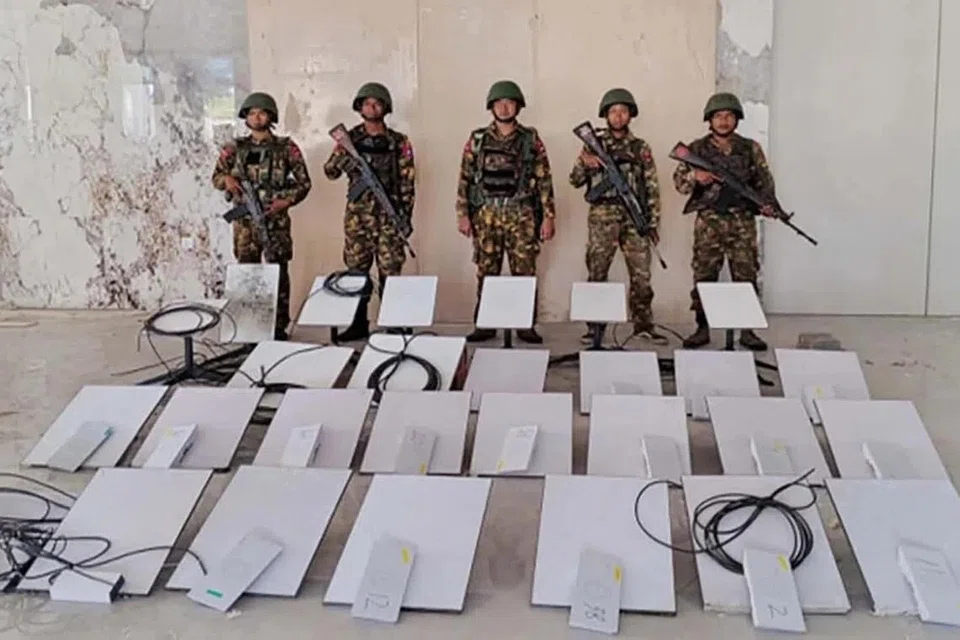
This includes the Myanmar military’s most recent claims of a crackdown at another notorious scam hub, KK Park in Myawaddy, which saw thousands fleeing across the porous border to Thailand’s Mae Sot.
The military junta seized power in a 2021 coup, but still does not control large areas of a country wracked by civil war.
It is eager to consolidate recent territorial gains and burnish its Chinese support ahead of a planned election in December 2025, dismissed as a sham by opposition groups.
Similarly, Thai Prime Minister Anutin Charnvirakul has had to go out of his way to appear tough on scams.
His appointee as deputy finance minister, Vorapak Tanyawong, was forced to resign on Oct 22, a day after Anutin asked him to explain allegations that he and his wife are linked to Cambodian tycoons and regional scam networks.
Vorapak has denied any wrongdoing and said he resigned to prevent his personal affairs “becoming a burden to the government”.
That same week, Anutin revoked the Thai citizenship of influential Cambodian businessman Ly Yong Phat.
The adviser to Cambodia’s former prime minister Hun Sen was sanctioned by the US in September 2024 for human trafficking and online investment scams. The Cambodian government has said that the US move was politically motivated.
Thai law enforcement froze 70 million baht (S$2.8 million) of his Thai assets.
“This clearly shows our government is taking action where others in the past did not,” Anutin said then.
On Nov 12, Thailand extradited, at China’s request, online gambling and alleged scam centre kingpin She Zhijiang, a Chinese national who also holds a Cambodian passport.
He headed a casino and entertainment empire in the notorious scam hub of Shwe Kokko on the Thai-Myanmar border and was first arrested by Thai police in August 2022 on an Interpol red notice.
Realpolitik
The ramping up of American law enforcement action against South-east Asian scamming syndicates has coincided with an explosion in US losses to online scams.
Americans lost at least US$10 billion to South-east Asia-based scam operations in 2024, a 66 per cent increase on the previous year, according to the US Treasury.
Sims, the transnational crime expert, said the increase substantiated what experts had been seeing in real time: that China’s crackdown against scam activity was shifting the harms to other wealthy demographics, including the English-speaking world.
“It was quite clear this was a tidal wave that’s about to hit the US,” he said.
“The data now supports what we’ve been yelling about for two years, but it’s also the case that you now have a very effective broad set of voices that are all saying this is a national security crisis for the US.”
But just as realpolitik has seen Beijing shy away from mentioning Bai Suocheng’s links to the Myanmar military and the regime’s broader involvement in its country’s scam ecosystem, so too has the US pulled its punches.
It chose not to emphasise the connections Prince Group and Chen Zhi have with Cambodia’s ruling Hun family.
The US Department of Justice on Nov 12 announced the creation of a new “Scam Center Strike Force” to combat the proliferation of online scamming targeting US nationals by transnational criminal networks operating out of South-east Asia.
US Attorney for the District of Columbia Jeanine Pirro said many of the perpetrators were pushed out of mainland China amid Beijing’s own pressure on gambling and scams.
“This pandemic is certainly a generational wealth transfer from Main Street USA into the hands of Chinese organised crime, making it both a national security problem and a homeland security problem,” she said. THE STRAITS TIMES
Decoding Asia newsletter: your guide to navigating Asia in a new global order. Sign up here to get Decoding Asia newsletter. Delivered to your inbox. Free.
Share with us your feedback on BT's products and services






