Water Week homes in on smart water technologies
In Singapore, the PUB has started deploying water tech in the form of robotic swans and smart meters
Singapore
THIS year's Singapore International Water Week (SIWW) will focus on smart water technologies, a growing market that could be worth up to US$25 billion in 2025.
These technologies harness big data to improve operations, lower costs and enhance decision-making in water management and operations.
SIWW assistant managing director Yeo Sheng Wei said at a media briefing on Thursday that for Singapore, smart water technologies represent the intersection of three focus areas - technologies, solutions and business.
McKinsey Global Institute estimates that about 80 per cent of utilities in developed countries and half of those in developing economies will have adopted smart water systems by 2025, creating a potential value of US$14 billion to US$25 billion.
Singapore's national water agency PUB is starting to use some of these technologies, ranging from robotic swans to monitor water quality in reservoirs to smart water meters.
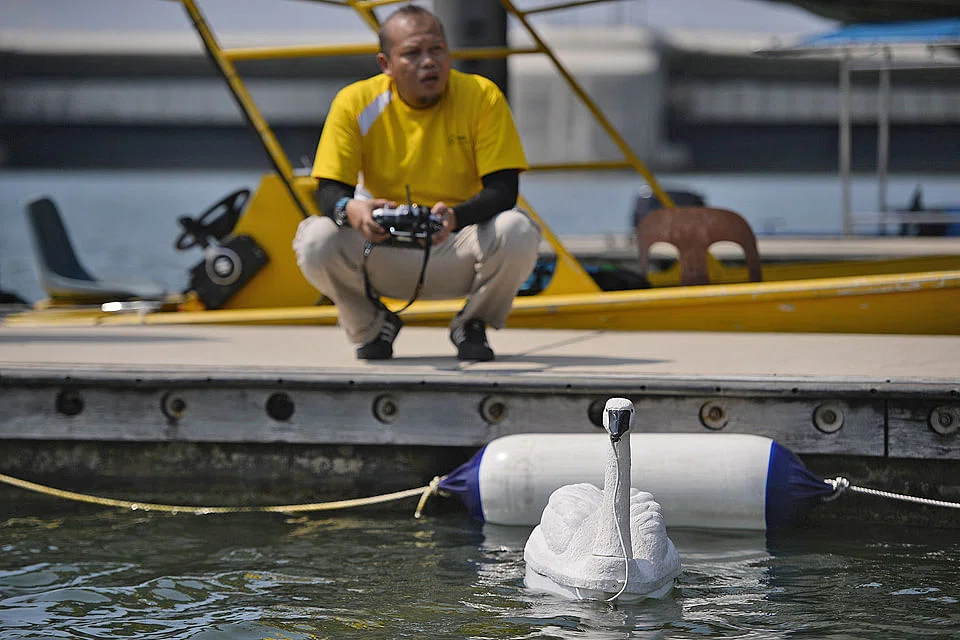
The robotic swans - which look like real swans - contain sensors that monitor various water-quality parameters, and can send the data back to central servers in real time. Kitted out with GPS (global positioning system) function, they can be remotely-controlled, but can also work autonomously.
The PUB has completed the test phase for the swans - named NUSwan (New Smart Water Assessment Network) - and will deploy them at selected reservoirs. Until now, the water agency has manually collected water samples from reservoirs, which entails going out in a boat.
At the other end of the water-use loop, the PUB is carrying out pilot projects to test smart meters that monitor and collect water consumption data continuously.
With these meters, the authorities will be able to analyse water consumption behaviours; consumers will also be able to review their own water consumption trends online. Mechanical water meters are now read manually once every two months - which is too infrequent for meaningful details about water consumption patterns to be gathered.
The PUB is also looking to work with technology providers to develop drones that can be used for inspection work in the Deep Tunnel Sewerage System - a network of deep sewers that convey used water by gravity to centralised water reclamation plants.
These drones will be fitted with multiple advanced sensors and cameras that can record 360-degree images, and should be able to fly in the dark and without GPS.
These technologies and others will be showcased at the Smart Water Solutions Pavilion at SIWW.
The event programme includes a Smart Water Forum held for the first time, featuring case studies by global water-technology companies.
The SIWW is held in conjunction with the World Cities Summit and the CleanEnviro Summit, which are together expected to draw about 20,000 participants from more than 100 cities. The integrated event will run from July 10 to 14 at Marina Bay Sands.
Almost S$15 billion in projects, tenders, investments and other deals were announced during the last integrated event held in 2014.