

What I learned ‘driving’ a Mercedes with next-level AI
AI driving has really arrived, and can intuit, anticipate and adapt with elegance and ease
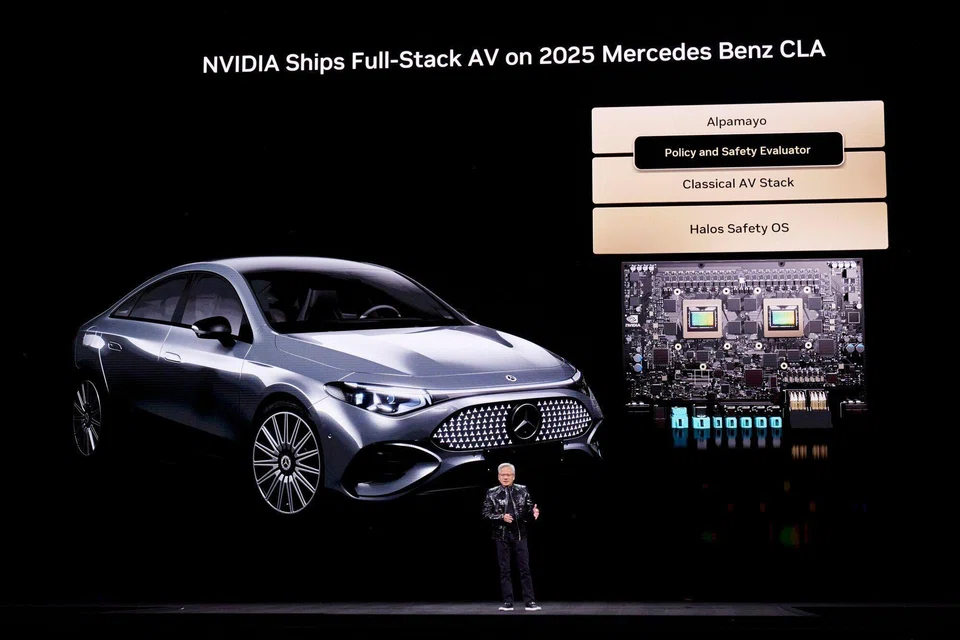
[NEW YORK] In October, Nvidia became the first public company to be worth US$5 trillion. It then promptly lost hundreds of billions of dollars in market value, amid concerns about a bust of a potential artificial intelligence (AI) bubble.
As analysts and even founders continue to warn that AI may be more speculative than substantive, car companies may beg to differ. This month, Nvidia is inching back, valued at around US$4.55 trillion, bolstered in no small part by confidence in the automotive sector.
Nvidia has collaborated with many carmakers, including Toyota, Volvo, BYD, Li Auto, Lucid, NIO, Rivian and General Motors, to develop AI-powered autonomous-driving and advanced driver-assistance systems.
That is part of its estimated US$5 billion automotive business in 2025, said Bloomberg Intelligence. On Jan 5, the company announced details about its new MB.Drive Assist Pro for Mercedes-Benz, designed for the next generation of AI-based driving.
But what is it like to experience a personal car being driven completely by AI? I tried it in December in San Francisco, riding with Joe Taylor, a senior systems engineer at Mercedes.
We were in the carmaker’s new US$47,250 Mercedes-Benz CLA, which had the most advanced AI driving system that you can buy in the US in a private vehicle to date.
My takeaway? An hour in a car driven by AI makes everything else feel, well, dumb.
Once consumers feel safe relinquishing control of their daily commute, I predict that they will eagerly adopt AI-driven cars, which will become status symbols among those in urban centres.
The trial consisted of two portions.

In the first part, I drove the car using a less-advanced system, MB.Drive Assist, to help the car drive itself on highways and city streets. It uses a combination of highly intelligent algorithms and end-to-end AI models.
It is already available across the entire Mercedes line-up, but it still needs occasional human input, like a hand on the steering wheel. The service costs a one-time fee of US$1,950.
I engaged it by pressing a button on the left side of the steering wheel, which lets the car creep forward into traffic, eventually steering itself through complex situations like the multi-lane left turn from Howard Street onto the Embarcadero.
It avoided unpredictable drivers in intersections, navigated the generalised chaos of roundabouts and adjusted its speed around construction sites, all without my hands on the steering wheel.
In fact, I stayed hands-off for chunks of time, occasionally being prompted to touch the steering rack to let the car know that I was still engaged.
The sensors in the steering wheel detect your hands there, and flashing icons and sound alerts ensue if you go too long without touching it.
Mostly, I kept my hands on my knees, taking in the view as the car crested steep hills, and held in place while women with strollers crossed the street – a surreal pause that kept me a little anxious. I hovered my foot over the brake pedal, just in case.
At one point, the CLA did not slow down and move over fast enough for my taste when approaching a double-parked cargo truck outside a cafe – I quickly braked and steered left.
Other times, it appeared to simply turn off the system when it did not like the environment, like entering a valet lane at a hotel. A dashboard icon alerted me when it disengaged, and the car would roll to a halt at that point, unless and until I started operating it again.
MB.Drive Assist left me thinking that I could easily become too disconnected from the act of driving, when in reality I still needed to be present and alert.
Driving with the more expensive, more advanced and not-yet-available MB.Drive Assist Pro inspired more confidence in me, since the car is consistently in charge when the programme is running.
It is already operating in China, and will be available in the US by the end of the year. A three-year subscription costs US$3,950.
MB.Drive Assist Pro is extreme Society of Automotive Engineers, Level 2 driving, which means that it does not require hands on the steering wheel at any time.
The car drives itself completely from a starting point to a final destination, even though the driver must still remain attentive with their eyes on the road, because they are still legally responsible for safe-vehicle operation.
This was the closest I felt to the Waymo rides I took last fall – but far different, too, because this was a normal-looking car made for anyone to buy, not an awkward-looking fleet vehicle.
The leap forward here is that the driving being done by the car can be collaborative if and when I want to jump in.
Drive Assist Pro weaves in any input on the steering wheel, if I decide to intervene, without cancelling the whole programme.
That means I can make minor adjustments from the driver’s seat if I wanted to, and it is not a big deal. Mercedes calls it “our philosophy of human-machine collaboration”.
Ali Khan, the director of product marketing at Nvidia, described the car as “AI-defined” – a vehicle informed, enhanced and enabled by AI to its very core. The humanistic element of this level of AI is essential, he says, so that “the car sees everything and understands what it sees”.
The MB.Drive Assist Pro uses 10 cameras, five radar sensors and 12 ultrasonic sensors. All this tech provides raw data to a supercomputer, which makes sense of those massive data streams.
It employs Nvidia’s AI end-to-end stack for core driving tasks, plus a parallel classical safety stack, built on Nvidia’s Halos safety system, that adds built-in redundancies, fail-safe checks and other safety guardrails.
The end-to-end stack means that the whole layered system was developed over an entire life cycle of building, deploying and training the AI, from the initial data collection to final integration into the car. Halos thus ensures the vehicle operates within defined safety parameters.
Therefore, the more you drive it, the better it gets, since the AI is constantly learning from the data it gathers on every drive.
I felt comfortable inside the cabin, because the car moved with total authority. It anticipated the road, avoided potholes and deep rain puddles, and it never hesitated in sticky traffic.
It expertly swam in San Francisco’s sea of jaywalkers and zippy Waymos, and it sailed through roundabouts and accommodated errantly parked delivery vans without a hitch.
The most impressive thing was its ability to know the nuances of good driving, like when it rolled through yellow lights and crept forward a smidgen to evade other traffic, correctly reading street conditions and behaving accordingly.
The highlight? It knew when to turn right on a red stop light, and when to remain stationary until the light turned green, if right-on-red was signposted as forbidden at that particular intersection.
We have not quite reached the AI utopia OpenAI founder Sam Altman foresees, even in the world of cars.
The new voice-activated virtual assistant – which is powered by Google Cloud’s Automotive AI Agent – ignored my repeated requests that the car stop reading news headlines during my drive.
It also flubbed questions about whether it was in fact ChatGPT, and did not respond when I asked it to reduce its own speaking volume to a conversational level.
It never did figure out how to navigate me back to the 1 Hotel San Francisco, either, and instead tried to offer me options for “one hotel in the city”. I ended up using my smartphone.
Safety is paramount – the public perception of which is as critical as the reality that AI-driven vehicles are in far fewer lethal accidents than those driven by humans.
For all its advances, MB.Drive Assist Pro works only on city streets, not highways, for now.
Still, AI driving is authentically here, and able to intuit, anticipate and adapt with elegance and ease.
The jump from rote algorithm to human-like comprehension has me believing that for many people, learning to trust an AI-defined car will be a welcome relief from the doldrums of daily commuting.
I will still want the option of driving my own car, of course, but I will not miss sitting in gridlock traffic, hands glued to the steering wheel while my eyes glaze over. A machine that can handle that unpleasant task while I read or answer e-mail? Yes, please. BLOOMBERG
Decoding Asia newsletter: your guide to navigating Asia in a new global order. Sign up here to get Decoding Asia newsletter. Delivered to your inbox. Free.
Share with us your feedback on BT's products and services
TRENDING NOW

Government to bring forward raising of retirement age, give employers more financial support to create flexi-load jobs

If Europe goes to war, the fallout will be felt in East Asia

Indonesia stocks suffer worst plunge in nearly 30 years as MSCI proposes standalone status

Vietnam’s northern provinces, not Hanoi or Ho Chi Minh City, are powering near 10% GDP growth

