Why India’s ‘cockroach’ movement is a worry for Modi
India has struggled to generate enough quality jobs for the millions of young people entering the workforce each year
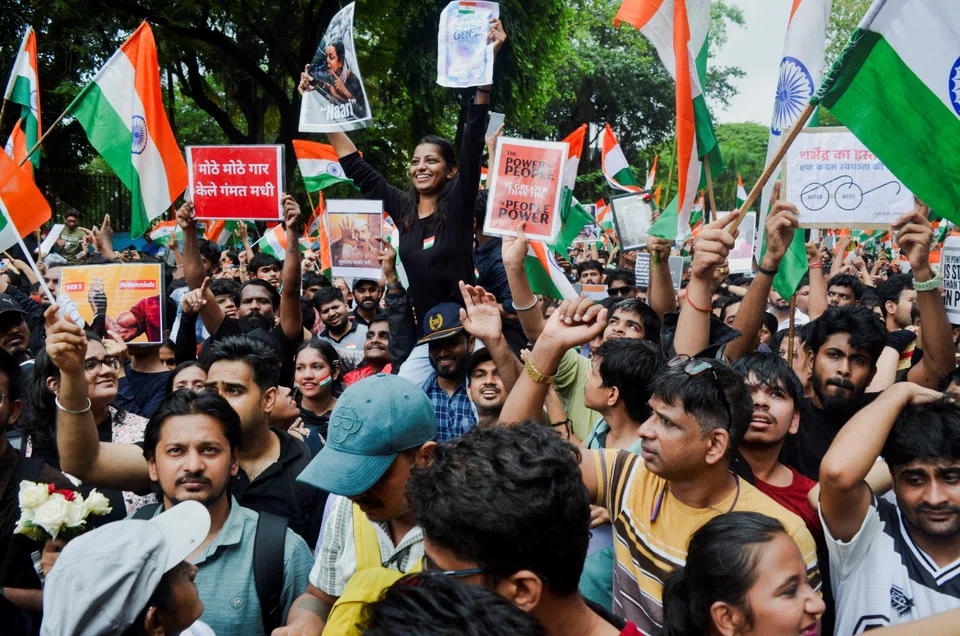
WHAT started out as a social media joke is turning into a serious headache for India’s political establishment, as the “Cockroach Janta Party” draws support from young people frustrated by a lack of jobs and a string of controversies surrounding the education system.
Since being formed in May, the mock political party has amassed almost 27 million Instagram followers — more than twice the number who follow Prime Minister Narendra Modi’s Bharatiya Janata Party.
It has since evolved into a nationwide, student-led pressure group that the government can no longer ignore. On Jul 25, the movement claimed its first major victory when it forced the resignation of Education Minister Dharmendra Pradhan over a national exam scandal.
There are signs the government is paying attention. In late July, it toughened penalties for those who leak test papers, and in mid-August, Modi used his Independence Day speech to make a broader pitch to India’s youth.
What is the ‘cockroach’ movement?
The satirical movement emerged on May 16 after India’s top judge, Surya Kant, referred to some unemployed young people as “parasites” and “cockroaches” during a court hearing. The remarks sparked outrage on social media, though the judge later said parts of the media had misrepresented his comments.
Among those who reacted was Abhijeet Dipke, a 30-year-old Indian graduate student in the US who was searching for a job. He responded by creating a parody website for the “Cockroach Janta Party” (CJP), describing it as a political home for India’s “lazy, unemployed and forgotten” people and a voice for millions of young Indians who feel excluded from mainstream politics.
The online phenomenon quickly gained traction and evolved into a broader nationwide movement focused on education, employment and government accountability, inspiring regular protests across major Indian cities.
Its momentum accelerated when climate activist Sonam Wangchuk began a hunger strike demanding greater accountability in India’s education system. After he was admitted to hospital following more than 20 days without food, organisers called for a march on New Delhi’s Parliament on Jul 20. Police were accused of using tear gas and batons to disperse thousands of demonstrators during the protest.

Why is there frustration among young Indians?
India remains the world’s fastest-growing major economy, yet it has struggled to generate enough quality jobs for millions of young people entering the workforce each year.
While official data places unemployment among those aged 15 to 29 at around 10 per cent, economists say the figure understates the problem. Research by Azim Premji University put the estimated 2023 unemployment rate among graduates aged 25 to 29 at around 20 per cent.
Those frustrations have been compounded by a series of controversies that have shaken confidence in the education system as a route to social advancement.
In May, authorities cancelled the country’s medical entrance examination — affecting more than 2.2 million candidates — after investigators found evidence that test papers had been leaked in advance.
Around the same time, thousands of students complained of errors in the results of one of India’s largest school-leaving exams, raising questions about the quality and credibility of the country’s public examination system.
Cockroach movement leaders say a political class that’s out of touch with the lives of young Indians is failing to heed their concerns or search for solutions to their problems.
While nearly 65 per cent of India’s population is under the age of 35, many of the country’s most powerful political leaders are in their 60s and 70s. Modi is 75.
Why is this a worry for Modi?
The protests culminating in the education minister’s resignation marked a rare setback for Modi’s government and showed that the cockroach movement had acquired real political influence.
The CJP has drawn comparisons with other “Gen-Z” movements that have swept South Asia in recent years.
In neighboring Bangladesh and Nepal, young people fed up with out-of-touch elites took to the streets and toppled unpopular governments. Those demonstrations were marked by violence, however, which Dipke says his group rejects.
There are other signs that the wave of political activism among younger Indians may be weakening the BJPs support base.
In the southern state of Tamil Nadu, young voters helped to propel a 51-year-old movie star to a shock election win in May, defeating parties that had dominated the state’s politics for decades.
Upcoming elections in Uttar Pradesh — India’s most populous state and the country’s biggest electoral battleground — will be closely watched for signs that young voters are drifting away from the BJP. The party already underperformed in the state’s 2024 general election, denying Modi an outright parliamentary majority.
Sensing a political opportunity, some of Modi’s rivals have already endorsed the CJP. Meanwhile, images of students being dispersed with tear gas and batons have raised awareness of the movement far beyond the Indian capital.
Modi, too, seems alert to the discontent. On Aug 15, he used his annual Independence Day speech to appeal to younger Indians, saying they would be among the main beneficiaries of the government’s economic growth plans.
He also announced free online coaching for students preparing for major competitive exams, as well as plans to train 10 million young people in artificial intelligence over the next year to better prepare them for the job market.
Whether those measures will be enough to quell the discontent among young Indians remains to be seen. BLOOMBERG
Decoding Asia newsletter: your guide to navigating Asia in a new global order. Sign up here to get Decoding Asia newsletter. Delivered to your inbox. Free.
Share with us your feedback on BT's products and services