

Why South Korea’s stock index is more volatile than Bitcoin
Amid other reasons, two companies account for its performance: Samsung Electronics and SK Hynix
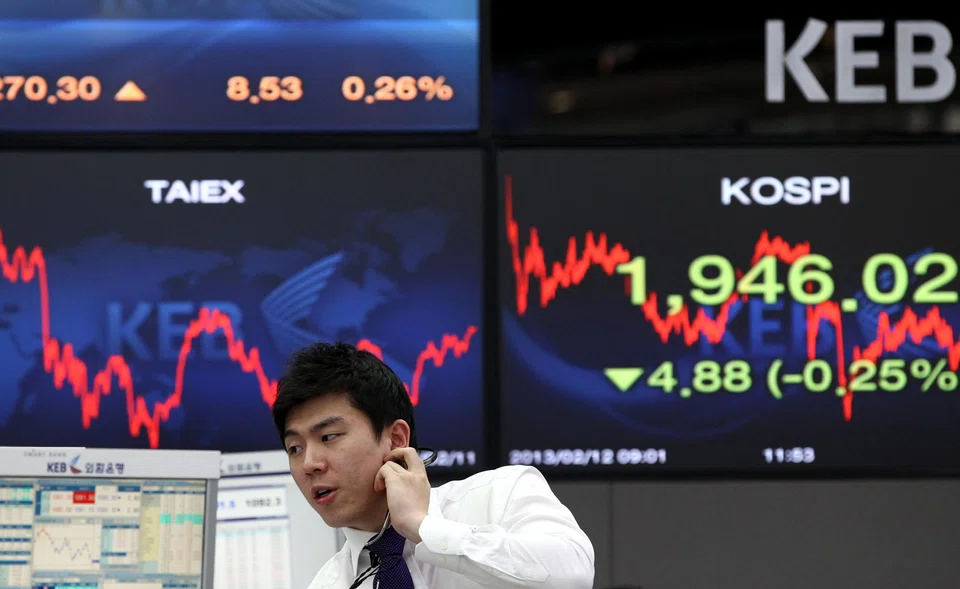
[SEOUL] Investing in South Korea’s stock market has yielded huge returns this year, but it has been a wild ride.
Volatility on the benchmark Kospi has topped 60 per cent, almost double that of Japan’s Nikkei 225. It has even put the notoriously unstable cryptocurrency Bitcoin in the shade.
The gyrations have forced the Korea Exchange to trigger its “circuit-breaker” mechanism, putting a temporary halt on trading to prevent flash crashes and avoid investor panic nine times this year until the end of July.
There was no such halt in 2025, and just one in 2024.
Following one especially violent slump in late July, government and central bank officials pledged a series of measures to try to stabilise the market.
Here are some reasons for the unprecedented volatility in South Korean stocks.
The Samsung-SK Hynix phenomenon
Two companies account for South Korea’s roller-coaster stock performance: Samsung Electronics and SK Hynix.
Their profits are exploding, as they supply the memory chips required for the new generation of artificial intelligence systems.
The AI boom has sent their stock prices up so far and so fast that they now account for more than 50 per cent of the Kospi. Listed affiliates of both companies have taken their shares even higher.
SEE ALSO
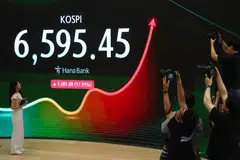

As a result, funds tracking the Kospi have effectively become a giant bet on AI. When it closed at a record high in late June, more than 650 of its 831 constituent stocks actually fell.
Hundreds of billions of dollars are being poured into AI platforms and data centres in a bet that the technology’s transformative capabilities will yield vast profits.
For now, AI has not generated enough revenue from end-users to cover the cost of building it, and prices of AI-related stocks are highly sensitive to changes in investor sentiment towards the sector.
Concerns that big US tech companies such as Meta Platforms are building more data centres than they need, coupled with disappointing earnings, contributed to a precipitous slide in SK Hynix shares that wiped 27 per cent off its market value in just three trading days in late July.
It later surged by the South Korean market’s 30 per cent daily limit, helping the Kospi to a record 18 per cent rally.
Leveraged ETFs
These investment funds are hugely popular in South Korea, and very risky. They use derivatives and debt to amplify the daily returns of an underlying index or asset, typically by a factor of two.
The sophistication and riskiness of leveraged exchange-traded funds mean that in most parts of the world, these products are mostly bought by professional traders and investors.
In South Korea, they are actively embraced by individuals trading using their savings. These individuals often lack much formal training in finance.
The country’s leveraged-ETF boom has its roots in 2010, when Samsung Asset Management launched Kodex Leverage, a two-times Kospi 200 product that the company and South Korean media described as Asia’s first leveraged ETF.
For more than a decade, South Korea’s leveraged-ETF market stayed mostly tied to broad indices.
The country’s financial regulators recognised the risks, when they tried to curb local investor demand for foreign leveraged ETFs in 2025.
But this year, they allowed the establishment of more than a dozen such products tracking Samsung and SK Hynix, 90 per cent of which are now held by retail investors.
Together with the two chipmaker stocks they track, the ETFs at one point accounted for more than 70 per cent of daily traded value in the US$3.4 trillion market, amplifying the share-price moves.
When South Korean stocks lurched lower in late July, Finance Minister Koo Yun-cheol acknowledged that authorities should have examined the products more carefully before their launch.
The government promised measures to curb retail access to the ETFs, including capping exposure to the assets at a set share of investors’ total portfolios and raising trading costs.
Retail investors
South Koreans have long dabbled in the stock market, but the AI frenzy focused on Samsung and SK Hynix has really got them excited.
Local individual investors have poured more than 110 trillion won (US$78.1 billion) into shares in the Kospi this year.
Their money is helping to lower the companies’ cost of capital, supporting ambitious expansion plans. But it has also added to the share-price volatility.
The sellers have often been foreign investors – specifically, fund managers obligated to reduce their positions in Samsung and SK Hynix to ensure their share portfolios are not overexposed to the two companies.
Foreigners have sold Kospi shares worth around US$115 billion this year, with SK Hynix seeing withdrawals of more than US$40 billion.
Retail traders in South Korea are often hungry for returns and willing to take risks. They are known locally as “ants” for their tendency to act in unison.
When a stock falls, it can trigger a panicked stampede. When it rises, it can induce a wave of buying at inflated prices by small investors anxious not to miss out.
Institutional investors are more likely to stick with a company that is going through a rough patch to have a clearer view of its fundamental value during waves of euphoria.
The boom in leveraged ETFs has only made things worse.
Goldman Sachs strategists wrote in late June that assets invested in South Korean leveraged ETFs tracking indices and single stocks had soared to over US$40 billion from US$5 billion at the start of the year.
By the end of July, the amount of stock buying using borrowed money had eased from a June peak, after stock losses led to forced selling and a retreat from South Korean ETFs.
In a Jul 29 note, JPMorgan Chase strategists said they believed the “leveraged ETF unwind is complete and hedge funds are done with about 90 per cent of deleveraging”. BLOOMBERG
Decoding Asia newsletter: your guide to navigating Asia in a new global order. Sign up here to get Decoding Asia newsletter. Delivered to your inbox. Free.
Share with us your feedback on BT's products and services
TRENDING NOW

DBS, OCBC, UOB rout lops billions off STI as inflation, rate concerns spook investors

Grab CEO’s wife Chloe Tong on life with Anthony Tan and finding her purpose

OCBC sheds S$8 billion in value as shares close nearly 6% down; analysts cautious on banks

Deal between tycoon friends sparks scrutiny of Philippine power sector

