

Women still underrepresented in semiconductor industry: forum
 Add BT as a preferred source
DeeperDive is a beta AI feature. Refer to full articles for the facts.
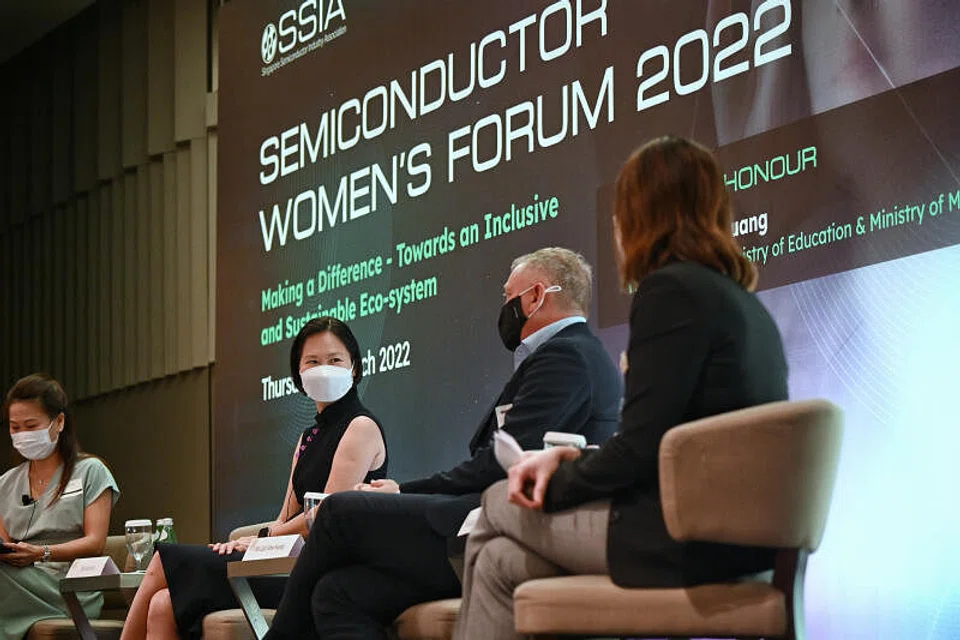
WHILE more women have been joining the semiconductor industry, they are still underrepresented in leadership and technical roles, said speakers at the Semiconductor Women's Forum 2022 on Thursday (Mar 10), organised by the Singapore Semiconductor Industry Association (SSIA).
SSIA chairman Andrew Chong said that while the association has observed a 7 per cent increase in women joining the sector through its Career Conversion Programme with Workforce Singapore, this figure is "still too low".
Despite its economic importance, the semiconductor industry may be "undersold" to jobseekers, said Gan Siow Huang, Minister of State for Manpower in a panel discussion at the forum, adding that she hopes collective efforts can be made to get Singaporeans to see the "value and purpose of the industry".
During a speech at the event, Gan, who was the guest of honour, highlighted that the industry has seen robust growth as chip manufacturers ramp up production to meet demand amid global chip shortages.
In line with global trends, the local semiconductor industry expanded by 14 per cent in 2021, and is expected to see "healthy growth" in 2022, on the back of sustained demand from end-markets such as 5G and data centres, she added.
Although the industry is traditionally a male-dominated one, more women have been entering the sector, she observed.
Navigate Asia in
a new global order
Get the insights delivered to your inbox.
Gan also noted that Thursday's forum was an example of industry efforts to encourage more women to join.
But the panellists agreed that more can still be done.
Fellow panellist Sylvia Chan, deputy director of operations and training development at semiconductor firm GlobalFoundries, said that semiconductor companies in Singapore have been ramping up initiatives to support and encourage women to advance their skills and leadership potential.
However, she cautioned that growing the number of women in the sector is not something that can happen overnight.
"Diversity and inclusion is actually a cultural change" and "will take some time", said Chan, who leads the company's GlobalWomen Singapore chapter that aims to create inclusive environments for women.
Earlier, Gan also noted that employers are expected to abide by the Tripartite Guidelines on Fair Employment Practices, as the government works towards lowering barriers that impede women's progress in the workplace.
However, she said that while legislating fairness sends "a strong signal" that workplace discrimination is not tolerated, "it is not a panacea".
"We must continue with our education efforts to break all forms of biases and stereotypes, and promote fair employment practices as discrimination is, at its root, a mindset issue," she said.
READ MORE:
- When will the semiconductor cycle peak?
- EU's chips drive 'poses no threat to Asia's semiconductor ops'
- Men and women are equal in the workplace, until they aren't
Decoding Asia newsletter: your guide to navigating Asia in a new global order. Sign up here to get Decoding Asia newsletter. Delivered to your inbox. Free.
Copyright SPH Media. All rights reserved.
TRENDING NOW
StarHub hands Ensign InfoSecurity control back to Temasek in S$115 million deal, books S$200 million gain

Singaporeans can now buy record amount of yen per Singdollar

Air India asks Tata, Singapore Airlines for funds after US$2.4 billion loss
Keppel DC Reit posts 13.2% higher Q1 DPU of S$0.02833 on strong portfolio performance

