

World must collaborate on pandemic R&D, manufacturing ahead of next one: Tharman
 Add BT as a preferred source
DeeperDive is a beta AI feature. Refer to full articles for the facts.
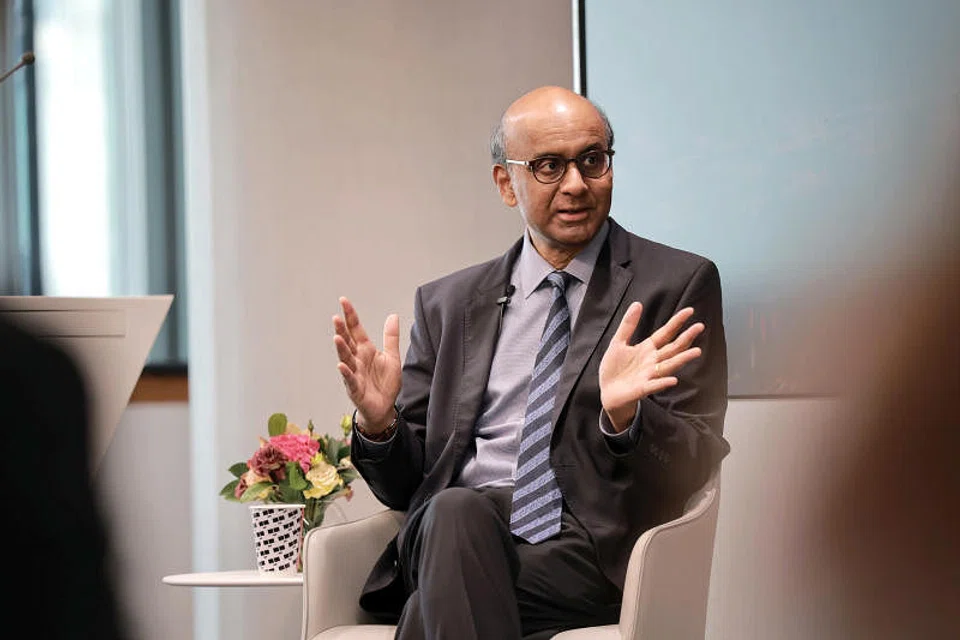
THE world must prepare in advance for the next pandemic, with global risk-sharing to ensure that manufacturing and distribution capabilities are in place ahead of time, said Senior Minister Tharman Shanmugaratnam at the Bloomberg New Economy Forum on Nov 17.
The private sector will not deliver that, due to the uncertainties involved, so it "requires public-private collaboration in a deeper sense", he said.
Pointing to the United States' Biomedical Advanced Research and Development Authority (Barda), which led the country's efforts to produce Covid-19 vaccines, Tharman said that the world needs a "global Barda".
"That's what we need: to develop ahead of time with public money, sharing risks, all the way from R&D to developing the manufacturing capabilities."
He was one of four panellists in a session on Two-Speed Global Recovery: The Dangers of a Widening Rich-Poor Gap, which looked at how the developed world, where the recovery from Covid-19 is underway, could work with developing countries that are still battling the pandemic.
Panellist Philip Isdor Mpango, Vice-President of Tanzania, noted that the recovery has been very sluggish and very uneven for countries such as Tanzania, which had very weak public health systems to begin with.
Navigate Asia in
a new global order
Get the insights delivered to your inbox.
The medical crisis was accompanied by an economic crisis as tourism dried up and trade disruptions meant that manufacturers could not import the necessary raw materials.
"I think really the key here is that we ask the advanced world not to forget sub-Saharan Africa," he said. "While the advanced economies are recovering relatively faster because of the vaccines, we don't have the vaccines. The facilities that have been availed to us - they're just too little."
Agreeing, Tharman noted gulfs in trust that have opened up between developed and developing countries, as well as within societies.
These gulfs have to be addressed "not just through narratives, not just through saying the right things", but through "concrete, collaborative ventures", whether for climate change or vaccine production and distribution.
"If Covid has had a benefit, it is that it has illustrated - unfortunately in a tragic way, but it has illustrated that collaboration internationally is far far less costly than not collaborating," said Tharman.
A similar philosophy applies for other global crises such as climate change, he said. Sustainability technologies, for instance, are being developed but may not all be "bankable" at the moment.
That is why their development must be accelerated "through a lot more public-private risk sharing", he said: "Because otherwise the technologies aren't going to be in place in time for the next decade or next 15 years for sustainability."
Two other panellists focused on the role that digital finance can play in narrowing international divergences.
"Entrepreneurial resilience in Africa is unmatched," said cross-border payments firm AZA Finance's founder and chief executive officer Elizabeth Rossiello. Compared to the formal economy, the "informal online youth economy" on the continent has shown great resilience and bounced back, she said, noting a role for venture or private equity.
With "everything moving to the mobile phone", affordable mobile connectivity can help improve financial health of communities, said Paypal president and CEO Dan Schulman. He highlighted the helpfulness of reducing transaction costs for international remittances, which are important to growth in many African economies.
The developed world could play a larger role in supporting developing countries in economic opportunities that have arisen from Covid-19, said Dr Mpango. For industries that have arisen, such as production of sanitisers, it would help to facilitate trade and the import of inputs.
"Even more importantly, I would like to see the developed world cooperating with us on R&D," he added. Some vaccine manufacturers, for instance, could site some facilities in Africa and "work with local researchers to push the knowledge frontier".
Decoding Asia newsletter: your guide to navigating Asia in a new global order. Sign up here to get Decoding Asia newsletter. Delivered to your inbox. Free.
Copyright SPH Media. All rights reserved.
TRENDING NOW

Vietnam formalises new state leadership, redefining ‘four pillars’ power balance

‘Largest Singapore commercial S-Reit proxy’: analysts say buy CICT shares after Paragon acquisition

From 1MDB to ‘corporate mafia’: Is Malaysia facing a new governance test?
Why where you park your joint venture matters: Lessons from a US$689 million shareholder dispute

