

Yellen’s China trip leaves little doubt Pan’s in charge of PBOC
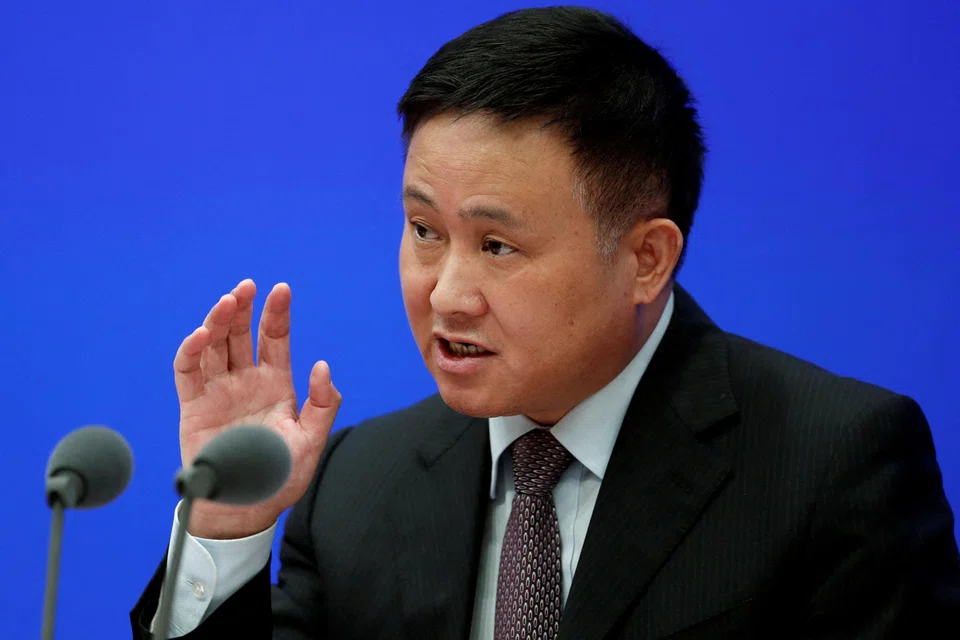
During US Treasury Secretary Janet Yellen’s trip to Beijing, US officials sowed confusion over the role of Pan Gongsheng, who was named party chief of the People’s Bank of China (PBOC) just days earlier. By the end of her visit, one thing was clear: He is now firmly in charge of the central bank.
The uncertainty built over the course of Yellen’s trip, during which she met current PBOC governor Yi Gang last Friday (Jul 7), in what US officials described as an “informal” exchange.
By Sunday morning, the Treasury Department simply referred to Pan as “head” of the PBOC, adding to expectations he would soon be the first person to concurrently hold the titles of party chief and governor since 2018.
Asked to clear up the uncertainty at a press briefing to conclude her visit, Yellen only added to it by referring to Pan as “acting governor” – a title that China has not used.
“It’s up to the Chinese side to decide and announce their decision,” Yellen said, before leaving Beijing. “But I did meet with the acting governor, the head of the PBOC at this point, and we had very good discussions.”
Pan’s elevation to PBOC party chief last weekend set expectations that he will soon take the governor title. Beijing often announces changes in party and government posts at different times, as they go through separate approval and bureaucratic processes.
Yi has reached the official retirement age of 65 for ministerial-level officials, and his re-appointment in March was seen by some as a stop-gap while China restructures its economic institutions.
Yellen held just one exchange with governor Yi during her trip to meet Beijing’s economic leaders. The Treasury did not release a readout of Yellen’s remarks, suggesting it was more of a catch-up between old colleagues than a formal exchange.
On her official trip to the PBOC later on Friday she was received by Pan and a deputy governor, stoking more speculation of an unannounced promotion. Typically, external guests would be met by the central bank’s governor.
The most important meeting of Yellen’s push to stabilise ties was her five-hour conversation with vice-premier He Lifeng and his economic team on Saturday. Yi was not present for that exchange.
Instead, Pan attended along with Finance Minister Liu Kun and Han Wenxiu, executive deputy director of the General Office of the Central Financial and Economic Affairs Commission, sending a clear signal about who is steering China’s economy.
Traditionally, an institution’s party boss has held more sway than its administrative chief. While that could have made it unclear to US officials who is truly in charge at the central bank, the Treasury did not refer to Pan by his party chief title during Yellen’s visit.
China has not deviated from the official script. In a Saturday release, the PBOC referred to Pan as party secretary of the PBOC and head of the State Administration of Foreign Exchange (SAFE), which manages the country’s US$3 trillion in foreign reserves.
Pan’s appointment to governor would likely need to be approved by the standing committee of China’s legislature, which usually convenes at the end of each even-numbered month. That protocol could punt his official appointment to the end of August, although the group can hold ad hoc sessions in special circumstances.
Pan held a deputy governor role at the central bank since 2012, and became the administrator of the SAFE in 2016. He has a PhD in economics from the Renmin University of China, and his overseas experience includes post-doctoral research at Cambridge University and a research fellowship at Harvard University. BLOOMBERG
Decoding Asia newsletter: your guide to navigating Asia in a new global order. Sign up here to get Decoding Asia newsletter. Delivered to your inbox. Free.
Share with us your feedback on BT's products and services
TRENDING NOW

He built the Vingroup empire. Now South-east Asia’s richest man is handing some key roles to his sons
Quarter of Singtel special discounted shares sold ahead of CPF Board transfer

Why Tan Aik Keong of digital solutions specialist Agmo wants to make himself less indispensable

Asia needs new energy security architecture

