

Zhou's PBOC past shows multiple policy moves
Central bank governor has a track record of consecutive steps and so his latest rate cut is unlikely to be a one-off
Beijing
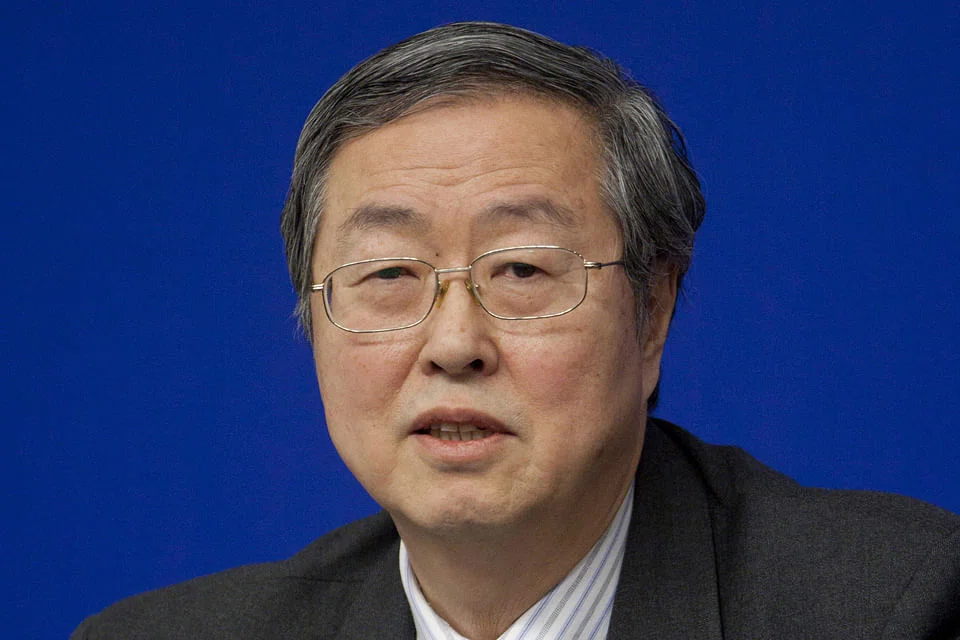
IN his 12 years as People's Bank of China (PBOC) governor, Zhou Xiaochuan has never stopped at a single shift to benchmark interest rates once prompted into action.
Mr Zhou, who took office in 2002 when Alan Greenspan was still chairman of the Federal Reserve, has overseen two tightening and two easing cycles for a total of 22 moves to the one-year lending rate and 20 to the one-year deposit rate. Simple maths suggests his latest cut is unlikely to be a one-off.
By joining Mario Draghi and Haruhiko Kuroda in the global stimulus camp, Mr Zhou signalled deeper concern over China's outlook and recognition that targeted measures alone weren't going to be enough to revive growth. A Bloomberg survey conducted late on Nov 21 through Monday showed economists forecast further monetary loosening by the middle of next year.
"Expect more interest rate cuts ahead," said Shane Oliver, who helps oversee about US$125 billion as Sydney-based head of investment strategy at AMP Capital Investors Ltd. "China's rate cut highlights that global monetary conditions are still easing with monetary easing in Japan, Europe and China taking over from the end of quantitative easing in the US."
The one-year lending rate will be 5.35 per cent in the second quarter of 2015 and the one-year deposit rate will be 2.5 per cent, according to the median forecast of economists surveyed by Bloomberg. AMP's Mr Oliver has the lowest forecast, predicting the lending rate will fall to 4.5 per cent by the end of next year; by contrast four of 15 economists see no further reduction.
Chang Jian, chief China economist at Barclays plc in Hong Kong who correctly forecast the rate cut this quarter, and Louis Kuijs, Royal Bank of Scotland Group plc's chief Greater China economist in Hong Kong, both expect cuts to the lending rate in the first quarter.
The PBOC late Friday lowered the one-year lending rate by 40 basis points to 5.6 per cent and the one-year saving rate 25 basis points to 2.75 per cent, and increased the ceiling for deposit rates.
Immediately after the Nov 21 announcement, it sought to downplay the move, saying it didn't represent a shift in its policy stance as the basic tone remains "prudent".
Money markets weren't convinced: two-year contracts that exchange the PBOC's 2.75 per cent savings benchmark for a fixed payment fell to as low as 2.60 per cent on Monday, reflecting bets it will be about 2.45 per cent in 12 months' time, data compiled by Bloomberg show. Buyers of the contracts receive the current deposit rate for one year, after which the floating payment is reset for the second year at the prevailing rate.
The PBOC's easing came weeks after the Bank of Japan boosted its asset-buying and hours after president Draghi said the European Central Bank must drive faster inflation and will broaden its asset-purchase programme if needed. By contrast, the Federal Reserve has stopped its quantitative easing programme.
Mr Zhou, 66, has a track record of consecutive policy moves. He cut both lending and deposit rates in June and July 2012 in the last rate-easing cycle. That was a reversal from tightening that saw him raise five times from October 2010 to July 2011.
"Things used to be simple for the central bank. It just raised interest rates when the economy was good and cut rates when it was bad," said Dong Tao, chief regional economist for Asia excluding Japan at Credit Suisse Group AG in Hong Kong. "Now the picture is complicated, with economic growth weak on one hand and financial risks high on the other hand."
China, weighed by a property slump and factory-gate deflation, is set to report the slowest full-year expansion since 1990. Meanwhile, financial risks loom from local government financing vehicles, property projects and state enterprises that borrowed excessively amid the government's massive stimulus response to the global financial crisis.
Before resorting to benchmark rate cuts, the PBOC tried various measures that largely failed to bring down real interest rates.
A cut to banks' reserve requirement ratio may be the next step, said Liu Li-Gang at Australia & New Zealand Banking Group Ltd in Hong Kong. "Conditions for further policy easing are ripe," Mr Liu wrote in a note. "Given the ineffectiveness of current monetary policy transmission mechanism, we believe that the PBOC will eventually cut reserve requirement ratio (RRR) to tackle the risk of deflation."
While cutting interest rates lowers the price of credit if passed on by banks, lowering the amount lenders must set aside as reserves would give a boost to liquidity. The RRR will be lowered from 20 per cent now to 19.5 per cent in the first quarter and 19 per cent in the second, economists forecast.
"The rate cut gives the clear signal that the government is determined to bring corporates funding," Lu Ting, Bank of America Corp's head of Greater China economics in Hong Kong, wrote in a note. The chance of a universal 50 basis point cut to banks' reserve ratio requirement is rising, he added. BLOOMBERG
TRENDING NOW
Despite the de-dollarisation debate, demand for dollar liquidity in Asia is growing
URA to review guidelines on floor space to give developers more design flexibility: Chee Hong Tat

He built the Vingroup empire. Now South-east Asia’s richest man is handing some key roles to his sons
Can a first-time homebuyer couple earning S$18,000 a month afford a new EC unit?

