

APS sticks to alpha hunting guns
Founder and CIO Wong Kok Hoi recalls how the company bounced back from the lemon years of 2005-2007, proving its critics wrong in the process
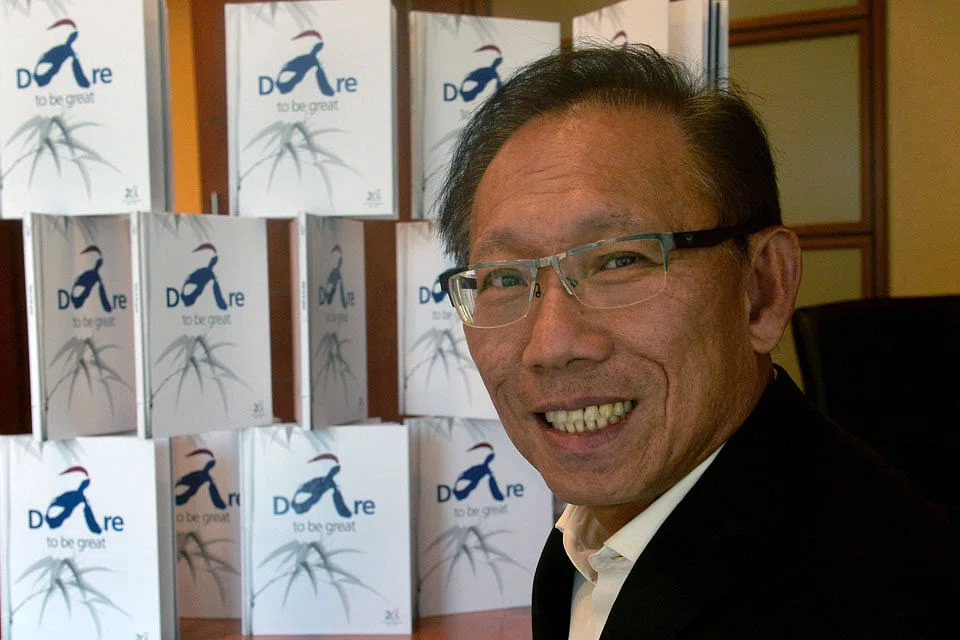
APS Asset Management is a thriving homegrown fund manager, with assets under management of nearly US$3 billion. But there were precarious moments between 2005 and 2007 when founder and chief investment officer Wong Kok Hoi stared down the abyss. At a time when global and Asian markets scaled new highs on debt-fuelled rallies, APS's assets plunged from a high of US$4 billion to US$400 million, thanks to poor performance and client exits.
Says Mr Wong ruefully: "Fortunately or unfortunately, every fund manager will have lemon years. Those were our most difficult."
Was the company remiss in its dogged pursuit of a bottom-up stock strategy? This is a pointed question today as central bank action appears to lead sentiment, currencies and fund flows. Many managers employ a top-down overlay.
"We had been advised by well-intentioned clients that a weakness of our process is the lack of top down overlay . . . We disagreed. Empirical evidence showed that the best economists more often get their forecasts wrong. We asked ourselves a question: Do we really have the skill set to make a macro forecast?
"Obviously, no. So we stuck to the same process we've had for 21 years, and we bounced back with the same process. By now, I can say with more confidence that our process is rigorous, and it works."
APS's flagship China A share fund generated a return of 25 per cent in 2015, placing it among the top funds in its category by Eurekahedge. The strategy has around US$2 billion in assets. Over 10 years, the fund has generated annualised return of 17.7 per cent, outperforming the CSI 300 Index by 6.3 percentage points.
APS's second flagship fund, the Asia Pacific Long Short Fund, generated a return of nearly 30 per cent in 2015, clinching a number of fund accolades. Over 10 years, it has returned 9.8 per cent on an annualised basis, outperforming the Mizuho-Eurekahedge Asia Pacific Long Short Equities Index by 4.8 percentage points. The strategy has around US$580 million in assets.
Both funds are down this year: minus 3.9 per cent for the Asia-Pac fund in the year to end-August, and minus 4.4 per cent for the China fund.
APS's stock strategy centres on its theory that alpha - traditionally defined as the value-add or excess return above the market or an index - is not homogenous. That is, the firm believes that there are four types of alpha - structural, economic, dynamic and opportunistic. Active managers strive to generate alpha consistently, which should justify charging higher fees.
"As practitioners, we find that alphas produced by different types of companies behave differently," he says. The most desirable is structural alpha, which is produced by firms with structural strengths, defined as favourable industry, social or political trends, core competencies not easily eroded by competition, and high entry barriers. "We like structural alpha stocks. We spend a lot of time searching for them," says Mr Wong. Examples of structural alpha stocks in APS's portfolio are Chinese cybersecurity firm Venustech and Wangsu Science & Technology, which offers online business solutions such as content distribution and server hosting.
Dynamic alphas are unstable and cyclical. Stocks such as Keppel and Sembawang, for instance, are linked to oil prices, and do poorly when oil is in a prolonged slump as it is today. Alpha from bank stocks are also cyclical in nature.
Economic alpha are value stocks. While a stock's business may offer strong financials, its share price may languish as it is unrecognised by the market. "We still buy them but we have to know the type of alpha and have patience. Once they are discovered by investors, you get an outburst of alpha."
Opportunistic alpha is that produced by special situations such as M&A or a change in management. This type of alpha is relatively short-lived.
So if the strategy was right, what went wrong between 2005 and 2007? "We grew too quickly," he says starkly. Assets surged from US$400 million in 2002 to US$4 billion by 2005. "Our teams were much smaller. We did not manage our growth well. I was also very stretched. I was CIO (chief investment officer) and CEO and travelling a lot.
"With that lesson, we're now very careful with our growth. We've upgraded in quality, not just in people but also processes."
Staff strength has just more than doubled from around 30 in 2007 to 65.
Former cabinet minister and member of parliament Raymond Lim is executive chairman and keeps an eye on strategy and top level hires. Mr Lim joined APS as chairman in 2013 and became executive chairman last year.
Mr Wong says that the firm is also "very selective" on the mandates it takes on. It turned down a US$1 billion mandate three years ago. "When we were growing, we took whatever business that came our way. That turned out to be a bad strategy."
At times, fees were an issue - APS charges a 2 per cent annual management fee and 20 per cent performance fee for its Asia-Pac long/short fund. For the China fund, it charges one and 20 per cent, respectively.
At times, strategy was an issue. "Some investors like our process and team, but they don't mind accepting lower returns for lower risk, such as buying more index stocks. That's not our style. We buy a stock only if we have full confidence that it will perform, not because it's an index stock. So we tell them, sorry, you have come to the wrong place. We won't change the way we manage money."
In the hedge fund arena in particular, there is growing pressure on fees. A Preqin survey this year found that most respondents believe performance fees needed to fall, and they wanted improvements in the way fees are charged.
Says Mr Wong: "When returns are strong, clients will not grumble. When you can't deliver, they ask - Why am I paying you fees? Fortunately we're not in the non-performing category. So far, we have not lowered our fees, not even by one basis point."
He adds: "In (Singapore), people think low-fee funds are good. They get Ait completely wrong. In asset management, there are two business models. One is high-volume, low-margin business. The ticket size is large and the manager doesn't mind lower fees. They make money by gathering a lot of assets. Two is low-volume, high-margin - like us."
APS made waves in 2003 when it launched the APS Alpha Fund, the first fund investing in Asia ex-Japan stocks with no annual management fee, but with a performance fee, subject to a 6 per cent hurdle rate. Returns were poor until just after the 2008 crisis. In 2009, the fund returned 98 per cent, and 12.6 per cent in 2010. In both years, the total expense ratio soared due to the performance fee. This caused the fund to fall foul of the CPFIS cap on expense ratios
APS has since restructured the fund, offering a share class with a 1.5 per cent management fee and no performance fee. This share class is in the CPFIS. Based on the July fact sheet, returns were flat for the year. Since inception, the fund has returned 3.9 per cent on an annualised basis.
gen@sph.com.sg
TRENDING NOW

Once staunchly pro-China, Malaysian Chinese businesses are now distancing themselves from Beijing

Inside Singapore’s government team that kills its own products

Johor’s investment boom is real, but actual contribution from JS-SEZ unclear
Inside F1: How ‘reactive’ DHL acted quickly to fit Malaysia race just before Singapore’s

