Dipping into high-powered immersive art
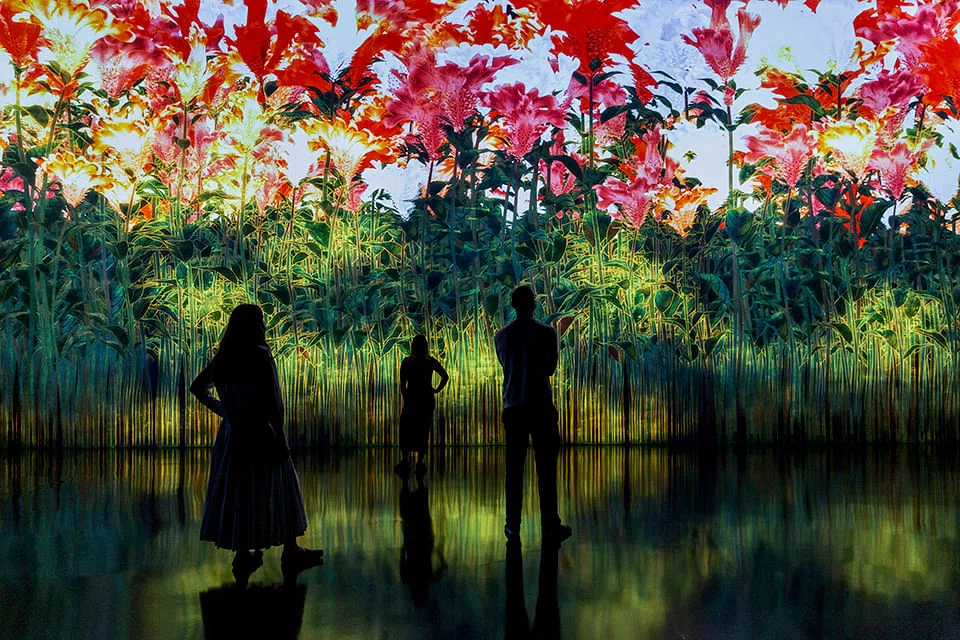
FEELING a little like Alice in Wonderland as gigantic digital images of red, white and cream-coloured dahlias budded, bloomed and shattered on the wall in front of me, I dithered over what I was witnessing. Is this a forward step in the march of modernism or a debasement of art into theme park entertainment?
The dazzling floral extravaganza by teamLab, a digital-art collective based in Tokyo, is the dynamic centerpiece of an inaugural exhibition at Superblue Miami, an "experiential art centre" (or an EAC to initiates) that begins invitational previews this week before opening to the public on April 22. Backed by the juggernaut Pace Gallery and Laurene Powell Jobs' Emerson Collective, Superblue is the blue-chip contestant in the rapidly growing field of immersive art.
The popularity of this genre is driven by contradictory desires, as demonstrated memorably by the line of visitors in 2019 who waited up to six hours for a one-minute stay amid the twinkling lights in Yayoi Kusama's infinity mirror room at the David Zwirner gallery in Chelsea, New York. Malnourished by their phones and computer screens, people yearn for real-life visceral experiences. And yet they remain stuck in the gravitational pull of virtual reality; the experiences they seek are ones they can record on their phone cameras and post on social media.
The renovated warehouse that Superblue occupies is across the street from a more traditional contemporary art institution, the Rubell Museum, which reopened at the end of 2019 in Allapattah, a commercial and working-class area west of its former location in the now-gentrified Wynwood district. Mera Rubell told Pace CEO Marc Glimcher about the availability of the building when they happened to be seated next to each other at a large dinner.
The structure contains 50,000 square feet of exhibition space, with 30-foot ceilings. It will display installations for a year or a year and a half before they are trucked off to other Superblue sites in yet-to-be-announced cities. "That's something we have to do to make the economics work," co-founder Mollie Dent-Brocklehurst, based in London, said on a Zoom call.
Teeters vertiginously
For the Miami exhibition, Superblue included AKHU by James Turrell, a Southern Californian who is an éminence grise of the experiential art world. The installation is what Turrell calls a Ganzfeld, a German word that denotes the loss of spatial perception that occurs in a featureless, uniform visual field, such as a fog whiteout. (As with Schadenfreude, Ganzfeld has no English counterpart.)
In AKHU (an ancient Egyptian term that roughly translates as "soul"), an oblong of light is projected onto a smooth blank wall and tints the room. The colour of the light gradually changes. If you climb the black-carpeted steps toward the threshold of the illuminated wall, your sense of where you are teeters vertiginously.
Es Devlin, whose Forest of Us is part of Superblue's first exhibition, has worked as a theatrical designer for 25 years, creating celebrated sets for The Lehman Trilogy, Kanye West tours and About Time: Fashion and Duration, the Metropolitan Museum's Costume Institute show last fall. Attending art school in London, Devlin admired the Young British Artists who preceded her, but, she told me in Miami, "I couldn't get my head around making and selling an object. My natural world was the theatre."
In the past five years, she has progressed from creating designs for other artists to acquiring "the confidence to write a narrative".
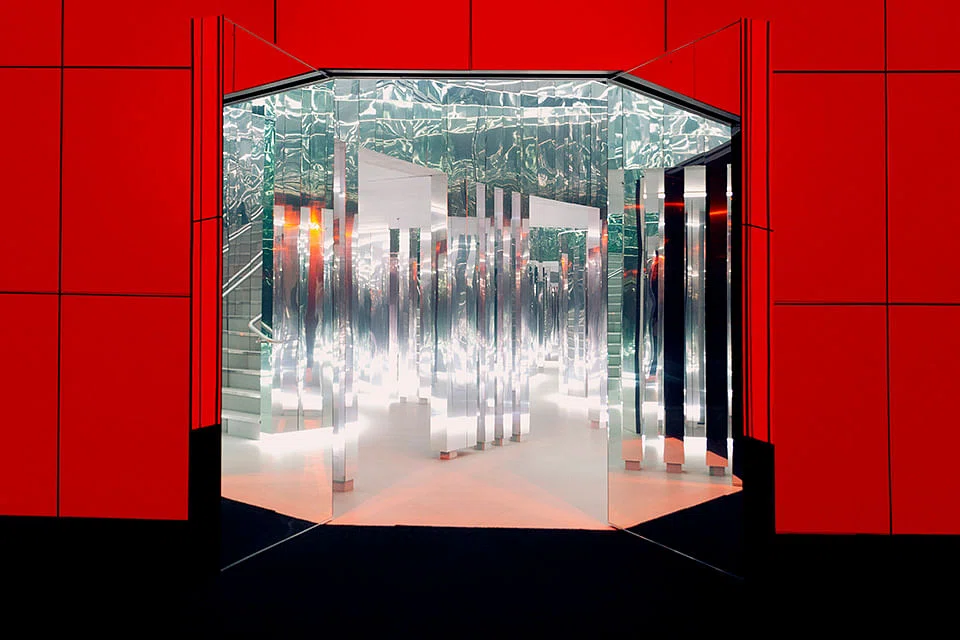
Forest of Us begins with a film of almost three minutes in which Devlin depicts branching - bronchi in the lungs, limbs of trees, rivulets into streams. The voice-over starts, "Every time I reach a fork in the road, I choose both paths," and ends, "Can you find it? Go and find it!" At which point the screen parts, and the visitor walks through a portal into a maze. With stretched Mylar film on the ceiling, optical-glass mirror on the surrounding walls and winding paths bordered by polished aluminum dividers, Forest of Us is a kind of hedge maze in which the traditional boxwood has been replaced by reflective surfaces.
Staring at my bounced-back image, I was reminded of Kusama's visionary Narcissus Garden, an expanse of mirror balls lying on the ground. (First created in 1966 at the Venice Biennale, Narcissus Garden happens to be on view in a later format at the Rubell Museum.)
But Devlin's work envelops you. Eventually you come to a shallow pool, 6 feet wide and 35 feet long, where, standing on marked circles at the edge, you can raise your arms and see your reflection as a dendritic filigree and hear the whooshing intake of breath.
Chilled, I felt I was standing by the bank of the river Styx, experiencing not my personal demise but the death of the planet.
At Superblue, the barrier between the viewer and the artwork has evaporated, which is the long-stated mission of teamLab. One way to regard the group's showstopping displays in Miami is that they allow a visitor to pass through a computer screen, just as the characters in Jean Cocteau's film Orphee walk through mirrors.
"What makes a boundary is the recognition of one by people," teamLab co-founder Toshiyuki Inoko said, speaking through an interpreter. "On a computer screen, once people recognise the screen, it becomes a boundary. We are trying to eliminate or soften the boundary."
Indeed, the largest of teamLab's four exhibitions at Superblue Miami is devoted to two separately conceived works that have been interwoven.
Digital waterfall
Universe of Water Particles, Transcending Boundaries is a digital waterfall that cascades down two walls and onto the shiny floor; coming into contact with a visitor's feet, the stream parts. Concurrently, another work, Flowers and People, Cannot be Controlled but Live Together, is erupting with huge blossoms that grow and die. The flowers bloom on the ground only in those spaces that have been cleared of the watery image by the visitor's presence.
The teamLab collaborative embraces its Japanese heritage most directly in a single-channel video, Life Survives by the Power of Life II, which transmogrifies the Kanji symbol for "life" into a tree branch passing through seasonal change in a dance of 3D calligraphy.
In another room, Proliferating Immense Life - A Whole Year per Year displays a sequence of rendered flowers that grow huge and fly off as petals, leaving behind a grid of small, gold-brown wall squares - an allusion to the gold leaf applied to the paper surface of a Japanese screen as well as (to my mind, at least) bare winter fields shadowed by clouds.
When my hand touched the flowers on the wall, I accelerated their dying - a caustic comment on humankind's blight as well as a ravishing rendition of the Japanese aesthetic of the ephemerality of beauty. NYTIMES
Decoding Asia newsletter: your guide to navigating Asia in a new global order. Sign up here to get Decoding Asia newsletter. Delivered to your inbox. Free.
Share with us your feedback on BT's products and services