

How to get out of a pandemic funk
If operating in start-stop mode is taking a toll and inertia has set in, here's how to make that shift

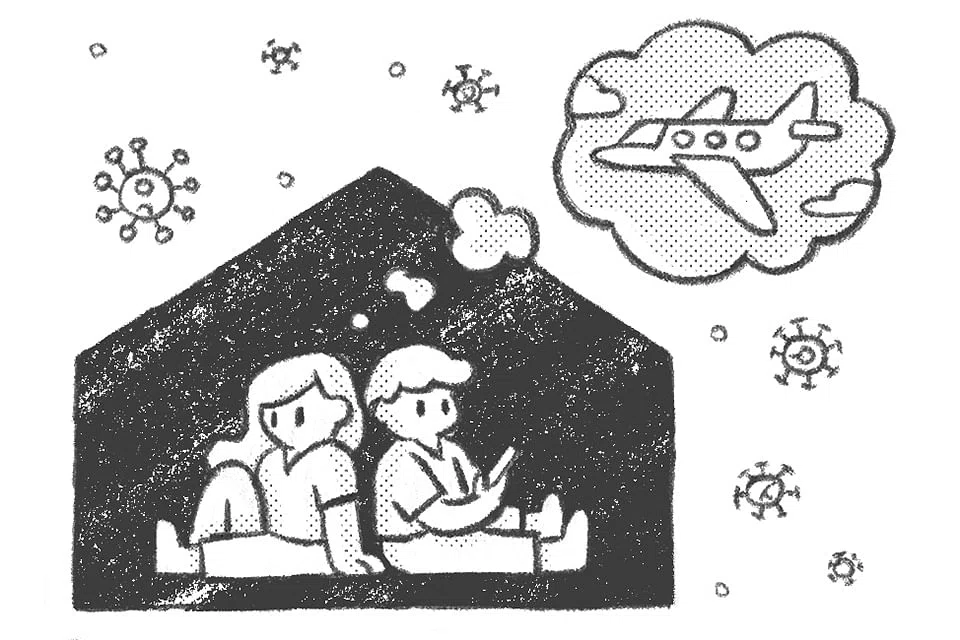
"IT will be great to welcome you back to New Zealand sometime soon." This advertisement at the bus stop, while attempting to convey joy and hope, really grates when I see it. It harks back to what is normal. And only serves to reinforce a sense of the "new normal" that we are faced with.
This new normal is not what I want. What I want is the old normal. Whatever confusing morass we are in now that hamstrings my activities should be a step towards gradually reverting to the good old days, which seem like a lifetime ago.
And yet, as I try to move forward while complying with renewed, then relaxed restrictions, inertia has set in with a vengeance. I find myself exercising and cooking less, and dabaoing more, and watching more TV while I am at it.
Operating in repetitive start-stop mode, like an engine that idles poorly, is taking a toll on my raring-to-go attitude.
I seem to have gotten quite used to this level of inactivity, and while I yearn to head out and socialise again - among other things, the introvert in me weeps.
Is this normal, or am I losing my marbles?
Victor Seah, senior lecturer of psychology at Singapore University of Social Sciences (SUSS), says that humans are social animals but Covid-19 has led to reduced social interactions for many. This can cause anxiety, especially so when psychological distance has likely grown because of a reduction in quality and frequency of interactions.
This explains why I feel unsettled and restless.
Samuel Chng, who heads the Urban Psychology Lab at the Lee Kuan Yew Centre for Innovative Cities, Singapore University of Technology and Design, adds: "It is indeed a complex situation and a dilemma for many as we reminisce about our life before Covid-19 and yet, we have managed to find joy in this new lifestyle brought about by the pandemic.
"In my opinion, we are now in the middle of figuring out what's the best arrangement going forward (hence the feeling of inertia at times)... However, some have adapted better than others."
I am glad I am not alone in this pity party.
Poh Chu Yan, who works in the real estate industry, says: "I think I feel more defeated this time. The burnout is real. And I'm of two minds about going back to the office. On one hand, I hate that companies are asking people to go back during these times. But on the other hand, I think I prefer being in the office. Because working at home is tiring, I think, due to a lack of real interaction and breaks. And there's this incessant need to prove you're not skiving."
In fact, a recent Randstad Singapore Employer Brand Research unveiled that 16 per cent of more than 3,000 respondents here say that they clocked longer hours in 2020, which is the highest in the region.
Jaya Dass, managing director, Singapore & Malaysia, posits that all these issues stem from the lack of trust between employers and employees.
"Managers need to learn how to trust their employees to get the job done and have the initiative to raise red flags when they face challenges when working from home. It's time for employers to learn how to focus on outcomes and results rather than the operational details, so it gives staff more motivation during this difficult period."
And as for dealing with the indolent feeling at work, Linda Teo, country manager of ManpowerGroup Singapore, says that employees trying to cope should try to find some normalcy amid the chaos.
"One way to motivate themselves is to set mini challenges that they want to achieve on a daily or weekly basis. The aim is to get themselves feeling motivated again and make them feel energised about what they have accomplished."
For businesses, the long road to recovery must be even more demoralising. Willie Tan, co-owner of Le Café Blanc, says: "Right now, there is very limited promotion I can do to attract customers. Hence, there is a general feeling of sian-ness as it really does put a brake on the momentum built."
Singapore Business Federation chief executive officer Lam Yi Young says that faced with pressing challenges arising from the pandemic, it is understandable that some business owners are very focused on immediate term issues, and may feel overwhelmed.
"But for recovery and growth, it is important for businesses to look beyond the immediate term challenges, and be cognisant of changing market and industry trends, and what they need to do in order to seize opportunities and thrive in the future."
To get out of the funk we have been thrust into, Dr Seah from SUSS says that while change is stressful, "one way to reduce our feelings of anxiety and inertia is to make the transition between Covid-19 restrictions 'smaller'".
"For example, informal workplace communication has been reduced as a result of lockdown measures. To make the transition back to the office easier, we and our organisations should seek to create opportunities for informal communication," he adds.
Instead of dwelling on what we cannot do now, "think about the future (for example, life after getting vaccinated), and the new opportunities that have emerged", says Dr Chng.
As we move slowly - but surely - with gradual reopening, we will eventually reach the end of the tunnel. On that note, I shall take the doctor's advice for now and dream of my trip to New Zealand - on my couch.
Decoding Asia newsletter: your guide to navigating Asia in a new global order. Sign up here to get Decoding Asia newsletter. Delivered to your inbox. Free.
Copyright SPH Media. All rights reserved.
TRENDING NOW

Two Singapore-listed palm oil firms named in Greenpeace report on Indonesian plantation fires
Singapore Airlines flight returns to San Francisco after ‘unruly’ passenger incident
Singapore looking into which companies responsible for haze-causing fires: PM Wong
Deluge IPO 3.86 times subscribed ahead of SGX debut

