My phone, my life
Leaving this gadget behind has made me realise just what an impact it has on our mental and emotional welfare

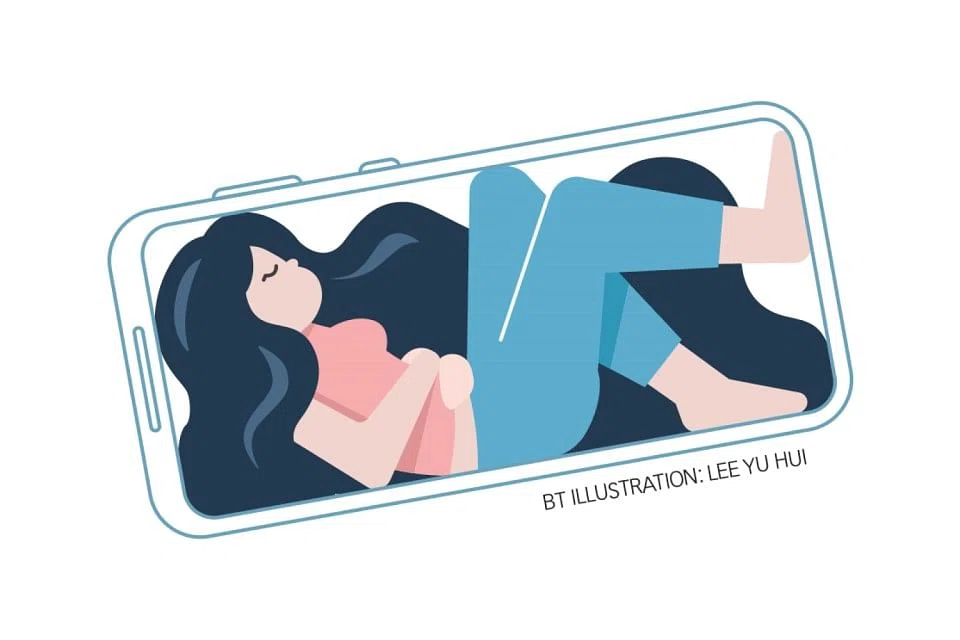
A PARALYSING fear seized me as I frantically dug through my bag in search of my phone. After going through the various stages - denial, anger, and finally acceptance that I had left it at home in my haste to leave - I slumped back in the seat of the bus and heaved a sigh, wondering how I was going to navigate the imbroglio.
The ride was awkward. I felt an ineffable feeling of loss while looking at other passengers, heads lowered, engrossed in that one item I did not have for the day. Drama much? Maybe. Irrational? Not so much.
The group of friends I met that day - just before tighter curbs kicked in - unanimously agreed that they would rather have left their wallets at home. "No wallet, can still go about your day. Everything is on the phone apps. Without it, I will be super lost 'cause I cannot message!" said one. Another concurred: "See la, have to do SafeEntry for you now - and order your food." As if I were culpable that the café only had an e-menu - and not that it would be an issue in the coming weeks.
This interlude has shown me how this little gadget is now more than just an accessory in our modern world. It is an extension of ourselves, a security blanket of sorts and, more importantly, an essential tool enabling our access to both work and consumption.
Victor Seah, senior lecturer of psychology at Singapore University of Social Sciences, says that it is no surprise that people feel out of place without their mobile phone - especially in a Covid-affected world where it is a key medium for connecting us to family, friends, and work. "While the exact level of need varies, we all have a need for affiliation - a desire for belongingness and social contact," he says. "The Society for Industrial and Organizational Psychology lists work-life integration as a top 10 work trend for 2021. Hence, one key reason why we feel out of place without our phones is that we feel excluded from work and notifications about it."
In March 2020, he surveyed 242 Singaporean adults about their social media use before the "circuit breaker". Following up with another survey of 280 Singaporeans in March 2021, he found that while the total time spent on social media has not increased, how the respondents used it has. "Specifically, 185 respondents in 2021 cited 'relaxation' as the primary reason for using social media, up from 141 in 2020. Similar increases in 2021 were observed for 'pass time' (up from 156 in 2020 to 176 in 2021) and 'entertainment' (up from 171 in 2020 to 220 in 2021)."
Over the last 15 years, mobile market penetration in Singapore has grown from 99.8 per cent (4.26 million mobile lines) in December 2005, to 148.2 per cent (8.43 million mobile lines) in December 2020.
According to a November 2020 Singtel survey with 800 respondents), there has been a shift in consumer behaviour since the start of the Covid-19 outbreak, with consumers reporting that they spend more time on the phone engaging with things other than social media - such as video streaming, video calls, and food delivery.
Anna Yip, chief executive officer (CEO), consumer Singapore, Singtel, says: "Digital adoption among our customers hit a high in 2020 - 43 per cent of all our sales transactions were completed online, and 70 per cent of customer interactions were conducted through our self-help channels.
Johan Buse, chief, consumer business group, StarHub, says: "Due to the Covid-19 situation, mobile phones have become an inseparable part of our daily lives - they enable many of our needs and play a vital role in keeping us safe. Beyond an increased usage for work and contact tracing, we have seen a pronounced demand for entertainment on mobile. Many of our customers are currently subscribed to streaming services such as Disney+, and this number continues to rise."
But too much of a good thing is bad. How much is too much?
Dr Seah points to these red flags that signal an unhealthy attachment to our phones: withdrawal (do you often feel bad when you cannot use social media?), persistence (have you often tried unsuccessfully to use your mobile phone less?), escape (have you often used social media or your mobile phone to escape from negative feelings?).
Among young people, excessive device use affects emotion regulation, and individuals with excessive device use may lack the necessary strategies to cope with negative thoughts or daily stress because of their over-reliance on cyber activities, says Shawn Soh, head of TOUCH Youth Intervention and DigitalMINDSET Lead. Youths who compulsively trawl social media (Facebook, TikTok, Instagram et cetera) are also more exposed to highly curated and photoshopped content which they may erroneously perceive as reality.
Hence, Mr Soh says, it is important to have open and ongoing discussions with children about responsible use of technology, and also help them develop other coping strategies - build enjoyable alternative activities into their schedules.
As the day progressed, surprisingly, I began to forget about the existence of my phone, and started to enjoy the company of my friends without the endless vibrations coming from my bag, which always felt like an itch I could not scratch if I did not respond immediately.
On the bus ride back, there was still that niggling urge or reflex action to reach my hand into the bag for what was not there, but it wasn't as intense as before. I started to enjoy the scenery before me and the people around, who were absorbed in the world their screens brought them.
Then I couldn't help but think: is this form of escapism and instant gratification partly the reason why we are becoming more hostile in reality? It's something to mull over, but first we have to put down the phone and smell the roses - real ones, not those on social media.
Decoding Asia newsletter: your guide to navigating Asia in a new global order. Sign up here to get Decoding Asia newsletter. Delivered to your inbox. Free.
Copyright SPH Media. All rights reserved.