
We are falling more in love with bad news
People are drawn to negativity because we think it keeps us safe. So here's the bad news: the Internet has made it worse
 Add BT as a preferred source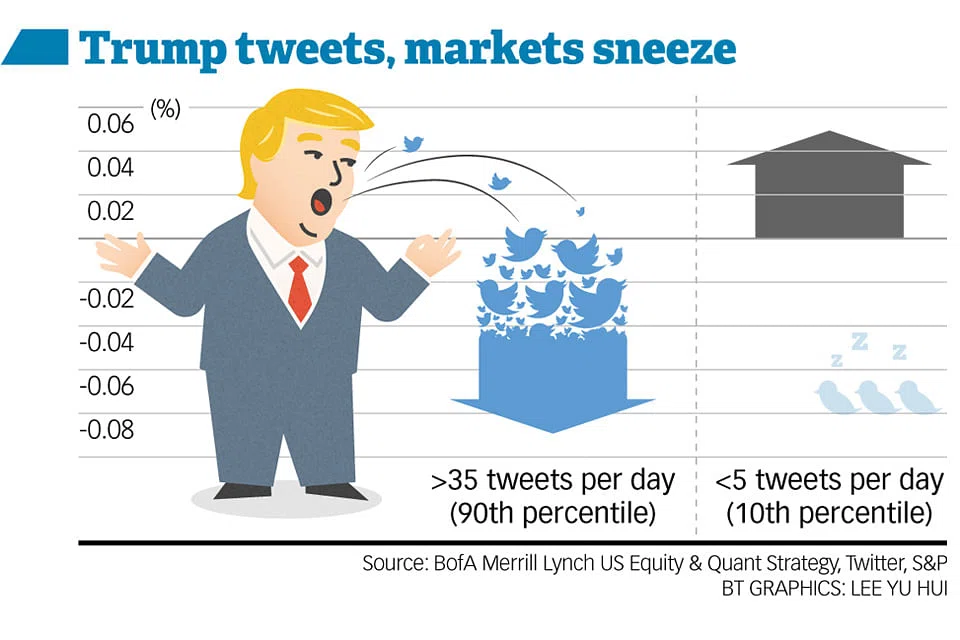
PEOPLE can't tear their eyes away from bad news. A 2014 study by researchers at McGill University showed that even when news consumers claim to enjoy positive stories, their attention would inevitably be drawn to negative headlines.
Psychologists and neuroscientists have explanations for why we can't kick the bad-news habit. For one thing, this negativity bias paradoxically creates a mental space for us to try to feel safe.
In a 2018 Time article, Loretta Breuning, Professor Emerita of Management at California State University, East Bay, said the mind is tuned to bad news to detect threats. "In a state of nature, our survival depends on finding rewards and avoiding harm, but avoiding harm takes priority," she told the magazine. "Our brain is predisposed to go negative, and the news we consume reflects this."
A second psychological kick comes from reading bad news. Armed with something coined as "availability heuristic", humans mentally assess the likelihood of an event by how quickly such an event comes to memory. And because the mind can attach greater meaning to events based on how they were presented - say with a vivid graphic - people can overestimate the odds that a similar event would happen. The common analogy is that people are more likely to fear plane crashes than car crashes, even though factually, car crashes have killed more people. But the images of plane crashes tend to stick in people's minds a lot more than that of car crashes.
The news has become disproportionately more glum. A sentiment mining analysis by data scientist Kalev Leetaru on articles and broadcasting material from The New York Times (NYT) and the BBC published between 1945 and 2005 showed that the news has trended towards negativity over the last 30-year period.
This comes despite a similar sentiment analysis on Wikipedia articles, where the data scientist mapped 37 gigabytes of data from entries written in English that detailed 80 million locations across 40 million dates, to "crowdsource the global pulse" alongside the trend of globalisation and the impact of warfare through the decades. It showed that global positivity has been on the up.
Navigate Asia in
a new global order
Get the insights delivered to your inbox.
Globalisation has opened doors to growth. Sure, money is not happiness. And it should be said that growth has come at the expense of the environment, some developing countries have been left behind, and income inequality persists. But over the last 25 years, more than a billion people have also lifted themselves out of extreme poverty, with the global poverty rate never lower. World Bank figures show that global wealth has expanded by about 66 per cent to US$1.14 trillion between 1995 and 2014. We have problems, but also, more in our arsenal today.
Against this backdrop, Dr Leetaru found that it was the late 1990s where worldwide media tone truly turned darker. And apparently the point that news plunged markedly towards the negativity matches the time at which online media emerged.
"Could it be that our world is better than ever but the digital world is merely flooding us with a curated feed of the world's worst? If we are bombarded with a customised stream of conflict, chaos, hate and violence designed to appeal to our worst fears in hopes of spurring us to greater digital engagement or if our news media is steadily darkening in order to compete for our attention, it would be no wonder we feel the world is collapsing around us," he wrote.
Could this have an impact on understanding rationality behind behaviours? A BofAML report showed that since 2016 - the year Donald Trump was elected US president - markets tend to fall on days when he would blast more than 35 tweets in a day.
But it would be incomplete to blame Mr Trump without considering how humans today react to information on the fly. Consider as well an anecdote from Michael Batnick, director of research at Ritholtz Wealth Management, on his blog. He wrote that teachers in New York were fervently discussing the apparent warning of a recession that came in the form of the yield curve inversion.
The bubbling discussion of the yield-curve inversion - occurring when short-term rates go above long-term rates - over Facebook spoke volumes about how news is spreading quicker than at any point in history. And Mr Batnick went on to show that in the late 70s and early 80s, the media paid less attention to the dangers of a yield-curve inversion. But over the last twenty years, the media attention behind the dangers of a yield-curve inversion has reached a boil.
"Normally you might think a bunch of teachers freaking out about their retirement accounts would be a contrarian buy indicator. I'm afraid those days are long over. If you're one of the people who rely on anecdotal sentiment to navigate the market, listen to me very closely - stop it. Stop it right now," wrote Mr Batnick.
"Everybody knows everything is the new nobody knows nothing. In ten minutes you can learn most of what took a lifetime for Darwin to discover. You have to be careful trying to infer something from everything, because in today's world, it is virtually impossible to separate the signal from the noise."
In dissecting the media coverage of the 2016 US election, the two founders of Solutions Journalism Network - a group that looks at reporting about responses to social problems - suggested that the Trump campaign had seized on this "hypercynicism".
"For decades, journalism's steady focus on problems and seemingly incurable pathologies was preparing the soil that allowed Trump's seeds of discontent and despair to take root. Today, this problem is magnified by the fragmentation of news sources and a proliferation of fake news," wrote David Bornstein and Tina Rosenberg in NYT.
"Journalism has a language with which to describe threats and failures, but it is tongue tied when it comes to letting society know when there's a win. Part of this is simple sensationalism. But perhaps more important is that journalists have become afraid to cover remedies, lest we seem gullible (which, for a journalist, is the greatest sin). We are comfortable, however, covering failure, and adding to the narrative of decline."
Where does that leave us, then? We could say that if the problem is despair upon despair, running on a feedback loop that is the Internet, then the solution cannot be further despair.
The late NYT media critic David Carr once talked about journalism as life. "Journalism is like housekeeping. It's a series of small, discrete acts performed over and over...just do the next right thing," he wrote.
What has always given me comfort is the pursuit of progress, however incremental it may be. Perhaps the lesson behind the history of our addiction to bad news is to accept that it exists, and with that, to break the vicious circle by finding courage to take one step forward. Time is the gift to humanity, not its curse.
Copyright SPH Media. All rights reserved.

