88-year-old Japanese ex-pet-shop owner built a two billion yen fortune buying stocks
WHEN a regulatory filing revealed a stake of more than 5 per cent had been built up in Japanese property management firm Storage-OH last October its shares spiked 17 per cent.
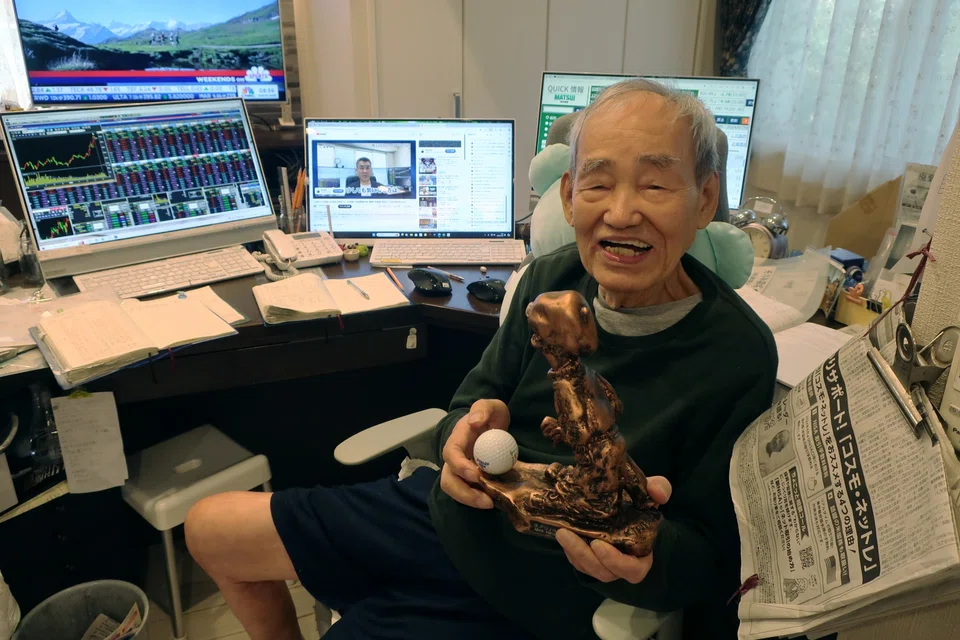
The investor that provoked the fevered market response was Shigeru Fujimoto, an 88-year-old former pet-shop owner from the city of Kobe.
In a nation where the norm has been for people to park their assets in cash and deposits that offer almost no interest, he’s built a small fortune. After almost seven decades of stock trading, the octogenarian has accumulated about two billion yen (S$18 million) of wealth.
He’s also built a following of loyal retail investors who hang off his actions. He’s even written a popular book about his investment strategy.
Fujimoto stands out in Japan not just because of his financial risk taking in a culture that has favoured playing it safe, but also because he has proactively accumulated money to pay for his old age while many older people are struggling to live on small public pensions as inflation picks up.
Not even last month’s stock rout, when the country’s shares saw the worst decline since 1987, has put him off.
“When the stock price gets low, then it’s time for me to buy stocks,” Fujimoto said. “But the question is whether you have the money or the courage to do that.”
Lost years
Many Japanese, particularly older citizens, have been reluctant to invest in the stock market for decades since the nation’s asset bubble burst in the early 1990s, leaving scars on the national psyche.
Cash savings make up more than half of household assets in Japan – far higher than in the US or Europe, according to a Bank of Japan report released earlier this month.
The Japanese government is trying to tap into that pool of liquidity, encouraging people to shift some of the roughly one quadrillion yen held in bank accounts to the stock market by expanding the tax-exempt retirement savings accounts known as Nisa.
The drive seems to be have had some success. Japanese households poured more than 10 trillion yen of funds into new Nisa during the first six months of this year, almost four times more than the same period last year, according to the Japan Securities Dealers Association.
But there’s a way to go – for example, two of the three main contenders for Japan’s leadership election that was won on Friday by Shigeru Ishiba have avoided investing in stocks.
Fujimoto, who does not have a smartphone, car or even a credit card, said it’s a good thing younger Japanese people are getting into stock investing, which he describes as “fun”.
“It’s fun when you think hard, study hard and good results come out and you make a profit, isn’t it?” he said. “It’s fun to study. It’s also fun to see the results.”
He sometimes gets asked if he takes on apprentices, gets name-dropped on social media and is called ‘Japan’s Warren Buffett’ in local media.
Fujimoto, who uses a mobility walker for support after hurting his back earlier in the year, said that he’s humbled to be compared to Buffett, but said the only things they have in common are age and a love of stocks.
“He is just as passionate about stock investing as institutional investors,” Hiroshi Namioka, chief strategist at T&D Asset Management, said about Fujimoto. “He has an influence on public and retail investors and Fujimoto’s fans are following him in terms of investment angles.”
Still, Fujimoto is an extreme example of investing in Japan. For the past 10 years, he has concentrated on day trading, putting him among only 3 per cent of investors in the country who hold stocks for less than a month, according to a survey in 2022 by the Japan Securities Dealers Association.
This type of risky investing, though, is not something he would recommend to young investors.
“It’s important to hold good stocks for the long term,” he said. “Don’t buy or sell immediately like a day trader. If you hold such stocks for a while, they will surely bear fruit.”
Parakeets and mahjong
His stock investing began almost 70 years ago at the age of 19 when he got talking to an executive from a local brokerage who frequented the pet shop Fujimoto worked at. The first shares he bought were in companies that became Sharp and oil refiner Eneos Holdings.
At the beginning, he was not fully committed. The parakeet lover opened his own pet store, later selling the shop to start a Japanese-style mahjong parlour as he believed that was where the money-making opportunity laid at the time.
In 1986, he raised 65 million yen after selling his parlours and started investing full-time in financial markets. He became a day trader in 2015.
Fujimoto, who often works with his pet parakeet Pi-Chan sitting on his head, wakes up at 2 am to check the US markets and watch CNBC. He also looks at American Depository Receipts of Japanese companies to get ready for his trading in the local market.
Fujimoto said trading in his late 80s helps him enjoy life and “prevents me from getting senile”. But he’s not without regrets, saying he is “full of dissatisfaction” with his two billion yen pot of wealth.
“I’m not putting enough effort into it,” he said. “I need to be careful not to be too greedy but also pursue a return from trading. It’s never good to be greedy.” BLOOMBERG
Decoding Asia newsletter: your guide to navigating Asia in a new global order. Sign up here to get Decoding Asia newsletter. Delivered to your inbox. Free.
Share with us your feedback on BT's products and services