Adopt AI or die, say Singapore’s creatives
From architecture to advertising, professionals are harnessing artificial intelligence to launch new careers, expand incomes or simply stay ahead

GEOFF Ang, who has been a commercial photographer for over 30 years, was stunned when he began using artificial intelligence (AI). He had shot pictures of a model standing in a shallow pool. After picking the best images, he fed them into Photoshop’s new AI tool, Generative Fill, and requested for rocks to surround the pool.
“Within seconds, it had given me exactly what I wanted,” he says. “I didn’t even have to think twice about its choice. They were the perfect kind of rocks.”
In the old days, Ang would have had to hire an art director, who in turn would instruct assistants to look for the right kind of rocks, transport them to the studio, place them artfully around the pool, then adjust their placements several times before the right look was achieved.
“But in one stroke, all those assistants are no longer needed. All those gigs and expenses have been made redundant by AI.”
Ang’s adoption of new technology has always helped him stay ahead of his rivals. In 1999, he was one of the first photographers in Asia to switch to digital photography, “carrying around a S$30,000 Phase One ‘digital back’… which is basically a little lump of sensors that you snap on to a traditional camera in order to create digital images”.
Now, he says, he’s jumping straight into AI: “I reckon potentially 50 per cent of jobs in some parts of the creative industry will vanish in the next few years… The last person standing will be the person who knows how to harness AI to do the work of dozens at a lower price.”
In past months, Singapore creatives across industries from architecture to advertising have started using AI to carve out new careers, expand their income streams, or simply stay competitive and relevant. Many think those who don’t adopt AI could risk losing their jobs within the next few years.
Speedy take-up in Singapore
According to LinkedIn’s Future of Work report released in August, workers in Singapore are the fastest adopters of AI. In a ranking of 25 countries, the share of Singapore-based members adding AI skills to their LinkedIn profile grew 20 times from January 2016. This is significantly higher than the global average of eight times. Other countries with high AI adoption rates include Finland (16 times), Ireland (15 times), India (14 times) and Canada (13 times).
These early-adopter Singapore-born creatives include entrepreneur Hajar Ali, who has no formal design training, but has been able to carve out a lucrative interior design career using AI.
Since late 2022, she has been using AI to create fantastical images of architectural and interior design. Her best works are posted on her Instagram account called Reverse Orientalism (@reverse.orientalism), named such because of its design philosophy of “co-opting and sometimes subverting occidental imagery”.
She started 2023 with about 10,000 Instagram followers. Now, she has over 382,000. The explosion in her following has led to a flurry of enquiries from interior designers, architects and property owners, which convinced her to register Reverse Orientalism as a full-fledged design business.
“Most of my clients now are from Middle Eastern countries,” she says. “I work with the top developers in Qatar and the United Arab Emirates, and was recently contacted by a top Saudi developer to work with their design ideas.
“To me, AI is a democratising force in the same way that the invention of the printing press facilitated the dissemination of ideas and expression. It has been able to speed up the workflow tremendously, visualising spaces not within a day but in minutes… The speed at which I’ve been able to hand over projects using AI terrifies even me.”
No traditional schooling needed
In a similar vein, Spark Architects director Lim Wenhui has zero training in animation. Yet, she has been able to create extraordinary, eye-catching AI animations that have attracted job offers and commissioned work. She was recently shortlisted for a 48-hour AI short film contest organised by the makers of AI programme Runway; she also bagged the fourth prize at a Claire Silver AI art contest for a music video she created.
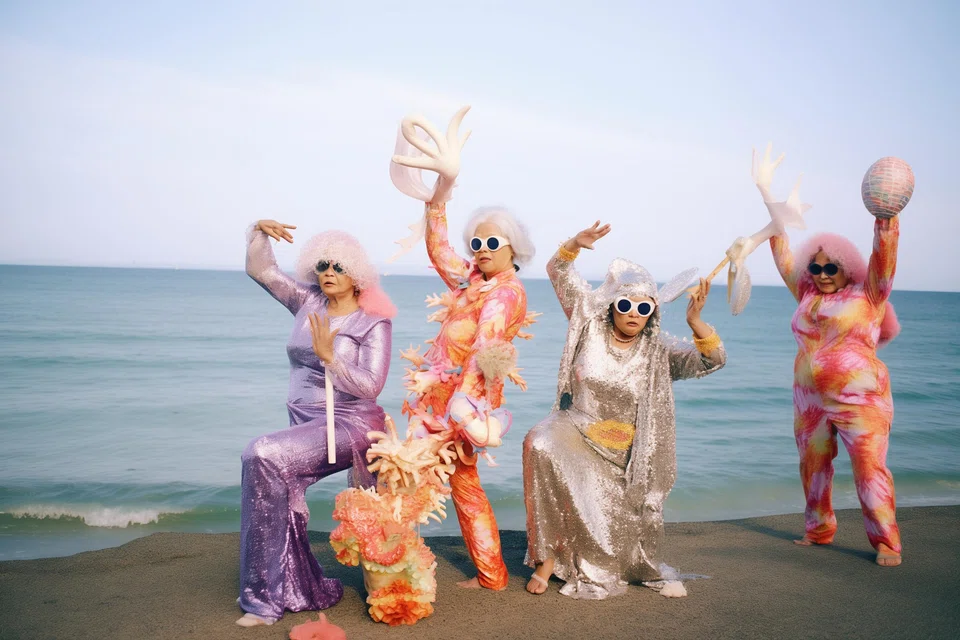
Like Hajar, Lim first got noticed on Instagram. Her account @niceaunties imagines elderly women doing extraordinary things for their age, such as synchronised swimming, martial arts, race-car driving and interacting with weird animals. She generated these images to pay tribute to her 11 aunts, mother and late grandmother – but these AI-generated images have now endeared her to over 54,000 Instagram followers from around the world.
“Some of them have approached me with various assignments and commissions, which include a music video for British pop band Autoheart, and a book cover design for the upcoming sci-fi novel The Rain Artist by Claire Rudy Foster,” she says.
She charges up to a four-figure sum for a still image, depending on its volume and complexity; her animation works cost a four-figure sum per minute.
Having worked in urban design for some 20 years, she says: “I was playing with AI because I’d been considering how to bring the liveliness and enthusiasm back to my architectural work… AI has turned out to be not just a healing salve, but also an income stream.”
Where’s the ethical line?
Her gain, however, is another’s loss.
Legal, moral and ethical debates are raging across the world, precisely because of the job losses AI incurs. In May, DBS held an internal event introducing its employees to AI by getting them to generate images using the technology, and printing them on tote bags. It drew an outcry among Singapore creatives, who felt it would accelerate the loss of income for professional image producers such as artists, designers and photographers.
Elsewhere in the world, lawsuits brought against AI companies have had mixed successes: In California, three artists initiated a class-action lawsuit against the creators of AI art generators Stability AI, Midjourney and DeviantArt. The artists alleged that their works had been used by these companies to train the AI models. But on Oct 30, all but one of the artists’ claims were dismissed.
Legal experts and industry observers say it’s hard to make a case against generative AI. In a sense, all art is inspired by art that already exists, so what’s wrong with machines appropriating trillions of online texts and visuals to generate new art?
However, a different outcome emerged in August, in a federal court in Washington, DC. The court there decreed that AI-generated art – unlike human-generated art – is not eligible for copyright protection. What that means is that any company using AI-generated artwork has no legal recourse if their creations are freely reproduced by other entities.
Rise of the one-person show
Meanwhile, the AI bullet train zips on. Some creatives have become so adept at it, they’ve been able to take up far more work that they used to. Audrey Chia, a copywriter, has been able to leave a full-time job with a company and strike out on her own.
“I’ve wanted to be a creative director since I was 13. But when I worked for traditional advertising agencies, I realised that there are certain structures and hierarchies in place that hindered me from growing as fast as I wanted to.”
When she began using OpenAI’s GPT, she saw incredible cost and time savings of “up to 70 per cent in my own workflow. It’s been able to replace the ‘churn-and-burn’, eliminate various mundane tasks, and simply speed things up”.
Working faster than before in her 11-month-old company she has named Close With Copy, she has landed jobs with clients who are specifically requesting that she work with AI for better outcomes.
She says: “When done the right way, AI can outperform humans by two or three times. With the right prompts, AI-generated content can create landing pages, advertisements and LinkedIn content that converts readers into customers – much better than a human can. It still needs a human to be the one to give it the right instructions, and that’s where I come in.”
She says: “A lot of copywriters use AI the wrong way: They use certain prompts to generate certain texts, then hope and pray that text will have the right effect on the reader. What they get instead are over-enthusiastic, artificial-sounding texts that persuade no one. The right way to use AI is to figure out the positioning of the brand, who the target audience is, what the appropriate tone of voice for the copy is, and so on – and then feeding all this knowledge into AI to create a perfect output.”
The proof, of course, is in the pudding; Chia says she has been able to increase her conversion rates significantly with the help of AI.
“Look, the technology is already here,” she says. “You can either fight the current – or ride the tide. You can adopt AI – or see someone else who’s good at AI take your job.”
To see AI-generated art by Singapore creatives, try these Instagram accounts: @niceaunties @reverse.orientalism @alsoguppyme @eye.em.ai @pebble_ai @briangothongtan
Decoding Asia newsletter: your guide to navigating Asia in a new global order. Sign up here to get Decoding Asia newsletter. Delivered to your inbox. Free.
Copyright SPH Media. All rights reserved.
TRENDING NOW
Grab CEO’s wife Chloe Tong on life with Anthony Tan and finding her purpose
Can Mark Shaw bring Singapore back to Orchard Road and the movies?
Ex-Sembcorp Marine CEO Wong Weng Sun acquitted of charges in Brazil corruption case
He built the Vingroup empire. Now South-east Asia’s richest man is handing some key roles to his sons