Anything but Chardonnay? Try Alsace Pinot Gris
Looking to stray off the beaten track in your choice of a white? You won't go wrong with these, but the drawback is that they need time to mature, and are best drunk after 10 years.
MY favourite complaint is "We are creatures of habit!" Say "white wine" and the first region that comes to mind is Burgundy - Chardonnay. Alsace in north-eastern France, Germany and Austria hardly ever get a look-in.
Habit has produced the battle-cry "ABC - Anything But Chardonnay!" Riesling is hardly ever mentioned, and white varietals such as Tokay may even evoke a "What's that?" response. Sauvignon Blanc? Yes, Cloudy Bay, period.
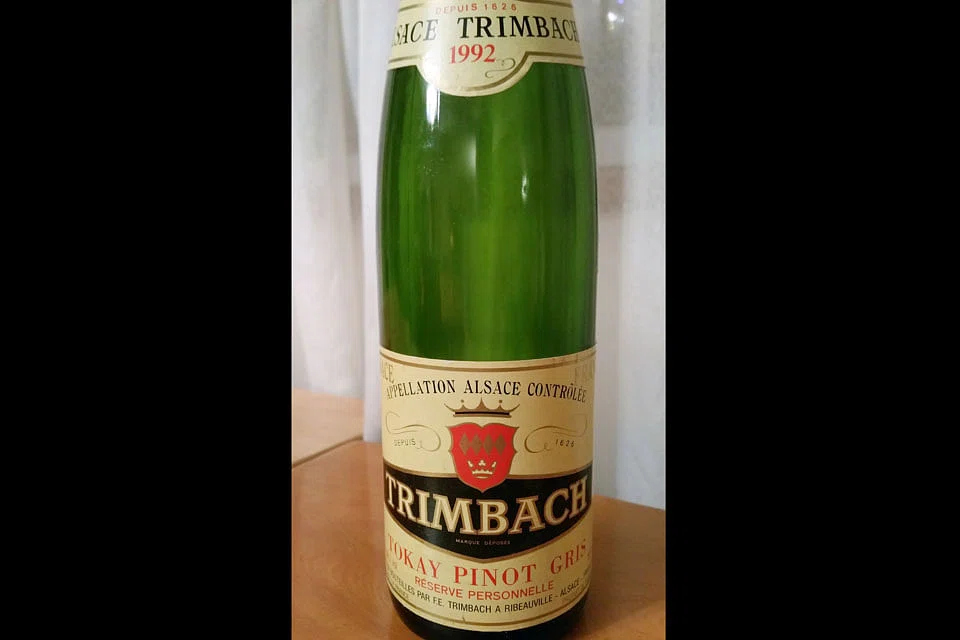
I must confess that I too sometimes have that mental block. So when I was looking for a white wine a few days ago, I was delighted to find one that had not cropped up in my memory for ages - an Alsace Pinot Gris by Maison Trimbach. I had wanted a wine to wash down white asparagus with hollandaise sauce with, and, from my wine notes, I realised that it had been a year or more since I last drank an Alsace Pinot Gris.
Tokay Pinot Gris Reserve Personelle 1992, Maison Trimbach
May 24, 2015. At home, with Italian white asparagus with hollandaise sauce. The wine had been bought in 2001 from local agents.
A brilliant rich yellow, almost golden, warm colour, very enticing and accompanied by an aroma of very ripe fruit, a mixture of melon and orange. Tropical, exotic. Sweet entry on palate, very good ripeness and strong flavours of melon mingled with lemon, orange, intense flavours, full-bodied and underpinned by very good acidity. A lovely wine in glorious prime at 23 years, still very fresh, looking as if it could go on forever.

Tokay is Alsace's food wine, with sufficient fullness and roundness to accompany a meat main course. The grape imported into Alsace around 1565 was initially thought to be from Tokay in Hungary, for the purpose of producing Hungarian-style Tokay in Alsace. But ampelographic studies later showed it to be a Pinot Gris from Burgundy. Its definitive name now is Pinot Gris, the word Tokay being dropped. What distinguishes Pinot Gris is its soft roundness and great foundation of freshness, well exemplified by this Tokay.
The longevity of Alsace Tokay is amazing and worth drawing attention to. Beyer's 1962 and 1967 Tokay Pinot Gris Reserve drunk in February 2006, were both equally amazing.
Pinot Gris Reserve 1962, Leon Beyer
February 2006, 44 years old.
Yellow gold, brilliant; sweet ripe fruit nose, no botrytis, smelled younger than 1967; good ripeness, still very fresh, elegant, holding well.
Pinot Gris Reserve 1967, Leon Beyer
February 2006, 39 years old.
Lovely rich gold colour; rich, honeyed, botrytized nose, very perfumed; lovely mouth feel, good volume and weight, very ripe fruit, slightly smoky, very intense taste, dry, lingering finish.
One point well illustrated by these (and other) wines reported in this column stands out: Wines such as these need time, but that is where the trouble is. As the well-known saying goes: "We have no time to stand and stare."
This sad conclusion was recently highlighted by a top Burgundian producer, who informed his distributors that beginning with the 2013 vintage, he would stop releasing his top Grand Cru until he deemed it ready for drinking. He said: "They are increasingly being drunk too young!"
The same reason was given by Chateau Latour two years ago, when its director Frederic Engerer declared that the Latour would no longer participate in the annual Bordeaux En Primeur campaign each May.
Maison F. E. Trimbach is one of my favourite Alsace producers. Established in 1626 by Jean Trimbach, the family-owned winery is now run by Hubert Trimbach and his brother Bernard. The winery and cellars are in Ribeauville and easily located within the small town; this is its most famous producer.
Visitors are warmly welcomed and if the meeting is pre-arranged, they will be given a tour of the winery and cellars which ends up in their spacious tasting room for a very informative tasting. Hubert Trimbach, a gentleman, used to be Alsace's great ambassador, a great traveller. In his prime, we knew we could expect to receive him in Singapore almost annually, but sadly, ill-health about 10 years ago put a stop to that.
Trimbach's most famous wine is Riesling Clos Ste Hune. It is Alsace's greatest Riesling, and one of the world's greatest wines, bar none. This wine comes from the tiny Clos Ste Hune 1.3 ha vineyard within the 2.6 ha Grand Cru vineyard Rosacker. But Trimbach refused to label their Clos Ste Hune a Grand Cru wine, because the AOC ( appellation d'origine contrôlée) rules stated that the "Clos Ste Hune" name could not be used and the wine would instead have to be labelled "Grand Cru Rosacker". Clos Ste Hune has been known and famed as Alsace's greatest wine for decades before AOC Grand Cru Rosacker appeared on the scene. So Clos Ste Hune it has remained.
Trimbach's other great Riesling is their Riesling Cuvee Frederik Emile, from the Grand Cru Osterberg vineyard, which overlooks their premises. This is another great wine, second only to Clos Ste Hune. This reminds me - I have been neglecting this wine; the last time I drank one, the 2001 in February 2006, it was far too young.
Riesling Frederik Emile 2001, Maison F. E. Trimbach
February 2006, at dinner, at home.
A very youthful pale yellow, beginning to develop the typical Alsace "keroseney" nose which tainted the palate. Still very youthful, very good concentration and balance, too young; needs at least another five years.
The character of Frederik Emile is quite different from Clos Ste Hune. The latter is more refined, has the "filigree" character with which Wilhelm Haag likes to describe his Mosel Rieslings. Frederik Emile, on the other hand, is a more masculine wine, not big or broad-shouldered, denser and tighter.
These great Alsace wines are not expensive, at most the price of a Premier Cru white burgundy. Clos Ste Hune, the equivalent of Burgundy's Montrachet, costs a fraction of the price, about that of a top Burgundy Premier Cru. Again, the drawback is that these Alsace wines, like all great wines, need time. Best after 10 years, better at 15 or 20. One other minor drawback is that the aroma of Alsace Rieslings after seven to eight years acquire that characteristic petrol or kerosene smell, which can be off-putting. But, hold the wine for a few more years, and that disappears. A little patience is required.
And one last point: Alsace wines, except for the odd few bottles of Schlumberger wines, are not available in Singapore. I had to buy the 2001 Frederik Emil and 2001 Clos Ste Hune directly from Maison F. E. Trimbach. London wine merchants are a good alternative source.
Share with us your feedback on BT's products and services