

Applying Rugby Sevens wisdom to the world of investing
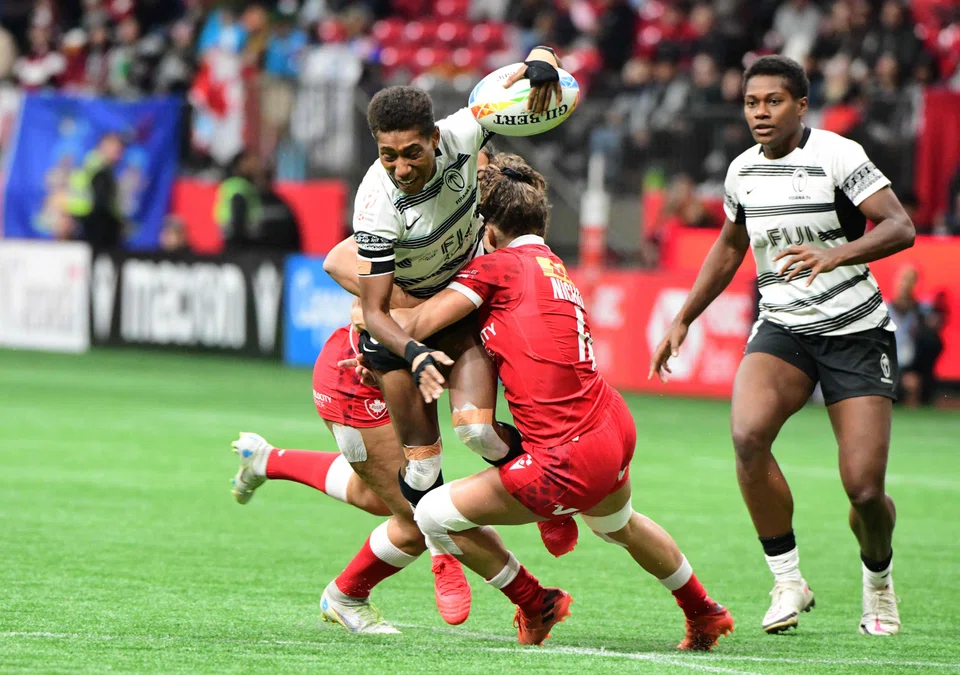
THIS year’s HSBC Singapore Rugby Sevens takes place this weekend at the National Stadium. The Sevens is a shorter version of rugby, but it is much faster and definitely more furious. Each game is made up of two seven-minute halves.
Anything can happen in a game of Sevens, just like the financial market with its many variables and unknowns where the landscape moves and changes every minute. Here’s my take on how rugby principles can guide one’s investment strategies.
Strategise first
Fiji is by far the most successful rugby Sevens team, and they go into every match with a strategy and a formation to win. This is not unique to Fiji, of course, as all winning teams have a strategy that exploits the weakness of its opponents and takes advantage of its own strengths.
The coach of the team is crucial to orchestrate a strategy – the interplay of free-flowing rugby between defense and attack, whether it is close to the forwards; hit big runners through the centre; or kick long and chase hard.
Similarly, investing is highly competitive and risky, especially without a strategy. There is a need to put in place a strategy that suits your investment objective, personal circumstances and risk profile.
For example, if you are a younger investor with a longer time horizon who might have a higher risk appetite, your asset mix can have an option of having a higher allocation to equities compared to bonds.
You need to decide at the onset the right asset mix to achieve your investment goals – how much of your fund is allocated into, and whether income-generating or growth investments suit your goals.
The earlier you start investing with a strategy, the better. This is because the longer your investment horizon, the more time you may have to ride out market fluctuations and grow your investments over the long haul.
It is important to note that there will be short-term market movements that can be nerve-racking.



During such times, there is a tendency for an individual investor to overtrade – sell at the low, or buy at the high. Very often, emotions such as fear will cloud investors to make the wrong decision – taking profits too early or holding on to a loser for too long.
Picking which rugby team to win the Sevens is difficult, and market conditions are similarly hard to predict. Trying to buy low and sell high can be hard, and most investors fail to get any significant returns this way.
A more sensible approach is dollar-cost averaging – investing in a fixed sum of money at regular intervals, whether the market is up or down. Hence, sticking to an asset allocation strategy and using dollar-cost averaging is important when it comes to investing.
Diversity matters
All rugby players are different. Bigger players are invariably stronger, while smaller players tend to be faster. For the Rugby Sevens, there are three forwards (a hooker and two props) and four backs (a scrum half, a fly half, a centre and a winger). Each of them brings their own blend of attributes and quality.
All teams need variety. You cannot have the biggest seven players or the fastest seven players. There is a need to get the right mix and balance.
Even though most spectators prefer a star player to be the one who wins the game, rugby is a team sport that relies on the diversity and collaboration of the entire team. While diversity is crucial to investing, a related aspect is a quality focus.
As the world enters an unprecedented cycle of high inflation and slow growth, idiosyncratic events – just like the recent banking turmoil – can trigger unexpected losses. There is a need to pick quality companies with strong balance sheets that can be more resilient in this environment.
Think of putting together your portfolio like how you might pick the most suitable or top quality players with different qualities to form a dream team.
Be flexible
The team that wins is the one that’s able to adapt to the unexpected such as an injury or a change in their opponents’ strategy.
This is the same with investing. Higher interest rates have created greater unpredictability in markets.
Investors have to be flexible to adapt to these changes. Investments that worked in the past may not work as well in the years ahead. There is a need to be nimbler and to adjust one’s strategy as financial conditions change.
Being conservative
Being conservative can be good for both investing and rugby. While it’s more exciting for fans to watch teams scrum it out and lump balls into the corner for a try, playing safe can often produce better results as many matches are won on penalty kicks.
An analysis of Rugby World Cup games found that teams scored a try from just 9.8 per cent of lineouts taken inside the opposition’s 22-metre line. In fact, against the top teams, if you get a penalty inside the opposition half, you should kick for the post 99 per cent of the time.
Playing safe and staying invested in a well-diversified portfolio may demonstrate resilient results for investing. Sound wisdom for rugby works for investors too. This can make a big difference for an investor’s long-term ability to optimise returns.
The writer is South-east Asia chief investment officer at HSBC Global Private Banking and Wealth.
Decoding Asia newsletter: your guide to navigating Asia in a new global order. Sign up here to get Decoding Asia newsletter. Delivered to your inbox. Free.
Share with us your feedback on BT's products and services
TRENDING NOW

Malaysian king buys stake in Singapore-listed mining firm expanding into rare earths

Grab CEO’s wife Chloe Tong on life with Anthony Tan and finding her purpose

Once staunchly pro-China, Malaysian Chinese businesses are now distancing themselves from Beijing

Longer wait times expected as S’pore healthcare institutions report system disruptions

