

Rare brutalist Singapore house opens to the public before changing hands
Dr Chng Nai Wee studied medicine, architecture, art and finance. His self-designed, art-filled Waterwall House reflects everything he’s learnt

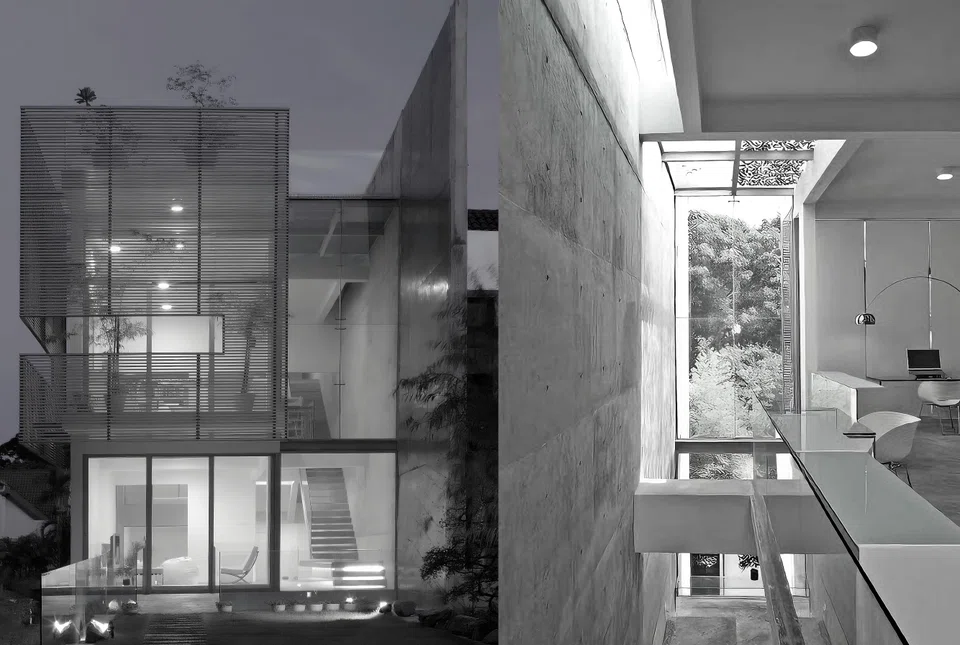
[SINGAPORE] It is rare to find an uncompromising brutalist house in Singapore, let alone one that is open to the public. But that is exactly what Dr Chng Nai Wee’s Waterwall House is doing before it is handed over to its new owner.
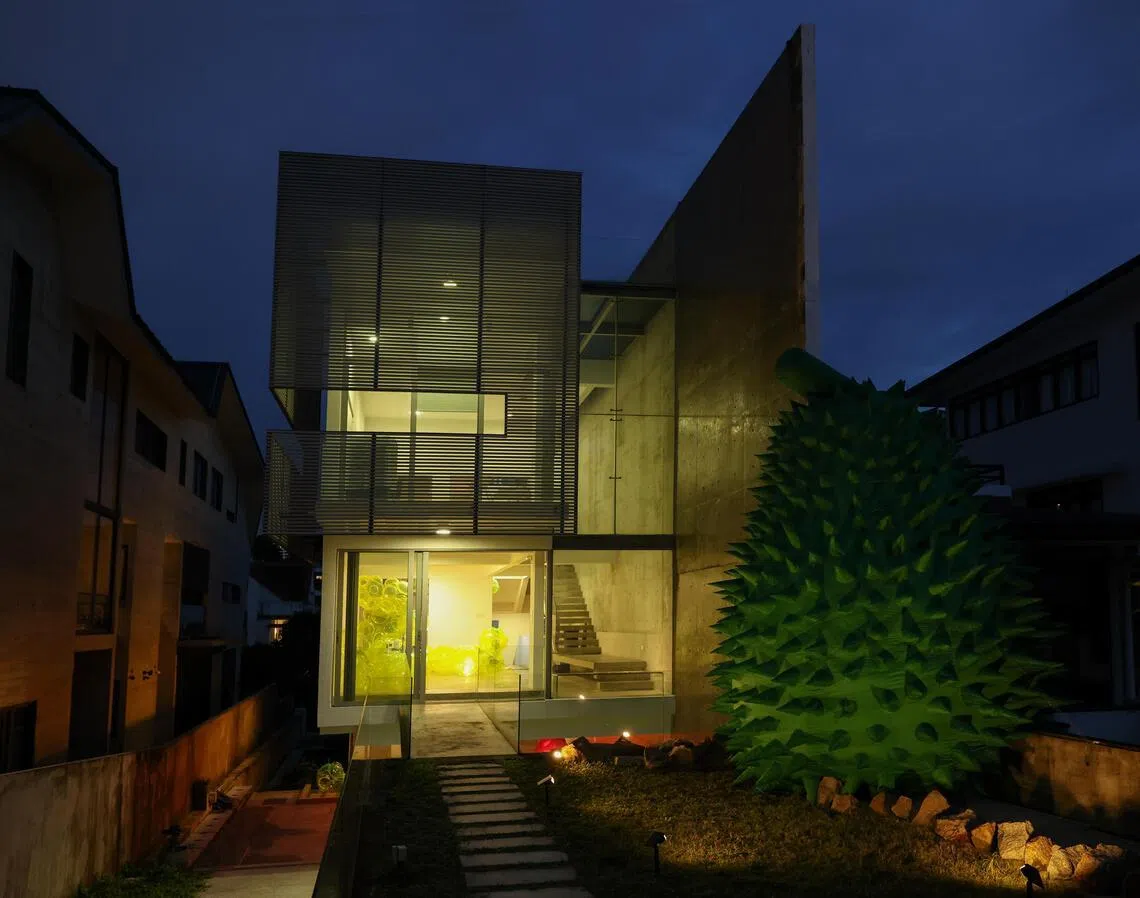
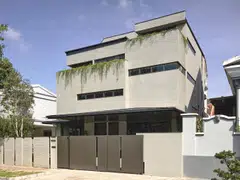
Located at 17 Namly Place, the house has few of the conventional hallmarks of its neighbours, such as ornamental facades and genteel balconies. Instead, it rises as a raw and striking composition of concrete, glass and horizontal screens.
By night, its facade glows like a lantern, the interior lights diffused behind layers of aluminium louvres. By day, the house appears almost monastic: a vertical mass of fair-faced concrete, cut by deep voids, water courts, glass balustrades and shafts of light.
For nearly 20 years, this has been the home of Dr Chng Nai Wee, the Singaporean ophthalmologist, contemporary artist and architecture enthusiast whose life has moved restlessly between medicine, art, finance, technology and architecture.
Now, after selling the property, he is opening it to the public for one final month. He, his wife, Dr Lim Ing Ruen, and their two sons are moving out, though he declines to say where to, or what shape life after Waterwall House might take.
The house is hosting Intermission, a public exhibition of Dr Chng’s own sculptures, paintings and digital works, curated by Sophie Wei-san Miller and Pristine Nael, and presented by Studio Chng. Running till Jul 5, the selling exhibition unfolds inside the home he conceptualised in 2007 with collaborator Atelier Oasis.
But the house is not merely the venue. It is a showcase in itself.
“The reason for holding the show is that I wanted to show the house, which is my own work, and how it relates to all the other parts of my art,” says Dr Chng. “As the house has just been sold, it may not remain in this form for very long. So I wanted to take the opportunity to show those who may be interested in my works and creative process, and understand it as a whole.”
That phrase, “as a whole”, is crucial to understanding both the exhibition and the man. Dr Chng does not treat his disciplines as separate compartments. Medicine, architecture, coding, finance and art all feed a single inquiry: how structures work – whether anatomical, spatial, technological or social.
Organised around water
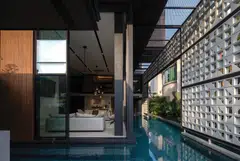
Waterwall House is the most literal manifestation of that impulse. Built on a 4,239 square foot site, the house has three storeys, a basement and a mezzanine. But it does not unfold like a conventional landed home. There is no simple stacking of private rooms above public ones.
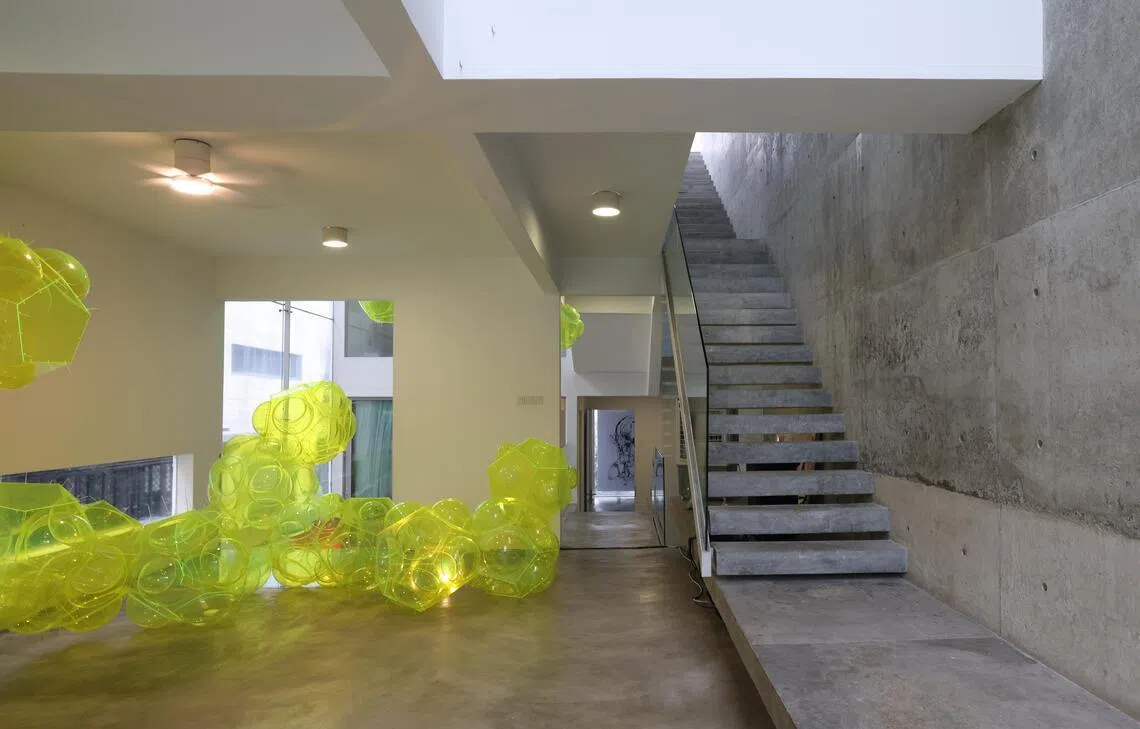
Instead, the house is organised as a sectional journey: stairs, bridges, split levels, glass railings, terraces, light wells and open voids – all anchored by a three-storey fair-faced concrete wall.
Its organising principle is – as its name suggests – water.
“A waterfall cascading from the front wall goes through the length of the house through the basin,” Dr Chng says. Water descends through the foyer into a central pool, then moves across the house into a reflective pool behind.
Elsewhere, glass light wells were designed so that water could cascade down their surfaces, especially during rain.
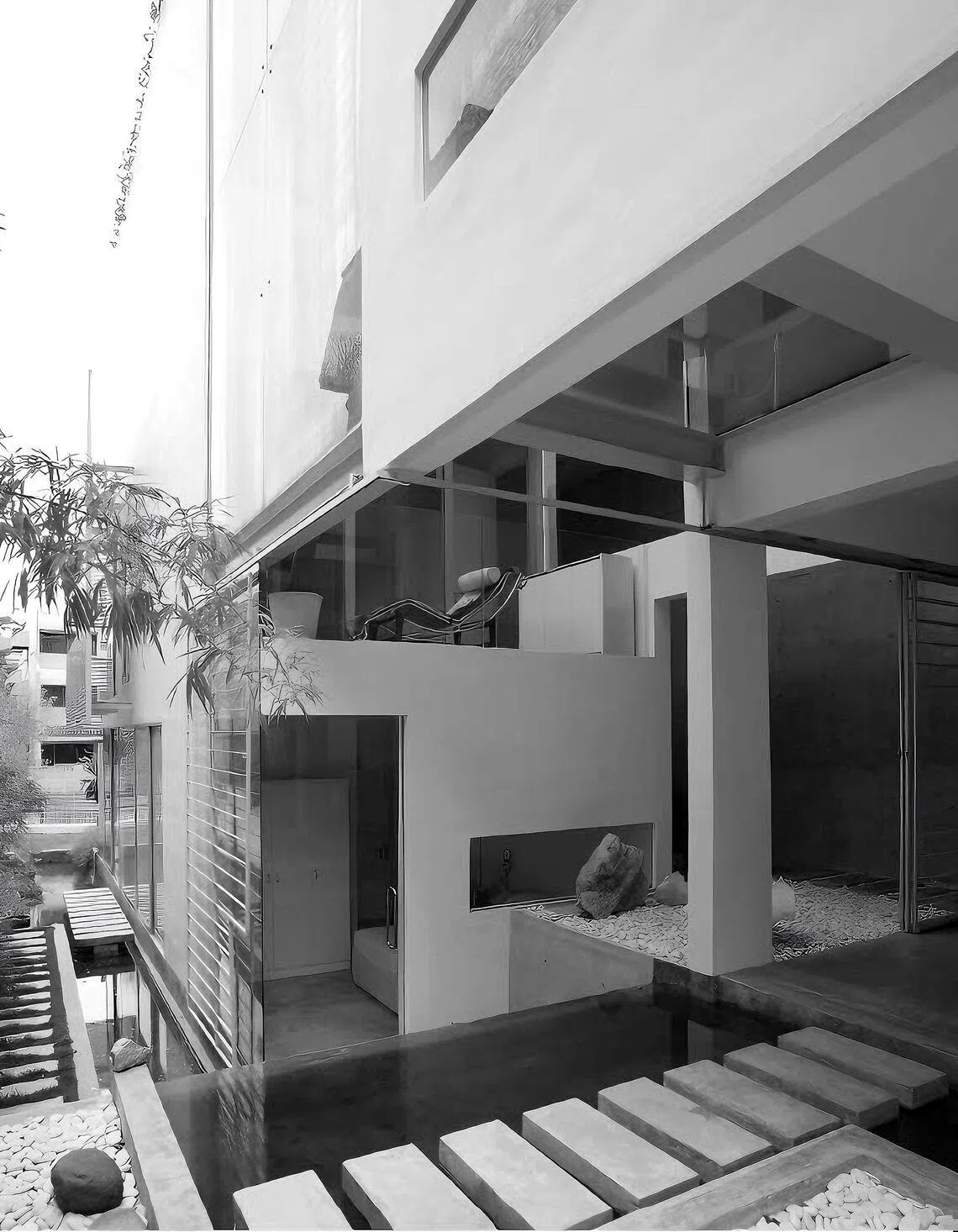
On a bright day, he says, the effect can be unexpectedly theatrical. “You can get all the effects of the water and the light interacting as it passes through,” he says. “Because there’s so much glass, at certain times of the day – such as near noon – you get a lot of little prisms of light, rainbows that are thrown around the house.”
The front screen adds another layer of optical play. Its bars, spaced at close intervals, create what Dr Chng describes as a Moire effect when seen from outside – the shimmering interference pattern produced by two overlapping grids.
“There are many artistic effects or visual effects in the house that are not totally apparent. But now that I’ve mentioned them to you, maybe you can look out for them,” he says, smiling.
The eye as architect
That statement could also describe the art exhibition. At first encounter, Intermission appears to be a show of bold contrasts: raw concrete housing neon acrylic sculptures, severe vertical architecture against bulbous objects.
But there is deeper logic of continuity at play.
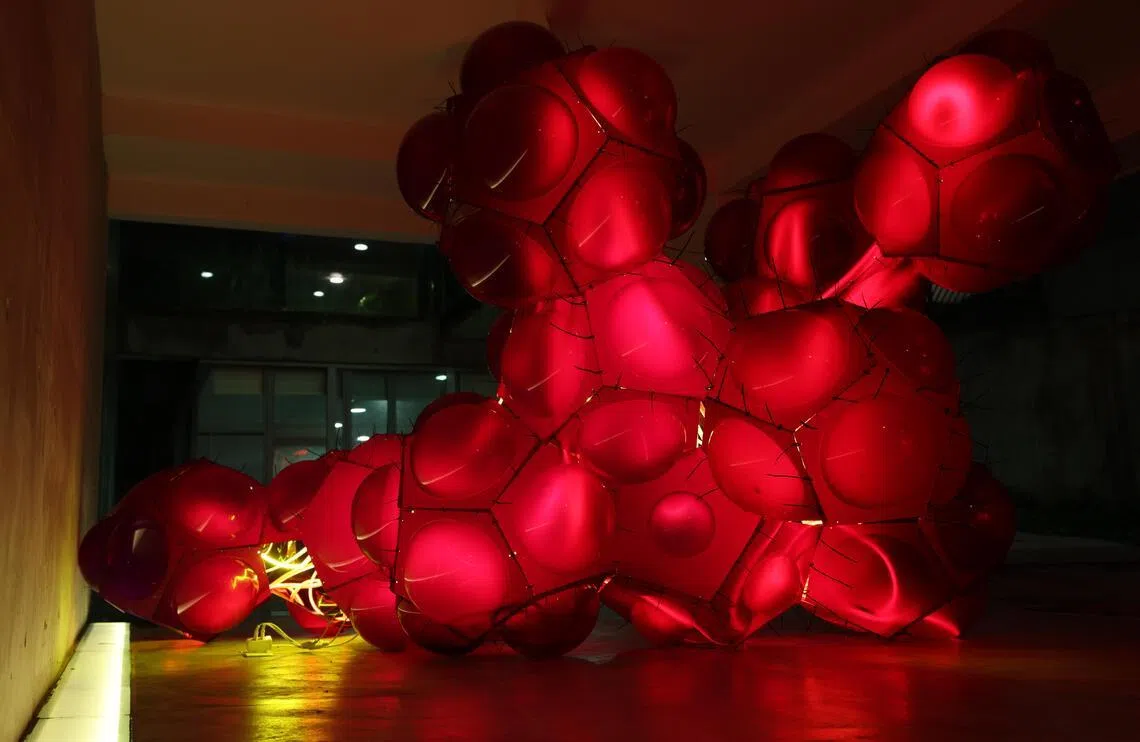
The central work is Moleculux, a two-part installation comprising Luminescent Bodies in Hyperspace and Autofluoromoleculux. Made from fabricated acrylic panels, cable ties and galvanised steel cables, the sculptures draw from molecular geometries, transforming microscopic configurations into architectural scale.
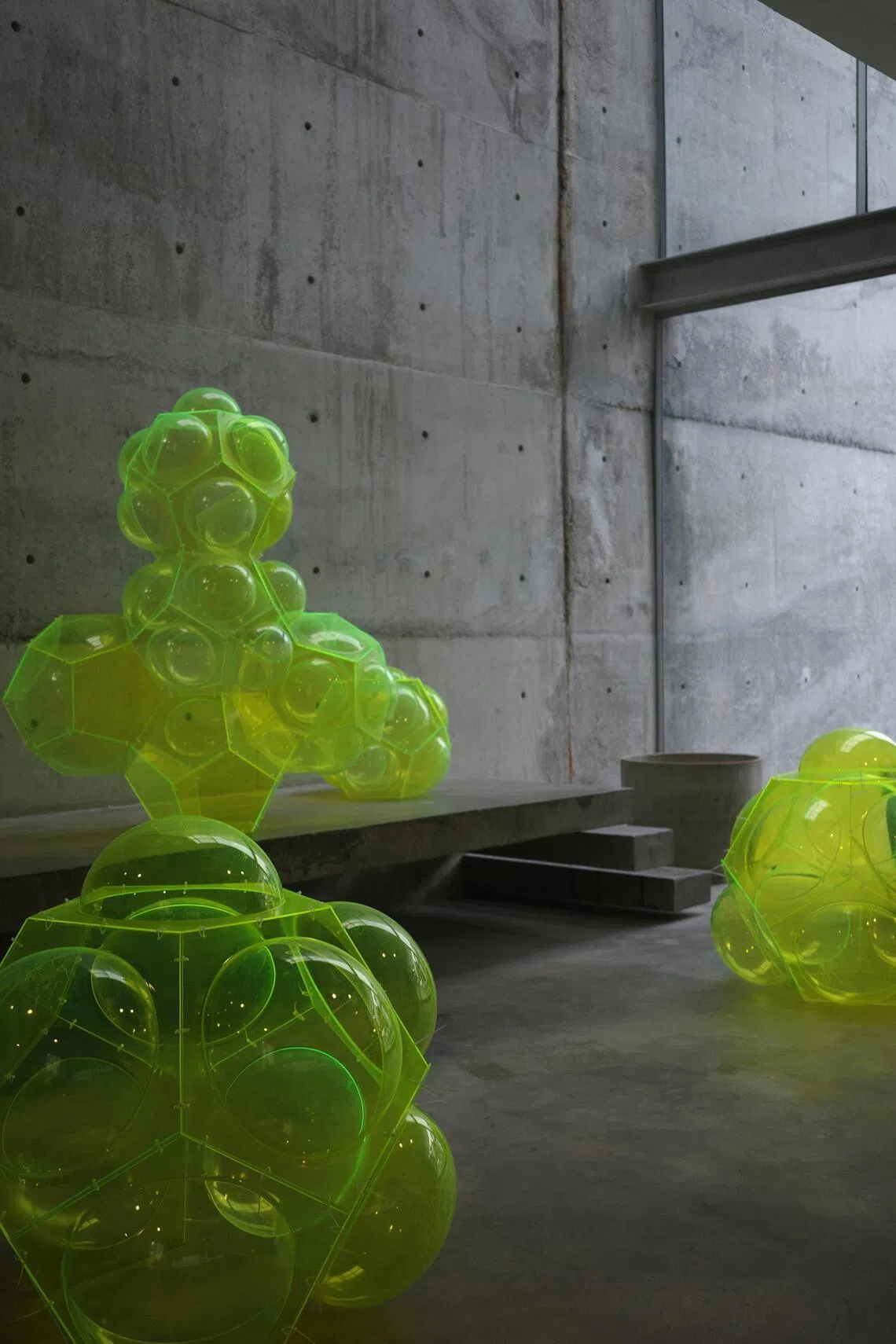
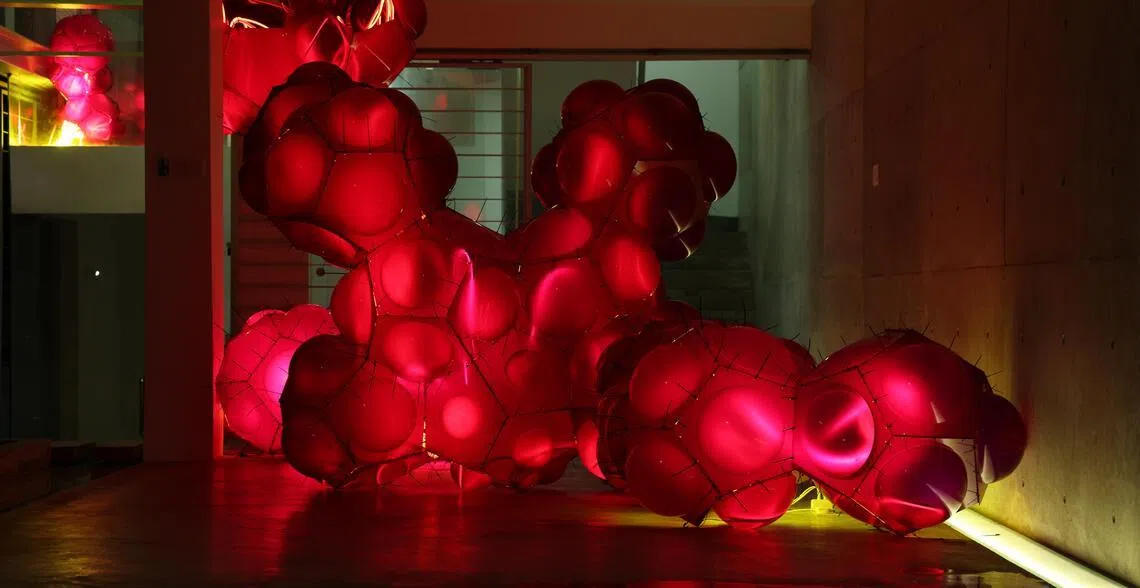
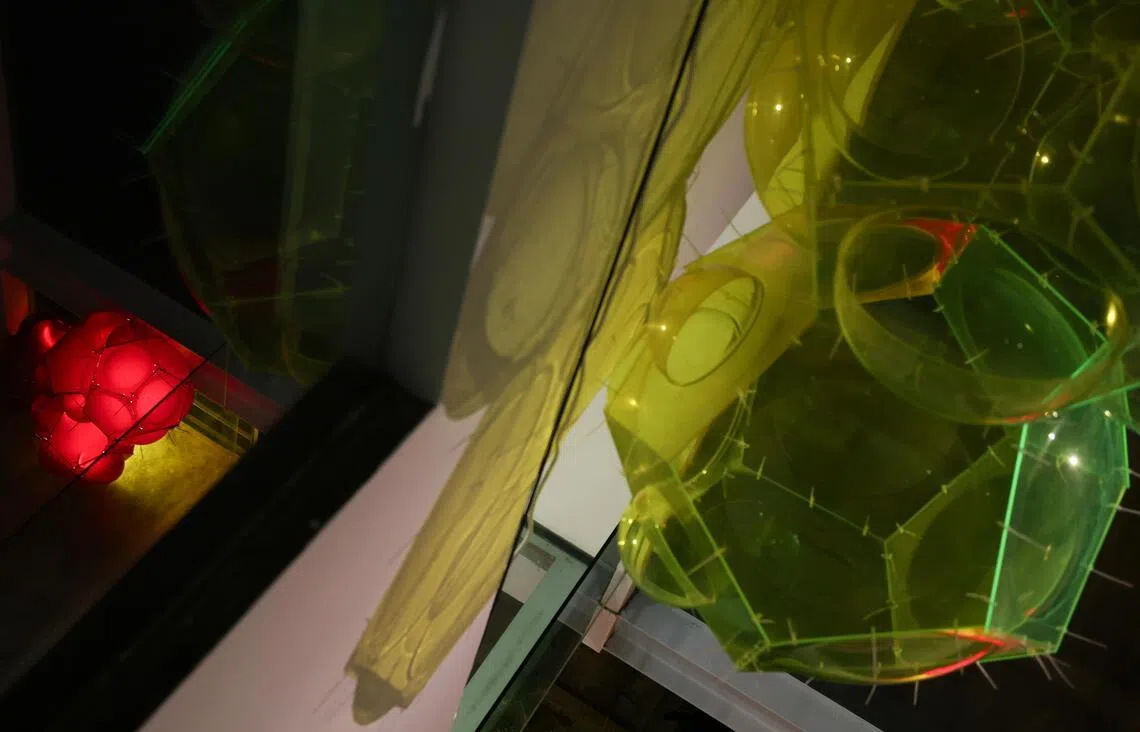
In the house, they appear as translucent clusters – acid yellow-green or glowing red, cellular and synthetic, as if some alien organism has entered the building and colonised its voids.
Dr Chng describes the series as “mutable, modular, scalable”, conceived as an additive system, its parts able to grow and reconfigure across space. While the concrete house speaks in planes, weight and permanence, Moleculux speaks in cells, membranes and light. Yet both are systems of construction.
Dr Chng notes that they are especially transformed at twilight, when changing light conditions alter how they are perceived. “In one moment, you’re looking at volume and form; in another, you’re looking at skeletal delineation of the outlines,” he says. “The red and greens also play on the eye’s opponent theory of colour, producing optical effects.”
It is the ophthalmologist speaking as artist. The eye is not simply a passive receiver of images, but a biological, psychological and cultural system. “There’s a lot of optical principles inside the work,” he says.
Crossing disciplines
Ophthalmology may have been Dr Chng’s vocation, but it has never been his only passion. He studied architecture through graduate classes at the Yale University School of Architecture, an experience that shaped his design of the Waterwall House.
He also took part-time courses in Western painting and was among the first artists in South-east Asia to experiment with multi-channel video installation.
His 2024 video installation MarketForces; Contemporaneous Action In Technology, also included in the exhibition, translates live financial data from Nasdaq into a visual representation of Singapore and Chinese financial markets. Dr Chng wrote most of the code himself, with help from an in-house collaborator.
He has formal training in finance, including the chartered financial analyst programme, and passed futures and securities examinations earlier in life. “All these knowledges are meant to be applied,” he says. “They’re not meant to store inside your head… There’s always the agency to do something.”
That line may be the clearest articulation of his restless interdisciplinarity. Knowledge, for him, is inert unless it is put into motion.
The art of moving through space
The house itself bears the marks of that thinking. It is not the kind of house that obeys the usual demands of landed living in Singapore – maximum floor area, maximum privacy, maximum resale appeal. Dr Chng did the opposite: He recessed volumes, preserved the slope of the land, created voids and split levels, and allowed generous views into the house via its full windows.
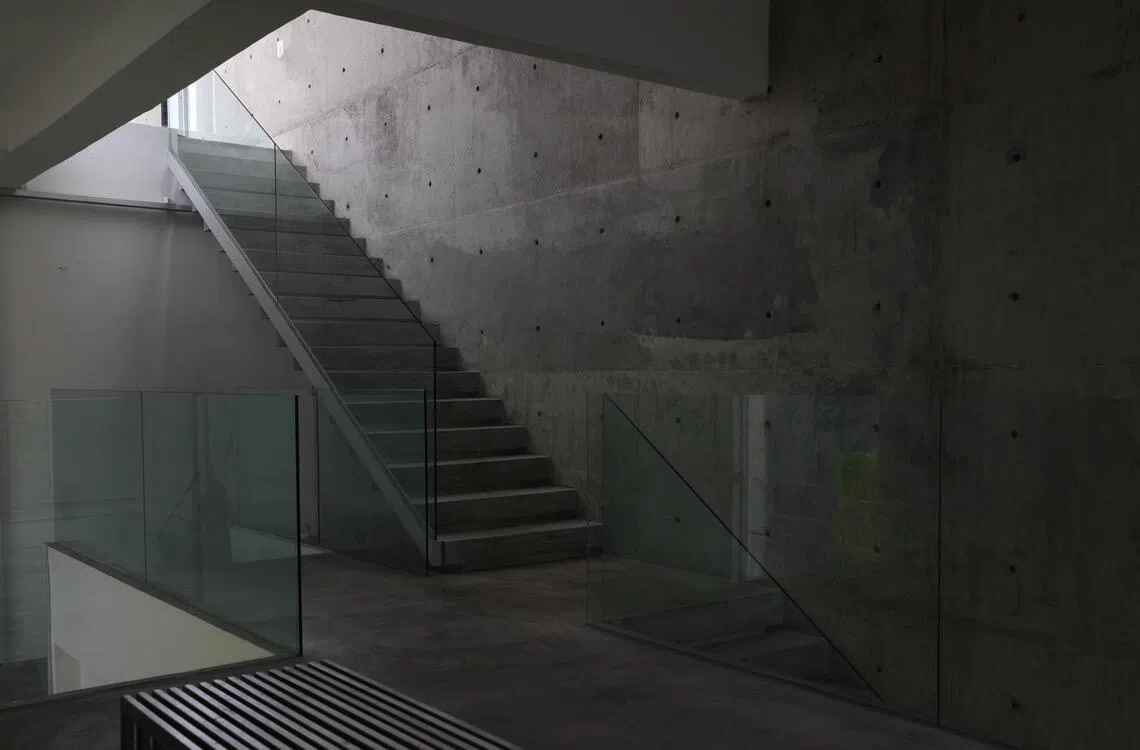
“There are many things that are done in this house that are counterintuitive because I wanted to create a certain kind of navigational experience,” he says.
The result is a house of movement rather than efficiency. The stairs, bridges, split levels and interlocking blocks elegantly choreograph a visitor’s journey, making each ascent, descent and crossing feel deliberate.
Even the stairs take on an Escher-like quality, creating what Dr Chng describes as the sensation of being on “a looping, never-ending journey”. Glass tables and furniture were chosen to echo the architecture, so that they “seem as though they’re integrated to the house”.
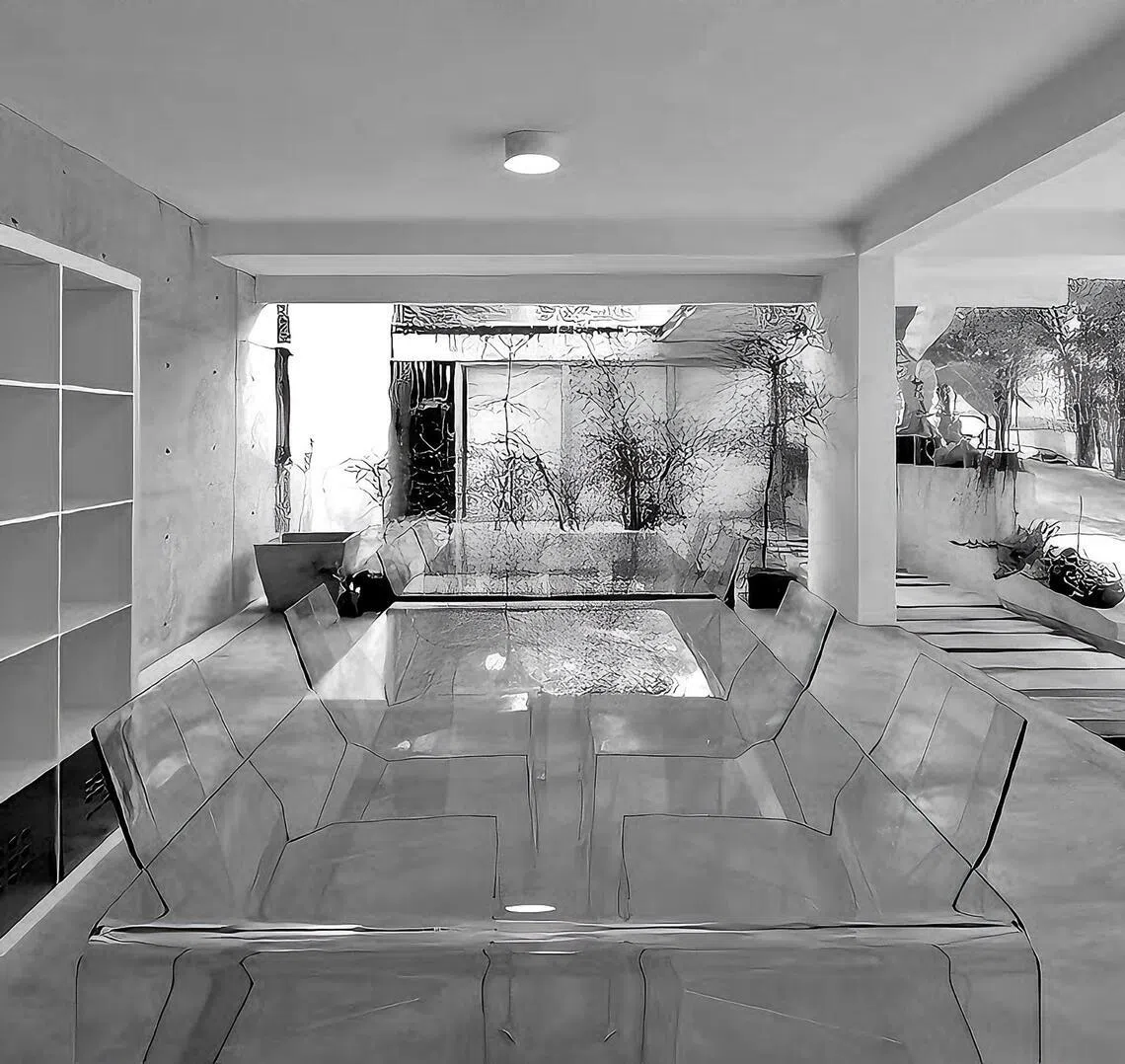
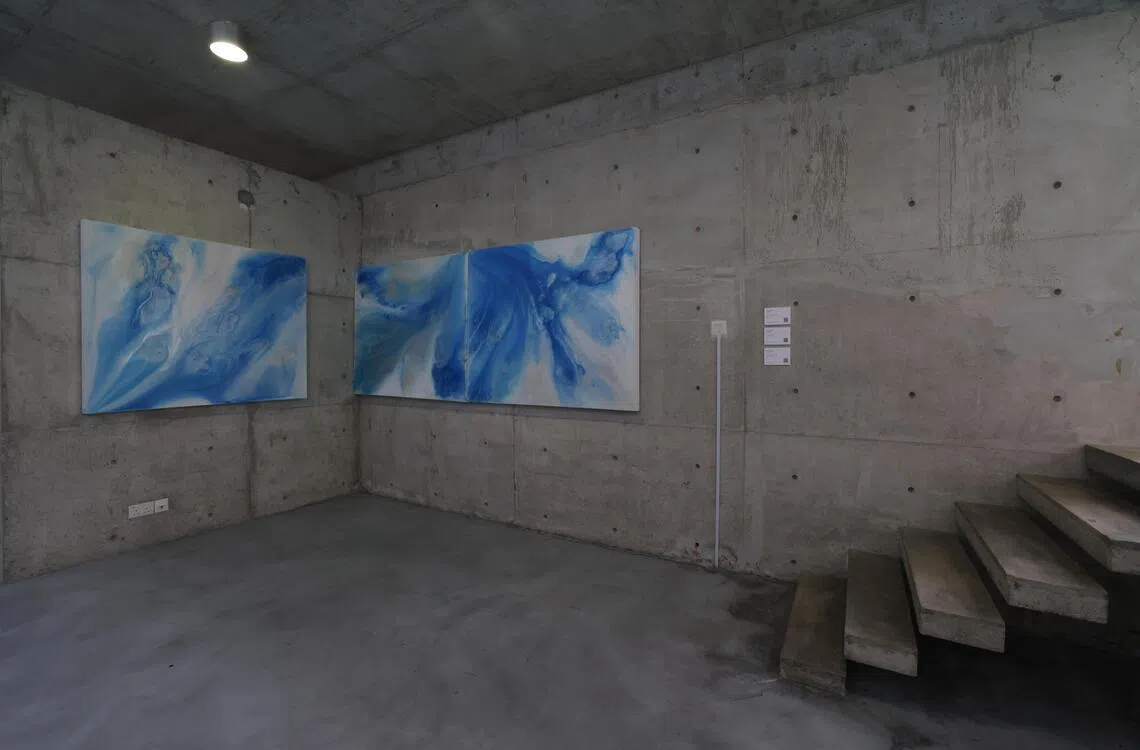
But if one finds the architecture too severe, there is always the art to temper its rigour and geometry. His abstract paintings bring liquidity and colour to the concrete walls, while his inflatable durian sculpture, placed temporarily on the front lawn for the exhibition, injects unexpected humour.
Taken altogether, the house gathers all of Dr Chng’s abiding fascinations – medicine and optics, art and architecture, technology and systems – into a single spatial statement. More than a home, it is a distillation of a creator who has spent his life moving between disciplines.
Intermission runs at 17 Namly Place from now till Jul 5, Tue to Fri , 4 - 10 pm; Sat and Sun, 3 - 9pm. Admission is free.
Decoding Asia newsletter: your guide to navigating Asia in a new global order. Sign up here to get Decoding Asia newsletter. Delivered to your inbox. Free.
Copyright SPH Media. All rights reserved.
TRENDING NOW

DBS, OCBC, UOB rout lops billions off STI as inflation, rate concerns spook investors

Grab CEO’s wife Chloe Tong on life with Anthony Tan and finding her purpose

OCBC sheds S$8 billion in value as shares close nearly 6% down; analysts cautious on banks

Deal between tycoon friends sparks scrutiny of Philippine power sector

