

Thai artist weaves the past, present and future in his works
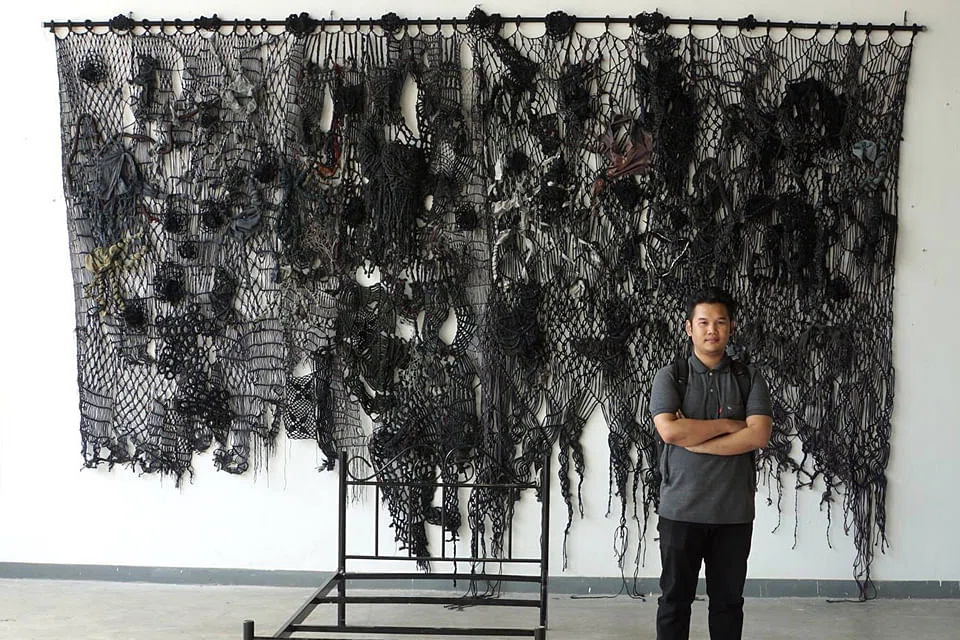
WEAVING, to Thai artist Santi Wangchuan, is more than just knotting and hand-joining threads together to create textile pieces. It's a day-to-day lifestyle and the force which holds the family and community together.
"It ties together our lifestyle, spirituality and occupation; it strengthens Thai traditions and it's an expressive skill," shares the 28-year-old artist who grew up in a multi-generational family of traditional weavers.
He learnt his skills from his grandmother, but after the Masters of Visual Arts graduate from Silpakorn University returned home, he found that he had to re-engage with a dying craft as handwoven baby cribs and beddings became replaced by machine-made objects.
The family business was dissolved and his relatives went on to other jobs, but Wangchuan's fascination with weaving from a social aspect - in the way it's been affected by urban development and how his way of life has changed - grew.
Wangchuan puts up a passionate case for weaving and knitting, asserting that they are no less valuable than other types of craftsmanship. "It deserves to be preserved and passed down. The charm of hand weaving lies in its longstanding sense of order and consistency, which reflects the idea of an orderly, moral way of life."
That it also speaks to the well-being and groundedness of family and community are some of the overarching themes that he seeks to explore and reinterpret in his works. He also uses tools native to his hometown, thereby preserving techniques that could be lost with urbanisation.
"I am interested in the connections between contemporary art and our lived experience. My studio practice is shaped by the techniques that folk artists have used, both as a means of living and a way of life. I am inspired by their creative processes, which are not only harmonious with the environment but also consistent with their cultural beliefs and rituals," he shares in an email interview.
Although weaving is now not in vogue for everyday items, it has resurfaced in Thailand in commercial products such as crochet bags, knitwear and lampshades. "So I feel that it is important that I hold on to the traditional methods that have been preserved in my family lineage," says Wangchuan, who won the "3rd Honoured Bronze Award" at the 61st National Exhibition of Art in Bangkok last year.
He shares how weaving personal items into his works is a cathartic process for him, in order to better create his contemporary art works. "It is not so much a sense of loss. By releasing myself from the sentimental hold that these mementos have, I am better able to interpret and share personal memories of family and tradition in my art. I would like my art to be a reflection of the circle of life itself - what goes around comes around."
Wangchuan believes that his works can have an emotional connection with viewers as they creatively interpret the various weaving patterns as symbolic bonds between family members and our world at large.
The Gift from my Grandmother series is a remembrance of his grandmother's love and commitment to the family, he elaborates.
"Dyeing the weaving rope from scratch, and binding it to various appliances, clothing and other remnants of my grandmother's material life has become a spiritual process for my family and me.
"Whether it is about the loss of a beloved elder or the strength of family ties that keeps us going every day, this work conveys a sense of nostalgia and most of all, familial love."
Share with us your feedback on BT's products and services
TRENDING NOW

Once staunchly pro-China, Malaysian Chinese businesses are now distancing themselves from Beijing
Stocks to watch: HPL, Aims Apac Reit, Zico, Advanced Systems Automation, ComfortDelGro
‘How many will survive?’: Bubble fears arise as China’s humanoid robotics face reality check
Smaller board lots can’t fix a market run by three banks

