

Arts galas show that extravagance never goes out of style
They are costly, labour-intensive and seemingly dated, but cultural organisations say black-tie dinners remain essential to pleasing donors and paying the bills.
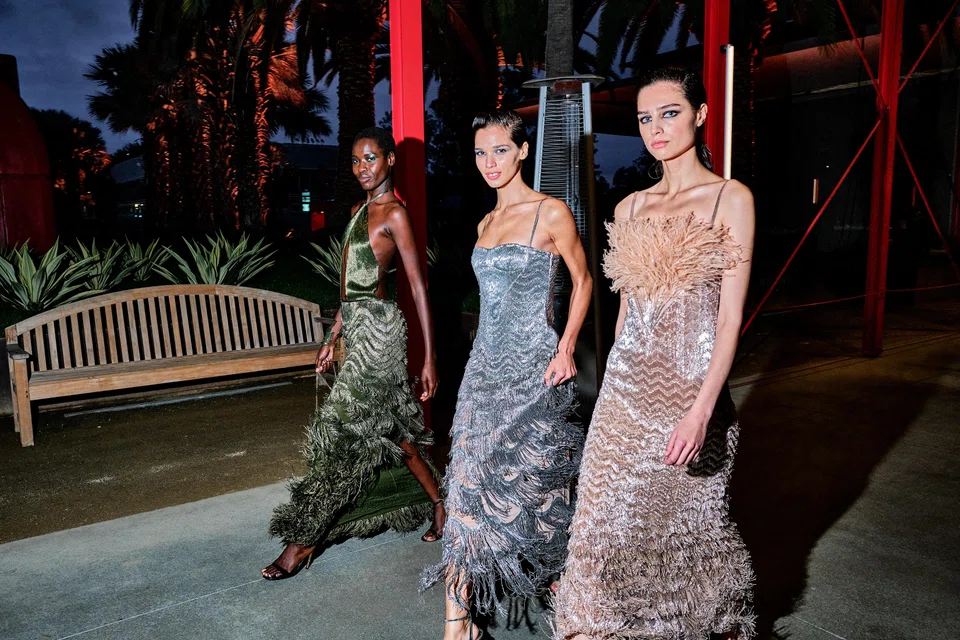
THEY drank salted maple espresso martinis and ate snow crab, Wagyu short rib and passion fruit bonbons.
They watched Kim Kardashian pose on the red carpet in a plunging white neckline. Leonardo DiCaprio charmed them as their host, and Charli XCX pumped them up with her hit song “360.”
But these were not attendees at some glamorous awards show. They were at a benefit for the Los Angeles County Museum of Art.
For its own annual fundraising event, the New York Philharmonic served Skuna Bay salmon and beef tenderloin. The tables were set with Wedgewood blue linens and tall arrangements of hydrangeas and orchids, surrounded by silver votive candles with sprigs of blue delphiniums.
At a time when cultural institutions are still recovering financially from the pandemic shutdown and face rising costs, one might expect their expensive annual fundraisers, first born as 19th century soirees, to have gone the way of top hats and opera glasses.
But even as some administrators question whether galas are worth all the money and effort, most continue to feature them as a mainstay of fundraising, and in some cases have doubled down on extravagance, entertainment and glitz to attract wealthy donors.
As enamoured as Philharmonic fans are of classical music, for example, the New York orchestra made sure its benefit crowd heard Josh Groban singing show tunes along with Giacomo Puccini.
Where an open bar and piped music used to suffice, galas now often feature speciality cocktails, live performers and elaborate decor by event designers.
As a matter of mathematics, the gala’s durability is based on the sizable takes, which for many remain substantial even if organisations are spending more to haul it in. The Philharmonic’s gala cost about US$600,000 and grossed more than US$4 million.



The Detroit Institute of Arts netted close to US$1 million at its gala, which cost about US$700,000; the Museum of Fine Arts, Houston – which has netted about US$3.2 million at its gala, having spent US$400,000; and El Museo del Barrio expects to net at least US$972,000 at its gala next spring, and to spend about US$378,000.
Even when the margins are slim, experts say the events have value as crucial perks for donors and trustees whose giving, year-round, is often some multiple of what they might spend for a table at a gala. It is typically a night where their time and money is celebrated and their stature within the organisation is rewarded by providing them with an opportunity to rub elbows with prominent honorees, featured artists and fellow philanthropists.
“It pulls your support group together for a moment of celebration and recommitment to an organisation when everyone sees each other – it builds an esprit de corps,” said Michael M. Kaiser, chair of the DeVos Institute of Arts Management at the University of Maryland, who used to head the Kennedy Center in Washington. “Many donors are not comfortable fundraising, but inviting someone to a gala is so easy. It’s a very simple quid pro quo and it’s a way for board members to introduce their circle to an organisation without a lot of effort.”
But to make an impact on donors, it helps to have the “wow” factor.
LACMA, for example, has brazenly – and shrewdly – exploited its adjacency to Hollywood with an annual “Art and Film Gala,” which in this year’s 13th iteration honoured filmmaker Baz Luhrmann and artist Simone Leigh. Chock-full of celebrities, it grossed more than US$6 million, having cost about US$3 million.
The Academy Museum Gala this year – which honoured director Quentin Tarantino as well as actors Rita Moreno and Paul Mescal – drew the likes of Nicole Kidman, Kerry Washington and Tom Hanks. It brought in US$11 million after spending about US$3 million.
And many an institution envies the Met Ball, an international fashion event at the Metropolitan Museum of Art that last spring grossed about US$26 million. The co-chairs included stars such as Jennifer Lopez and Zendaya, and the money raised went towards underwriting exhibition and conservation efforts by the museum’s Costume Institute.
The sense of getting VIP access to artists and performances also has an impact, especially for guests less familiar with a given cultural organisation.
“You need to see the work. You need to be in the Koch Theater and see a performance,” said Darren Walker, president of the Ford Foundation, who served on the board of City Ballet. “It is harder to experience the mission of the organisation remotely. “
Reynold Levy, the former president of Lincoln Center and a philanthropy expert, described the gala as an opportunity “to reach beyond the existing fundraising base of an organisation and to increase the giving of existing donors who have the opportunity to show off a little.”
And if you want to attract broader financial support for some of the most cultivated of American arts, it doesn’t hurt to have a few boldfaced names walking the red carpet. Both recent Los Angeles galas received flashy photo spreads in Vogue, People, W and WWD, as did the New York City Ballet’s Fall Fashion gala, hosted by Sarah Jessica Parker, which this year attracted stars such as Brooke Shields, Laverne Cox and Justin Theroux. Tables ranged from US$30,000 to US$200,000 and individual tickets were US$3,000 to US$15,000.
Upping the ante on lavishness is often not a practical strategy for regional museums with smaller budgets that can produce tasteful, warm and well-attended dinners that draw a devoted and sophisticated crowd, but not a lot of celebrities.
The Katonah Museum of Art, for example, held its last gala at Blue Hill at Stone Barns in Westchester, New York, which has a capacity of 250. Last year’s honorees were artist Bisa Butler, to whom the museum gave a solo exhibition in 2020; Jennifer Indig, the founder of the Fern Hill Project, a nonprofit for female entrepreneurs; and Peter W Kunhardt, Jr, the executive director of the Gordon Parks Foundation. Perhaps the best-known celebrity there was Michael Kelly, the actor from “House of Cards.”
For its upcoming gala in March, the museum has landed iconic musician Patti Smith. Nevertheless, given the economics – a cost of US$190,000 and expected net of US$241,000 – as well as the strain on its small staff, the Katonah Museum is considering long-term alternative approaches, such as a series of smaller events with a programmatic element or one elevated cocktail party.
“People want more experiences, want to be able to mingle, and want it to be more fun,” said Michelle Yun Mapplethorpe, the museum’s executive director. “The question is how do you do that and be able to justify such a high ticket to command the revenue you need the event to make for you?
“For a small museum like ours – with limited staff and limited resources,” she added, “you can exhaust the staff if you’re doing these kinds of things.”
Other organisations are also reevaluating. The Portland Museum of Art in Maine, for example, is focusing on its broader fundraising efforts, having moved away from an annual dinner about a decade ago. “A gala does not make economic sense for us,” said Elizabeth Jones, the deputy director. “We may revisit that choice down the road.”
The Charlotte Symphony is repositioning galas as the way it starts each season and “to make some kind of statement of intent about where the orchestra is heading,” said David Fisk, the president and CEO.
“There are people who enjoy dressing up and going out for a special night,” Fisk added. “There is still a role for fundraising and for doing good all in one evening.”
To be sure, there are some donors for whom the prospect of another gala can be tiring, and they might feel tempted to just write the check rather than dress up for another evening making small talk over poached salmon.
“I’m sure that all of us at five o’clock on the evening of a gala at least once have said, ‘Do I really have to go?’” philanthropist Adrienne Arsht said. “But then we go and have a glorious time.”
Some patrons were quite happy during the Covid-19 pandemic when the galas became virtual affairs.
But arts organisations have realised that many donors want, and deserve, a more public acknowledgement, not only of their gifts but of their commitments to the institutions to which they have dedicated years, sometimes decades, of their lives.
“It’s a way to thank your donors, a way to acknowledge your donors,” said Levy, who came under some criticism for having too many galas at Lincoln Center. “I know some people say you can overdo it,” he said. “I personally don’t think so.” NYTIMES
Decoding Asia newsletter: your guide to navigating Asia in a new global order. Sign up here to get Decoding Asia newsletter. Delivered to your inbox. Free.
Share with us your feedback on BT's products and services
TRENDING NOW

If Europe goes to war, the fallout will be felt in East Asia

Indonesia stocks suffer worst plunge in nearly 30 years as MSCI proposes standalone status

Director of PR firm sacked for secretly recording internal meeting loses wrongful dismissal claim

Firms linked to haze pledge cooperation in meeting with Shanmugam; government to table changes to haze law

