

Flesh And Blood
76-year-old Wong Keen, Singapore's first abstract expressionist, is finding fresh inspiration in butcher shops

Helmi Yusof
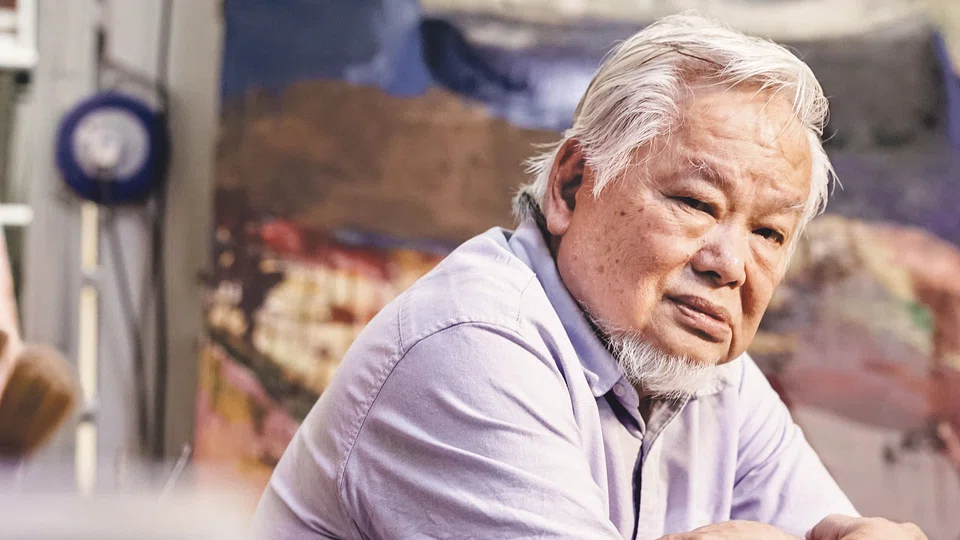
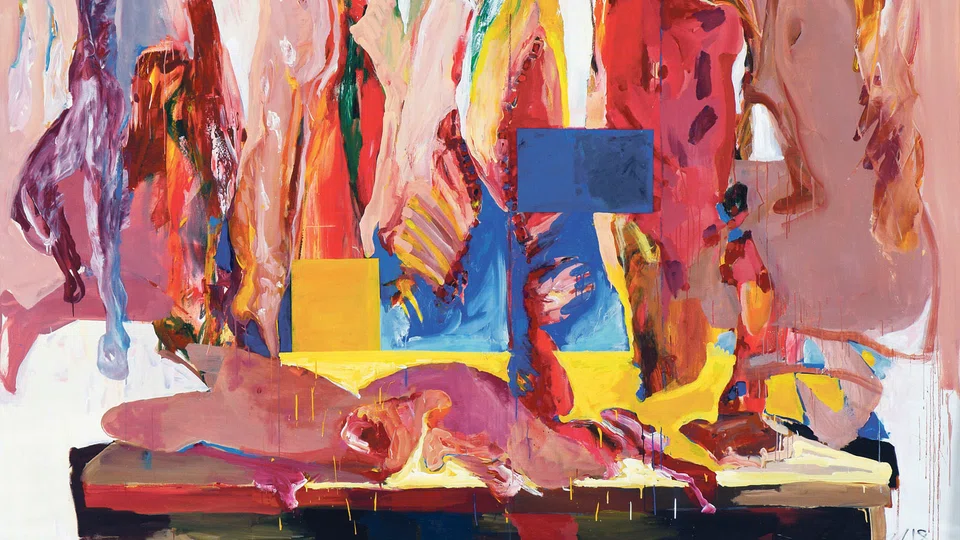
"STILL ALIVE, STILL KICKING" is how Wong Keen replies to the standard greeting of "How do you do?" At 76, the veteran painter has lived a storied life that includes studying under Singapore art pioneers Liu Kang and Chen Wen Hsi when he was a boy, and then moving to New York at the tail end of the Abstract Expressionist movement led by Jackson Pollock, Willem de Kooning and Mark Rothko to study under other great teachers.
Wong would himself become Singapore's first abstract expressionist, spending a good part of his youth in New York to master his craft and run a gallery. Now he balances his time between Singapore and the US, and has just opened a strong new solo show at Helutrans focused on his latest inspiration - the meat shop.
Wong recalls: "I was on a residency programme with Galerie Urs Meile in Beijing when I decided to visit the street markets. When I saw the meat stalls, I was struck by the bursts of colours and textures. Of course, I've been to meat stalls before; I lived in the Lower East Side in New York where there are many butcher shops, but I was never inspired to do any work there. Somehow the experience in Beijing drew me deeper and deeper into the subject matter and it began to really provoke me."
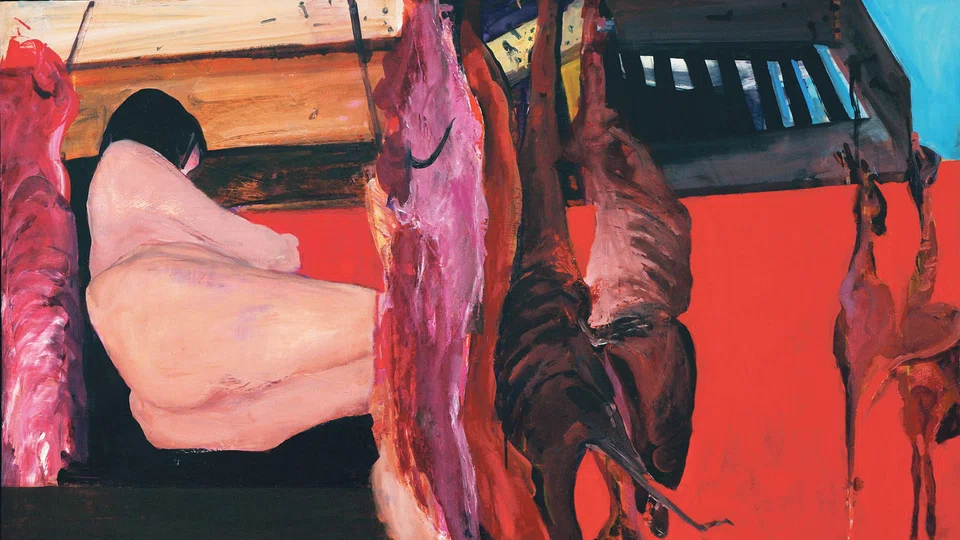
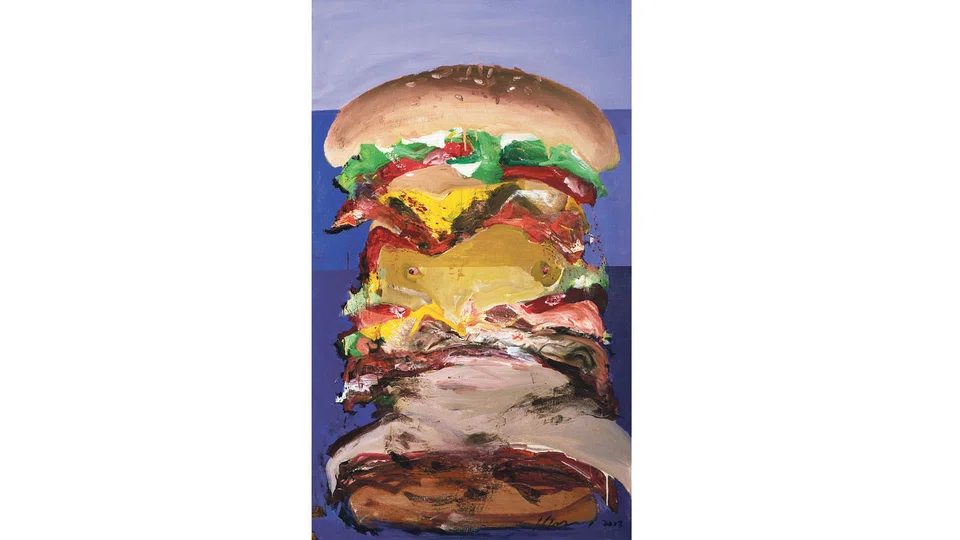
Wong experienced a creative surge, producing dozens of works on canvas and paper centred on meat. His largest is a 6.10 metre by 3.05 metre mural that depicts a vivid scene in a butcher shop with animal carcasses laid out and hung. It's one of the most ambitious works of his career, crackling with a restlessness and immediacy that at once arrests and repels. The work is also one of his priciest, tagged at S$380,000.
Wong says: "I'm fascinated by the shape and form of the cut meat, hung there beautifully; the sharp contrasts of reds, pinks and whites; the regular patterns of the ribs. There are in a butcher shop all the sources and elements for a good painting.
"Beyond that, though, the displays of meat also evoke a truth about humanity, our appetite for blood and violence, our need to kill another living being to feed ourselves, our strong instinct for survival."
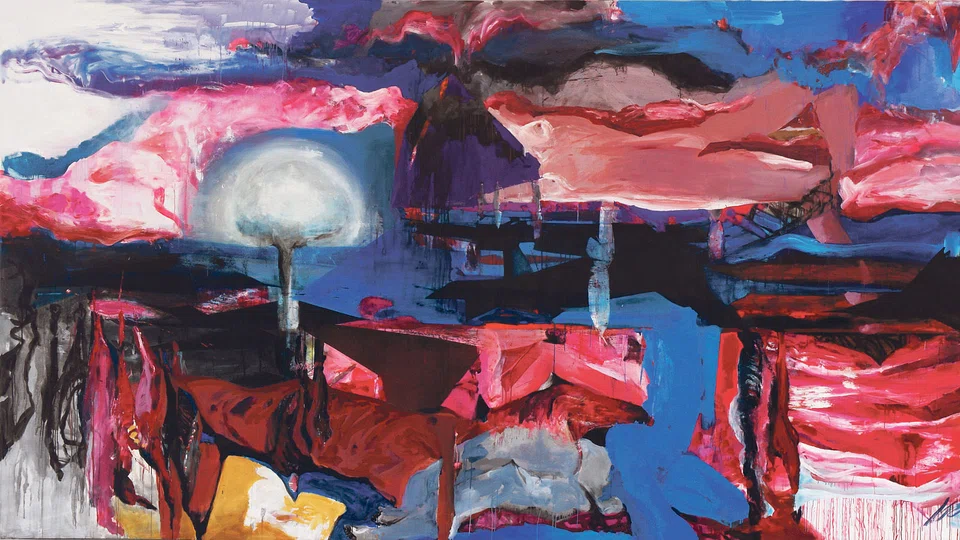
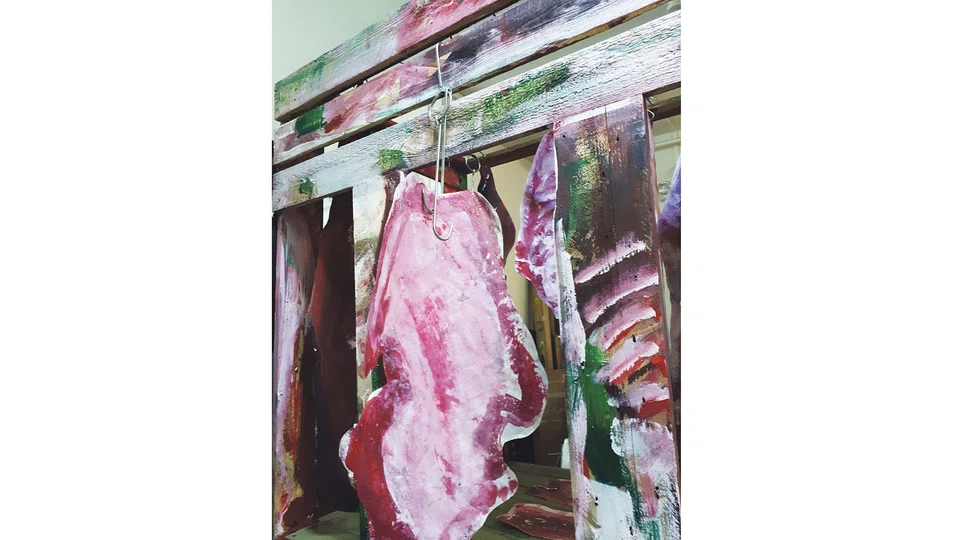
If his 6-metre opus is too large for most private collectors' walls, there are many strong smaller works measuring 2 to 3 metres and priced up to S$135,000. There are also several paper works priced from S$8,000 to S$30,000. Besides these, there are sculptural works - rice paper cut and painted on both sides to resemble slabs of meat and hung in acrylic boxes - that represent his first experiments with three-dimensionality.
The early years
Wong's early start as an artist is worth retelling for its dramatic value: Discovered at an early age to possess artistic talent, Wong was sent to study under the great Liu and Chen who lived not too far from Wong's family home.
After showing his works at various exhibitions where he was always the youngest participant, he left for the US in 1961 and became the first local artist to pursue an art education in New York. He won a place at the Art Students League of New York and studied under important Abstract Expressionist artists such as Sidney Gross, Morris Kantor, Vaclav Vytlacil and Hans Hoffman. He also persuaded other Singaporean artists such as Goh Beng Kwan, Choey Kwok Kay and Yu Tien Cheu to join him in New York.
Wong recalls: "Back in those days, New York was the best place to look at new art. There you'll find the absolute best art and absolute worst art because artists are brave enough to take great risks."
Wong experimented by combining abstract expressionism techniques with Chinese ink painting and earned encouragement from peers and teachers. He admits, though, that when he left school and started painting for profit, he fell on hard times. "Very few of my works sold, so I was broke and depressed."
To continue living there, he ran a picture framing shop by day while painting at night. The business was successful enough to be converted into an art gallery that showed many Asian artists' works for 15 years.
Eventually, though, he closed it. He says: "The truth is, artists shouldn't run galleries, as Chong Huai Seng (his art collector friend and adviser of The Culture Story) said to me once. Most artists are biased, they have their own tastes and practices, they never pick artists based on whether they can sell the works or not - and that's not a good strategy."
By that time Wong had also become more confident about his own practice to paint full-time and mount more solo shows: "There was a time when I looked at the top artists and compared myself to them - and could safely say: I'm not there yet. But today, I assure you, I'm there."
His latest obsession with meat, he says, has allowed him to combine his knowledge of Chinese brush strokes with Western pictorial depictions of meat which stretch from as far back as Rembrandt to Chaim Soutine and Francis Bacon, to produce a personal visual alchemy.
He says: "Some of these paintings may appear to be inspired by Western images and iconography. But if you look closely at the strokes, they can only be produced by someone with knowledge of Chinese ink painting and calligraphy . . . These images combine blood, violence and, in some, even sex. But they also have a certain calm and serenity."
"Flesh Matters" by Wong Keen is jointly organised by The Culture Story and Artcommune Gallery and runs at Artspace@Helutrans from July 14 - 22. E-mail ning@theculturestory.co for enquiries.
Copyright SPH Media. All rights reserved.
TRENDING NOW

OCBC mobile, online banking services restored after Friday afternoon disruption

SGX CEO Loh Boon Chye to step down; succession planning under way

Waymo founder predicts ‘landslide’ robotaxi adoption in Singapore, driven by high car costs

Vietnam’s northern provinces, not Hanoi or Ho Chi Minh City, are powering near 10% GDP growth

