

Banks including JPMorgan relax return-to-office rules amid Europe heatwave
Societe Generale, BNP Paribas, Deutsche Bank and Credit Agricole are among the lenders allowing more flexibility
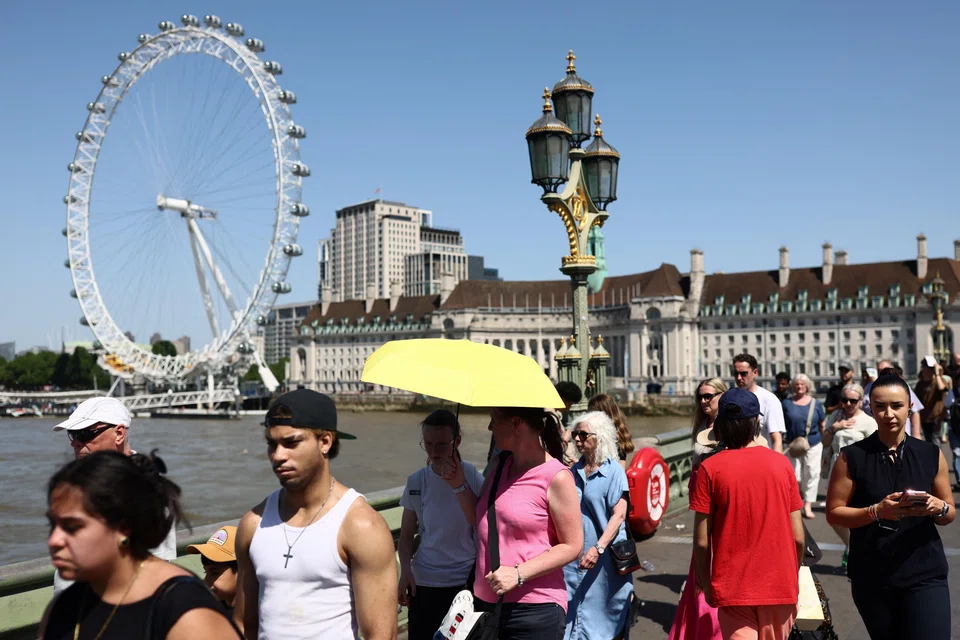
[LONDON] JPMorgan Chase has relaxed some of the finance industry’s strictest return-to-office requirements for its London staff, after the UK capital sweltered through record-high temperatures.
Last month, the bank concluded that the heat wave was serious enough to merit having staff talk through work-from-home arrangements with their managers, according to a person familiar with the situation who asked not to be identified discussing internal matters.
The more flexible approach comes as Londoners have faced school closures and disruptions to public transport after temperatures reached all-time highs for June.
However, there was a smaller-than-expected dent on in-office attendance, which saw a decline of just 15 per cent, according to the person familiar.
The fact that JPMorgan’s London headquarters are air-conditioned while most private homes in the UK are not is likely to have played a role, the person said.
A spokesperson for JPMorgan, which has roughly 13,000 London-based employees spread across offices in Canary Wharf and Victoria Embankment, declined to comment.
The example shows how rising temperatures are impacting professions not usually associated with the physical fallout from extreme heat.
It has long been clear that farmers, builders and other workers whose jobs require them to be outdoors need protections in a hotter world.
But as heat records keep being broken, the risk of economic disruptions across sectors is rising, according to a recent report by Dutch bank ING Group.
SEE ALSO





In London, a major consideration for white-collar workers in recent weeks has been whether to brave train rides that often are not air-conditioned, even if the destination is an office fitted with air conditioning.
The alternative is trying to work in a home that is often built to keep the heat in, with apartments constructed in the past two decades sometimes even becoming heat traps.
“The whole infrastructure of the city would need upgrading for people and businesses to cope well in a heat wave,” says Frances Brown, global workplace sector lead at the engineering consultancy Cundall.
At the London offices of Citigroup, a spokesperson said the bank’s hybrid work model served it well during the latest heat wave.
The bank did not feel the need to adjust its policy even as temperatures soared, with employees already free to decide whether to work from home or in the office, the person said.
In Paris, where the temperature soared above 40 degrees Celsius in June, banks have been relaxing dress codes to make sure employees do not languish in suits designed for a different climate.
In the French offices of at least one global bank, employees have been given permission to turn up in shorts and T-shirts, according to a person who works at the firm’s Paris office who asked not to be identified by name.
And French banks have also responded to record-high temperatures by relaxing in-office requirements, mostly to let staff look after their kids as schools close in the heat, according to people familiar with the matter.
Banks allowing more flexibility include Societe Generale, BNP Paribas and Credit Agricole, the people said. In several cases, employees were allowed to bring their children to air-conditioned offices, some of the people said.
Spokespeople for the banks declined to comment.
Younger bankers who do not have children, meanwhile, have been turning up to work in higher numbers in order to be in air-conditioned spaces, according to people familiar with the matter.
As is the case in London, a key challenge for Parisians making their way to the office to escape the heat is the metro ride, which for the most part is not air-conditioned.
“We’re clearly not ready for this,” said Éléonore Caroit, minister delegate for francophonie, international partnerships and French nationals abroad.
“It is really striking to see how people seem to still be unaware of how hard this is going to hit us.”
In Frankfurt, meanwhile, Deutsche Bank employees are quietly fuming over management’s decision not to include heavy duty air conditioning in a major refurbishment completed more than a decade ago, according to staff members who spoke on condition of anonymity.
But Deutsche Bank expanded work-from-home arrangements during the heat wave for employees in roles that did not require office attendance, they said.
A spokesperson for Deutsche Bank declined to comment.
Unlike their counterparts on Wall Street, bankers in Europe are much less likely to have air conditioning units installed at home.
In the UK, for example, the technology only exists in roughly 7 per cent of homes, while another 8 per cent have cheaper portable units, which tend to be less efficient.
In the state of New York, meanwhile, around 90 per cent of homes have some form of air conditioning.
With Europe as the fastest-warming continent, figuring out ways to keep its population cool during the hottest months of the year is fast becoming a policy priority.
So far this summer, heat records have already been broken in the UK, Germany, Spain and France. And temperatures are likely to keep rising, according to climate experts.
“The stresses that we see today are only going to get worse because heat waves like this ten years from now will be over 40 degrees Celsius,” said Sarah Kapnick, JPMorgan’s global head of climate advisory and a former chief scientist at the US National Oceanic and Atmospheric Administration. “And it will keep going.” BLOOMBERG
Decoding Asia newsletter: your guide to navigating Asia in a new global order. Sign up here to get Decoding Asia newsletter. Delivered to your inbox. Free.
Share with us your feedback on BT's products and services
TRENDING NOW

Once staunchly pro-China, Malaysian Chinese businesses are now distancing themselves from Beijing

Looking beyond looming CEO succession, should UOB potentially pursue a transformative merger?

Could stablecoins be the future of money?

Grab CEO’s wife Chloe Tong on life with Anthony Tan and finding her purpose

