

Bernard Madoff, mastermind of giant Ponzi scheme, dies at 82
 Add BT as a preferred source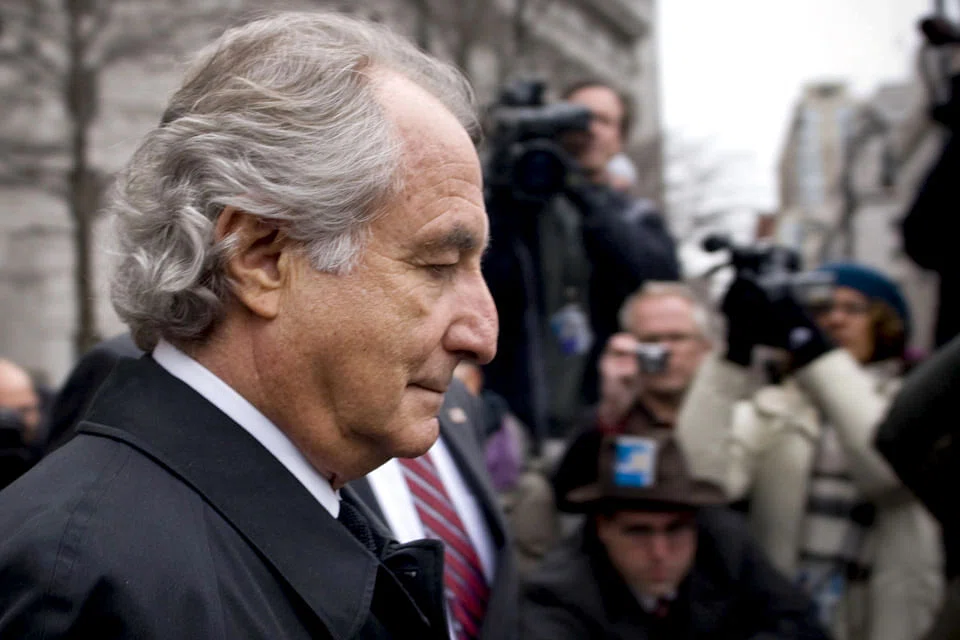
BERNARD Madoff, the Manhattan investment adviser who promised stellar returns to his A-list clients and instead defrauded them of more than US$19 billion in history's largest Ponzi scheme, has died. He was 82.
His death was confirmed by the New York law firm of Brandon Sample, Madoff's attorney. Madoff's home since July 2009 was the Butner Federal Correctional Complex in Butner, North Carolina, where he was serving a 150-year term. He requested compassionate early release, citing end-stage kidney disease, in February 2020.
Like Charles Ponzi, whose 1920 con earned him a place in the annals of crime, Madoff seemed to deliver stunning returns to his clients, when in fact he was paying existing investors with money from new ones.
Unlike Ponzi, who soared and fell in the course of one year, Madoff achieved a level of respect and acclaim among finance professionals - he was chairman of the Nasdaq Stock Market in 1990, 1991 and 1993 - and kept his ruse going for at least 15 years, even under the gaze of regulators who visited his office to inspect his records.
His thousands of clients entrusted him with more than US$19 billion in principal and were led to believe, through fake statements and trade confirmations, that they had almost US$65 billion among them in their accounts. Irving Picard, the trustee appointed to unwind the accounts, had recovered more than US$14.4 billion to partially reimburse clients who lost money.
Madoff's big-name investors included Fred Wilpon, then-majority owner of the New York Mets; husband-and-wife actors Kevin Bacon and Kyra Sedgwick; Henry Kaufman, former chief economist at Salomon Brothers; the late Boston philanthropist Carl Shapiro; two of Europe's wealthiest women, Alicia Koplowitz of Spain and Liliane Bettencourt of France; charitable foundations of director Steven Spielberg and Holocaust survivor Elie Wiesel; and New York and Yeshiva universities.
Contributing to Madoff's facade was the existence of legitimate businesses alongside the fraudulent one at his firm, Bernard L Madoff Investment Securities LLC.
The company's market-making and proprietary trading units, run by his sons and brother, occupied the 18th and 19th floors of the red, cylindrical Lipstick Building in Midtown Manhattan. Madoff's 17th-floor office, where the fraud was run, was off-limits to most employees.
With his promise to deliver steady returns through markets bullish and bearish, Madoff built such a sterling reputation that he had to turn some prospective investors away. He owned homes in Manhattan and Montauk in New York state, Palm Beach in Florida, and Cap d'Antibes on the French Riviera. He sailed on a yacht called "Bull" and lavished jewelry on his wife, Ruth.
The fraud collapsed in December 2008, when plunging equity markets prompted clients to seek more withdrawals than he could accommodate. His sons Andrew and Mark notified the Federal Bureau of Investigation that their father had confessed to them.
"The money is gone," Andrew Madoff quoted his father as telling the family. "It's all been one big lie."
The loss of more than money
Andrew Madoff recalled the quote for Laurie Sandell's Truth and Consequences: Life Inside the Madoff Family (2011), an authorised biography.
Madoff pleaded guilty in March 2009 to fraud, money laundering, perjury and theft. In court, and in later interviews from prison, he insisted that he had run a genuine investment business for many years before finding himself unable to maintain the generous returns his clients had come to expect.
He said that - "to the best of my recollection" - the fraud began in the early 1990s, during a recessionary period for the US economy, and that he "believed it would end shortly and I would be able to extricate myself and my clients".
"As the years went by, I realised that my arrest and this day would inevitably come," he said. Prosecutors said the fraud began in the 1980s, if not earlier.
Though Madoff said he alone was responsible, others also went to jail. His brother, Peter, the firm's chief compliance officer, pleaded guilty to securities fraud and falsifying records and was sentenced to 10 years in prison. Prosecutors said he filed regulatory statements claiming the firm had only 23 accounts, when the real number exceeded 4,000, a lie that helped avert scrutiny by the US Securities and Exchange Commission (SEC). A settlement with the trustee required his family to forfeit assets valued at US$90 million held by his wife, his daughter and others.
Madoff's key lieutenant, Frank DiPascali Jr, and two of his former accountants, David Friehling and Paul Konigsberg, also pleaded guilty. In March 2014, a jury in Manhattan convicted five former Madoff assistants of having aided the fraud. Friehling was sentenced to two years' probation, including a year under house arrest. Konigsberg also avoided prison, agreeing to forfeit US$4.4 million of commissions his firm received for Madoff clients. DiPascali died of lung cancer in May 2015 before his scheduled sentencing.
As for Madoff himself, he lost not just his wealth and freedom but the once-strong bonds of family. The elder of his two sons, Mark Madoff, who had been head of sales at the firm, killed himself on Dec 11, 2010, the second anniversary of his father's arrest. He was found hanging from a dog leash attached to a pipe in the living room of his Manhattan apartment.
His suicide was the final straw for his mother, Ruth Madoff, who said it prompted her to break off all communications with her imprisoned husband.
"I was responsible for my son Mark's death, and that's very, very difficult," Bernard Madoff said in a May 2013 telephone interview from prison, according to CNN Money. "I live with that. I live with the remorse, the pain I caused everybody, certainly my family, and the victims." In September 2014, his son, Andrew, died of cancer.
Madoff underwent surgery to open a clogged artery following a heart attack, Politico reported in March 2014 after interviewing him at the prison. At that time, Madoff said he was on medication for his heart, kidneys, blood pressure and anxiety, and also was undergoing weekly counselling.
Driven, in the wrong direction
Bernard Lawrence Madoff was born on April 29, 1938, to Ralph Madoff and the former Sylvia Muntner, known as Susie. He grew up in the middle-class Jewish neighborhood of Laurelton, in the New York borough of Queens, with an older sister, Sondra, and a younger brother, Peter.
He left home for the University of Alabama, lasting six months before transferring to Hofstra University on New York's Long Island. He graduated in 1960 with a degree in political science. By then, he had married Ruth and filed papers to open Bernard L Madoff Investment Securities.
He tried a year at Brooklyn Law School before devoting himself full time to investing. He and his wife settled in Roslyn, on Long Island, to raise their two sons.
From his firm's first Manhattan offices, at 39 Broadway, then at 110 Wall Street, Madoff traded penny stocks and participated in the push to computerise the over-the-counter market.
"I was very driven," Madoff said in a 2011 interview with the Financial Times. "But I was always outside the club, the club being the New York Stock Exchange and white-shoe firms. They fought me every step of the way." BLOOMBERG
Decoding Asia newsletter: your guide to navigating Asia in a new global order. Sign up here to get Decoding Asia newsletter. Delivered to your inbox. Free.
Share with us your feedback on BT's products and services
TRENDING NOW
Orchard plot, Jurong East EC, Raffles Town Club site among 10 new housing parcels in H2 GLS plan

TikTok billionaire overtakes Mukesh Ambani as Asia’s second-richest person
Uber cuts 23% of people division as new president takes charge

Meta launches enterprise-focused AI ‘business agent’ to automate daily operations

