

Bonnie Tyler, who sang ‘Total Eclipse of the Heart,’ dies at 75
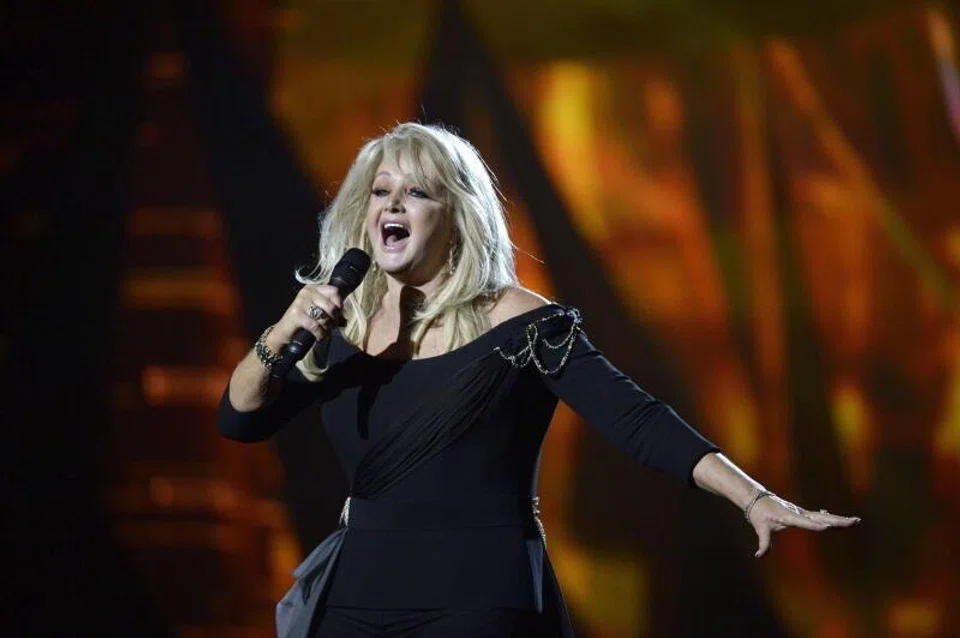
[LONDON] Bonnie Tyler, the Welsh singer who, with a frosted, teased-up coiffure and a voice both weathered and operatic, soared to number 1 with Total Eclipse of the Heart, one of the titanic pop anthems of the 1980s, died on Wednesday at a hospital in Portugal. She was 75.
The cause was an illness, according to a post on her official Facebook account. She underwent emergency intestinal surgery at a hospital in Faro, Portugal, where she had a home, the Facebook account said in May. She was temporarily placed in a coma and remained in intensive care afterward, it said.
Tyler reached her commercial zenith with a handful of hits at the peak of the MTV era, none more indelible than Total Eclipse.
That pounding power ballad, with its repeated plea to “turn around, bright eyes,” evoked the hunger of unrequited love and was written by Jim Steinman, who Rolling Stone once called “the lord of mega-pop overkill.” Now firmly entrenched as a cultural mainstay, with listenership inevitably spiking during eclipses, it has over 1 billion streams on both Spotify and YouTube.
Riding a blend of country, pop and rock, with a gravelly voice that could match Rod Stewart or Kim Carnes pebble for pebble, Tyler emerged from the Welsh pub-rock scene in the mid-1970s. She scored her first worldwide hit in 1977 into 1978 with It’s a Heartache. A loping ballad about love gone wrong, the song was drawn from her second album, titled It’s a Heartache in the United States and Natural Force in Britain.
She had plenty of competition with the song, as future country star Juice Newton and onetime girl-group standout Ronnie Spector released their own versions in 1978.
But it was Tyler’s cut that topped charts in Australia, Canada and throughout Europe, rising to number 3 on the United States pop chart and number 10 on the country chart.
Making it in America was no small deal for the shy daughter of a coal miner. “It was great, getting in the limo and you’re fixing with the radio stations, and you’re on just about every station,” she recalled in a video interview decades later. “It was like, ‘Put the windows down, that’s me!’”
Still, little could have prepared her for the smash success of Total Eclipse of the Heart, a song she only had a crack at through a stroke of luck for her – and bad luck for Meat Loaf.
In the early 1980s, Tyler was signed by Sony, and wanted to move from her country-inflected early sound toward something more arena-worthy.
After seeing Meat Loaf singing on TV, she told Muff Winwood, a producer at the label, that she should work with Steinman, who wrote all the tracks on Meat Loaf’s blockbuster 1977 debut album, Bat Out of Hell, including the hits Paradise by the Dashboard Light and Two Out of Three Ain’t Bad.
“Muff looked at me like I was barmy and told me that Jim would never do it,’” Tyler later recalled. “‘I just want you to ask him,’ I said.”
Intrigued by her voice, Steinman invited her to his apartment in Manhattan to run through Total Eclipse of the Heart – which, he told her, he had originally written for an unfinished musical about the vampire Nosferatu.
With its rock-opera bombast bordering on the Wagnerian, the song seemed like a natural fit for Meat Loaf. But “around the time we were recording,” Tyler later told The Guardian, “Meat Loaf had lost his voice.”
So Steinman gave it to her instead, to use on her 1983 album Faster Than the Speed of Night, on which he was a producer.
“After it was a hit,” Tyler recalled, Meat Loaf “always used to say: ‘Dang. That song should have been mine!’”
Tyler earned Grammy nominations for both the song (best pop vocal performance) and the album (best rock vocal performance). In 2023, Rolling Stone listed Total Eclipse at number 56 on its survey of the 200 best songs of the 1980s, describing it as “Power Ballad Armageddon.”
Gaynor Hopkins was born on June 8, 1951, in Skewen, a village in South Wales. She was one of seven children of Glyndwr Hopkins, a coal miner, and Elsie (Lewis) Hopkins. (She adopted her stage name in the 1970s to avoid being confused with another Welsh singer, Mary Hopkin).
In a 2012 interview with The Guardian, Tyler recalled growing up in a musical household. She took an early interest in singing, and her mother counselled her, “Believe in yourself, because no one else is going to do it for you.”
She left school at 16 and worked at a grocery store while dreaming of a music career like that of her idols Janis Joplin and Tina Turner.
She gained experience singing with local R&B bands and eventually was discovered by a talent scout while performing at a club in Swansea, Wales, in 1975. On the strength of solo demos, Tyler earned a contract with RCA.
“I can’t help it if I’ve got a husky voice,” she added, referring to the mature burr her voice had taken on after she had surgery in 1977 to remove nodules on her vocal cords.
In 1973, she married Robert Sullivan, a British judo Olympian turned property developer. In the late 1980s, they settled in the Algarve region of southern Portugal. In 2023, she published an autobiography, Straight From the Heart. NYTIMES
Decoding Asia newsletter: your guide to navigating Asia in a new global order. Sign up here to get Decoding Asia newsletter. Delivered to your inbox. Free.
Share with us your feedback on BT's products and services
TRENDING NOW

Once staunchly pro-China, Malaysian Chinese businesses are now distancing themselves from Beijing

‘How many will survive?’: Bubble fears arise as China’s humanoid robotics face reality check

Philippine power giant First Gen rebuffs foreign offers, plans up to US$2.6 billion in expansion

Indonesia imposes US$116 million in fines over manipulation of Sinar Mas, Prajogo-linked stocks

