BOOKS

Booker Prize finalist: Held traces grief, memory and longing across four generations

In lyrical language, Anne Michaels reflects on how we carry the dead with us, and how their memories leave a permanent imprint
Published Thu, Oct 31, 2024 · 06:30 PM
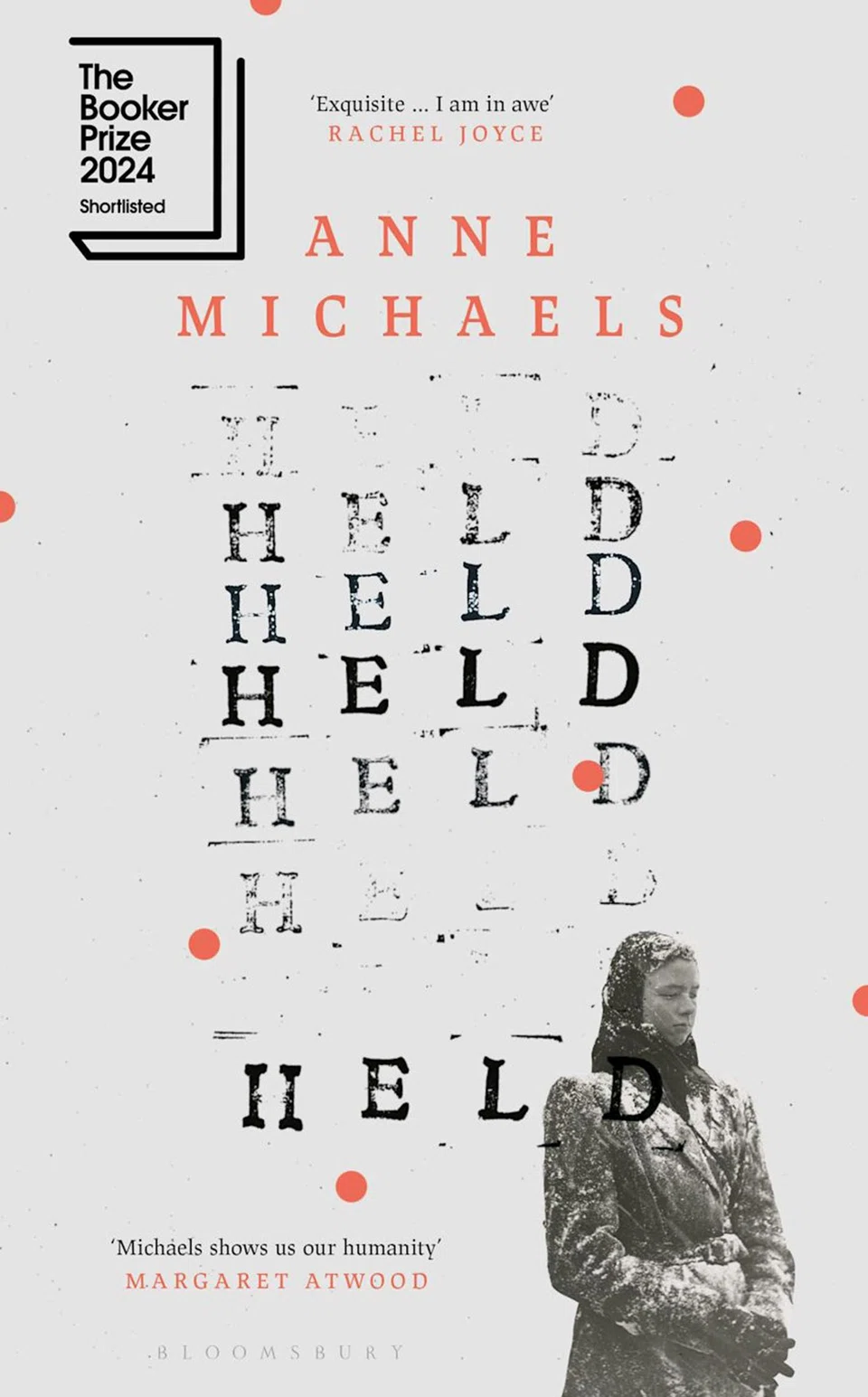
    • Held by Anne Michaels. The author's poetic language captivates and leaves readers with profound quotes to ponder.
    • Held by Anne Michaels. The author's poetic language captivates and leaves readers with profound quotes to ponder. PHOTO: KNOPF

    CANADIAN author Anne Michaels’ Held spans over a century, guiding readers through a wide array of settings – from a World War I battlefield to the Gulf of Finland in 2025. The novel unfolds in interconnected vignettes, each introducing a new place and a set of characters across four generations. Gradually, readers discover subtle links between these characters, creating a web of connections that binds the narrative.

    Michaels uses poetic language throughout, with the text of some chapters broken up into lyrical snippets to reflect the characters’ experiences. (Michaels was a poet before she became a novelist.)

    For example, John, the first protagonist, reflects on his traumatic experiences as an injured soldier during World War I through brief snippets, showing how fragmented and scattered his mental state was during such a tumultuous period. The novel also employs rich metaphors and rhetorical questions to demonstrate his conflicted mind.


    Following the war, John starts a photography business, but he continues to be haunted by his experiences. The deceased loved ones of the people he photographs start appearing as apparitions in their portraits – a reminder that those we have lost never really leave us. 

    Many characters in subsequent chapters must leave home to work, and their loved ones have to deal with their absences. For instance, John’s daughter Anna and her own daughter Mara both work as doctors in war-torn areas, experiencing a similar calling to do good. Mara feels her mother’s presence as she carries out her work, reiterating the theme of how we carry the dead with us for most of our lives.

    Another central theme is how love and human connection help the characters through times of grief, chaos or tumult – whether in war zones, a totalitarian state or a refugee camp. The characters rely on a strong support network or hold on to memories of loved ones to help them endure the worst. Letters and photographs serve as vessels of remembrance.

    Asean Intelligence

    Get insights into businesses across South-east Asia

    Get the free report

    After the first few chapters with John as the focus, Held becomes challenging to read as more characters are introduced, and the non-linear narrative jumps between time periods. We start with John and move on to his direct descendants. But towards the end, the linkages between the characters become less explicit, and readers find themselves becoming increasingly detached from the characters and settings.

    Even iconic scientist Marie Curie makes a surprise cameo, which Michaels explained in an interview as an exploration of “our conflation of science with technology” – even though this theme is not apparent in the novel.

    Despite its narrative and thematic complexity, Michaels’ poetic language captivates and leaves readers with profound quotes to ponder, such as: “The mechanism that disproves something is also the very mechanism of proof, and what we do not believe teaches us what we do believe.”

    Held may demand focus and patience, but its lyrical language often invites reflection and reverence.

    Decoding Asia newsletter: your guide to navigating Asia in a new global order. Sign up here to get Decoding Asia newsletter. Delivered to your inbox. Free.

    Copyright SPH Media. All rights reserved.