

Nature springs to life in Van Cleef & Arpels’ latest collection
These stunning works of art are a combination of multiple artisanal disciplines including automaton artistry, métiers d’arts, watchmaking, and jewellery making
FAIRIES, BUTTERFLIES, LOTUSES AND SONGBIRDS often play starring roles in Van Cleef & Arpels’ jewellery and timepiece collections. But lately, these favourite themes of the maison have also started to animate a rarefied though lesser-known métier: the art of automatons. Since 2017, Van Cleef & Arpels has been enchanting its jewellery customers and lovers of precious objects alike with such unique creations as the Fée Ondine automaton from its Extraordinary Objects collection.
A tabletop timepiece that reminds one less of a clock and more of a miniature theatrical excerpt from A Midsummer Night’s Dream, Fée Ondine automaton springs to life at the touch of a button. Its lily pad begins to undulate, as if stirred by a gentle breeze; a lotus unfurls, revealing a bejewelled butterfly fluttering in its midst; all this activity has thus awakened the fairy, who stretches her wings and lifts her head ever so gently, as she takes in this magical spectacle.
Yet, as transportive as the above performance may be, Fée Ondine’s grace and lightness of movement derive from a highly complex automaton mechanism comprising wheels, discs, levers, cams, springs, pins, and prongs. Speaking to BTLuxe at Watches & Wonders 2023, Van Cleef & Arpels’ automaton craftsman revealed that many ideas for Fée Ondine’s internal mechanism, such as the upward-downward motion of the butterfly, had come in fact from vintage camera-making techniques.
Taking Van Cleef & Arpels seven years to realise, Fée Ondine’s greatest challenge was for all components large and small to move with completely fluid, supple movements. “Inside the object there are many discs of different sizes, with wheels, small holes, and little bumps. Each disc has a very complex and specific shape in order to capture the tiny nuances of each creature’s action,” the craftsman explains.
He added that the fairy alone contains five different mechanical systems all discreetly hidden out of sight. And in order to evoke smooth, gentle gestures rather than robotic movements, he sculpted the fairy with a higher number of articulated moving parts than usual. “Because the fairy was made completely out of gold and gemstones, it was all the more important to express softness in spite of these hard and heavy materials,” he shares.
Indeed, 2017’s Fée Ondine and subsequent Van Cleef & Arpels Extraordinary Objects differ from classical automatons in that they combine stone-cutting, jewellery and watchmaking, traditional métiers d’arts, and cabinet-making with automaton artistry. The maison enlisted the expertise of around 20 different artisans for some of these creations.
Capturing Emotion
After Fée Ondine, Van Cleef & Arpels followed up with a trio of new objects in 2022 showcasing different interpretations of bejewelled automaton art. The Fontaine aux Oiseaux automaton reveals a tender scene where a pair of songbirds are frolicking around a pond. When activated, the water begins to ripple and a lily begins to bloom; a dragonfly rises into the air, and the songbirds move around the basin – gingerly at first, then without abandon and full of love.
Winning the Mechanical Clock Prize at the 2022 Geneva Grand Prix, Fontaine aux Oiseaux was simply mesmerising to watch. “We are telling a different story with Fontaine aux Oiseaux,” says the craftsman. “Traditional automatons feature birds usually inside a cage. Here there is no cage, the birds are free.”
The objective was to portray the animals with maximum realism, and also to tell a story. Moving with softness and grace, their feet are completely articulated, the solution for which came from locomotive wheels. “Did you know I made five different prototypes just for the feet?” he smiles. And the water ripples, too, were conceptualised from ground up. Historically, automaton makers used turning tubes to symbolise running water. But because he didn’t want to rely on a method from the past, he crafted this element from undulating plates made of a combination of chalcedony and rock crystal on aluminium.
SEE ALSO

These are also singing birds, whose charming melody was composed exclusively by a real orchestra for Van Cleef & Arpels. Yet anyone who has an elementary knowledge of musical complications knows that any moving mechanical device will have to contend with the problem of noise emitted by the internal mechanisms. For Van Cleef & Arpels, however, the automaton specialist devised an ingenious solution.
“Mechanical objects usually make a lot of noise in operation, but listen to Fée Ondine, Fontaine aux Oiseaux, and (in 2023’s) Éveil du Nénuphar. They are completely silent,” he says. To ensure that the customer hears only a crystal clear melody, he implemented a mechanism called a silent governor. “Such mechanisms have been used in 18th century phonographs. They cancel all the noise, so you only hear the music.”
Other than Fontaine aux Oiseaux, which is a standing automaton object, Van Cleef & Arpels also presented in 2022 Rêveries de Berylline, a table piece just like Fée Ondine. Embracing the theme of nature, it is set upon a circular base of ornamental stones which conceal the mechanism driving a corolla of fine tendrils. Unfurling in concert, they release a beautiful hummingbird bearing a single briolette-cut sapphire in its beak.
Floral Wonders
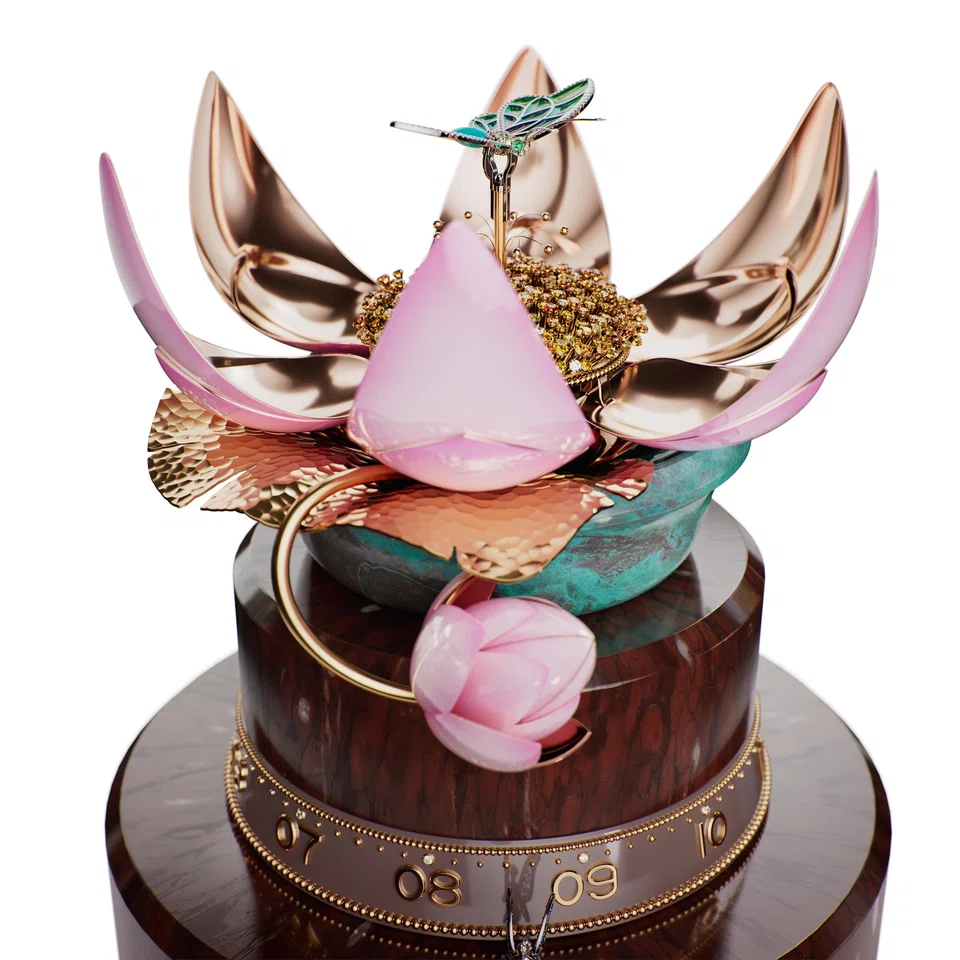
Rêveries de Berylline provided the blueprint for Van Cleef & Arpels’ two new automaton objects for 2023, Floraison du Nénuphar and Éveil du Cyclamen. In the former, a single majestic water lily takes centre stage, moving with the unhurried pace of a prima ballerina. When it is in full bloom, an ethereal butterfly with plique à jour enamel wings takes flight, flitting energetically as butterflies do.
This is a clear showcase of the automaton artist’s talent. “To elicit two different speeds of movement in one object, we needed a combination of large and small discs,” he explains. “At the same time, the floral petals are large and very heavy, while the butterfly is small and light, so we needed separate mechanisms for each.” For every style of movement, he needed to conceptualise and produce a separate set of discs and cams. This butterfly alone, for instance, necessitated three individual systems working in synchronicity: one for the wings, another for turning, and one more to move up and down.
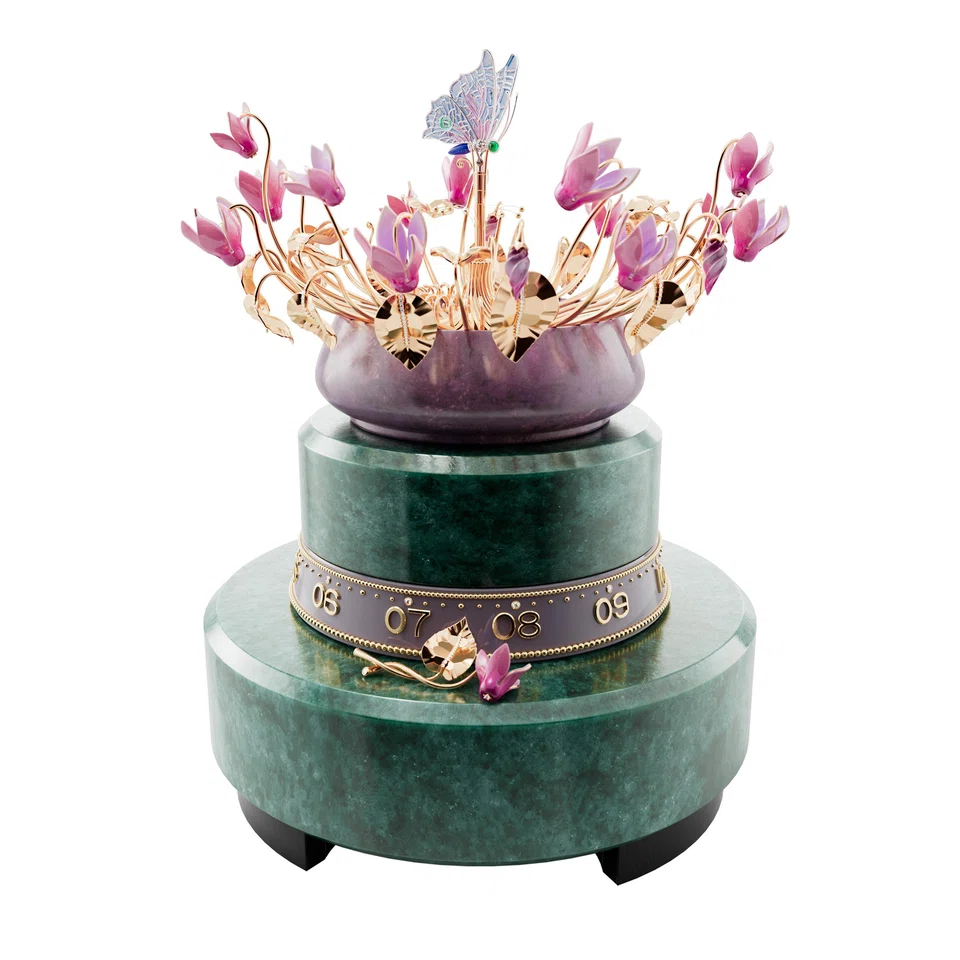
Likewise in Éveil du Cyclamen, a butterfly emerges from a cluster of sweet pink cyclamens as it flaps its wings to a naturalistic rhythm. Every flutter, every quiver, every chime draws one ever closer into a meditative state of pure bliss. On the green aventurine base, a single flower appears to have fallen over, but this is all part of the show. Moving around the base in 24 hours, its gold leaf directs your gaze to the hours and minutes, telling the time with such immaculate elegance as to leave anyone utterly spellbound.
Decoding Asia newsletter: your guide to navigating Asia in a new global order. Sign up here to get Decoding Asia newsletter. Delivered to your inbox. Free.
Share with us your feedback on BT's products and services
TRENDING NOW

Government to bring forward raising of retirement age, give employers more financial support to create flexi-load jobs

If Europe goes to war, the fallout will be felt in East Asia

Indonesia stocks suffer worst plunge in nearly 30 years as MSCI proposes standalone status

Vietnam’s northern provinces, not Hanoi or Ho Chi Minh City, are powering near 10% GDP growth

