

At the busy Paralympics workshop, plenty of fractures but no broken bones
Repair technicians at the Paris Games fix everything from bent wheelchair frames to broken sunglasses
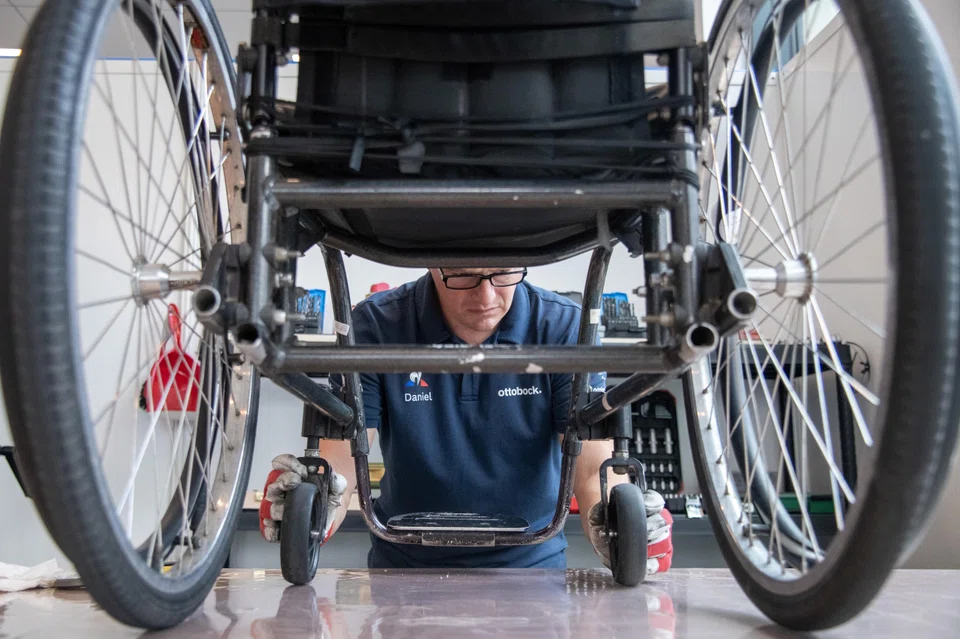
SPEND some time watching the Paralympics and it will soon become obvious from seeing wheelchair athletes bash into each other while playing rugby and basketball that their flattened tyres and dented frames might need multiple repairs over their tournaments.
But at the Games’ fix-it shop in the Paralympic Village in Paris, repair requests can and do come from every sport.
Tyre replacements and the spot-welding of chairs broken in collisions made up only about 56 per cent of the shop’s service requests through the first half of the Games, which end on Sunday (Sep 8).
Many of those chairs were never actually in the shop. Instead, the fixes were made by technicians on-site during rugby matches at the Champ de Mars Arena.
“My feeling is that I see wheelchairs the whole time,” said Merle Florestedt, communications director for Ottobock, the German wheelchair and prosthetics company that runs the shop.
But the reality is different, she added. “It’s just as much as prostheses. And we also count when somebody brings in sunglasses that are broken.”
The repair shop has refitted prostheses (by traditional methods and via 3D scanning), sewn loose straps back into place on braces, and even restored the silicone to a man’s prosthetic leg.
The facility is a cross between a mechanic’s garage and a bloodless emergency room, where 164 staffers are available to triage damage to the equipment and assistive devices of more than 4,000 athletes competing in the Games.
Across almost a dozen workstations this week, technicians and mechanics welded, sewed and even sawed the equipment necessary to make the Games possible. Their services are offered at no cost to all Paralympians.


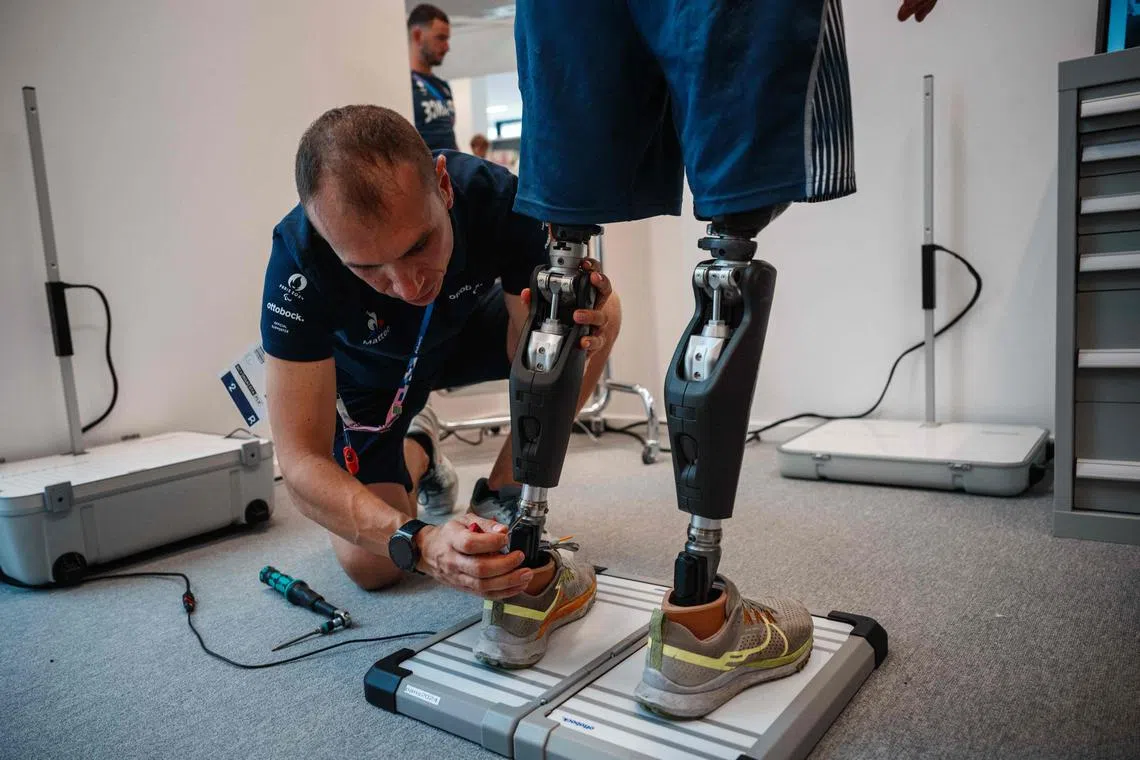
On Monday, the voices of the members of the Brazilian men’s sitting volleyball team rose as they played a board game while waiting for a teammate’s prosthetic to be refitted.
A wheelchair athlete from Ghana scrolled through her phone at a table in the holding area outside the main workshop, which Ottobock has operated at every Paralympics since 1988.
Emergency call
It was a moment of relative calm at what can be a chaotic, though largely unseen, locus of the Paralympics. At the Tokyo Games in 2021, Jeffrey Waldmuller and another technician received an emergency call two hours before the men’s 100-metre wheelchair final, when Belgian racer Peter Genyn and two teammates discovered that their competitive chairs had been vandalised.
“It was really bad. Flatted his tyres, broke the steering linkage, all this stuff – these are custom parts that they broke,” Waldmuller recalled. “We robbed some parts from his teammate’s wheelchair that was competing the next day, put it on his. But then none of them fit or lined up. We zip-tied and duct-taped it together.” Genyn won a gold medal in the jury-rigged chair, setting a Paralympic record in his classification.
The company brought two metric tonnes of equipment and replacement parts to the Games, setting up shop a week before competition began in part to handle the nicks and dings that can happen in transit.
Alignment problems
Lindi Marcusen, an American who is competing in the 100 metres and long jump, is an above-the-knee amputee who travels with multiple legs for competition and daily use. When she arrived in Paris, the socket on her “day leg” wouldn’t seal properly (it uses suction to stay on), an issue that can cause alignment problems and wounds at the graft site.
Marcusen was particularly worried because she had had a wound caused by friction in July 2018 that did not fully heal until late in 2021.
On that occasion, she opted to continue training for the Tokyo trials without a leg, using a ski machine and resistance bands to keep up her strength. In Paris, technicians took less than a day to remove and clean the valve that helps Marcusen’s socket stick.
The Ottobock team said that it had produced 11 sockets for Paralympic athletes via the traditional method, which requires plaster casting and plastic moulding shaped by heat and pressure. Eleven were made using the company’s 3D scanning and printing software, the first time the technology has been used at the Games.
To create a model for a custom socket, technicians can scan an athlete’s limb using a hand-held device the size of a computer mouse, avoiding invasive prodding and measuring by hand.
The image can then be used to form a plastic mould in the workshop or sent to a nearby lab for printing.
Marcusen said that replacing a competitive socket had cost her US$20,000 in the past. “I work full time to like set aside money to pay for legs,” she explained. “I don’t have a car payment. I have a leg payment.”
The technicians at the repair garage, she added, embodied the spirit disabled athletes bring to every area of their lives. “You’ve got to be scrappy looking for solutions,” she noted.
Decoding Asia newsletter: your guide to navigating Asia in a new global order. Sign up here to get Decoding Asia newsletter. Delivered to your inbox. Free.
Share with us your feedback on BT's products and services
TRENDING NOW

Once staunchly pro-China, Malaysian Chinese businesses are now distancing themselves from Beijing

Looking beyond looming CEO succession, should UOB potentially pursue a transformative merger?

Could stablecoins be the future of money?

Grab CEO’s wife Chloe Tong on life with Anthony Tan and finding her purpose

