

Buzz Aldrin’s space memorabilia sells for more than US$8m
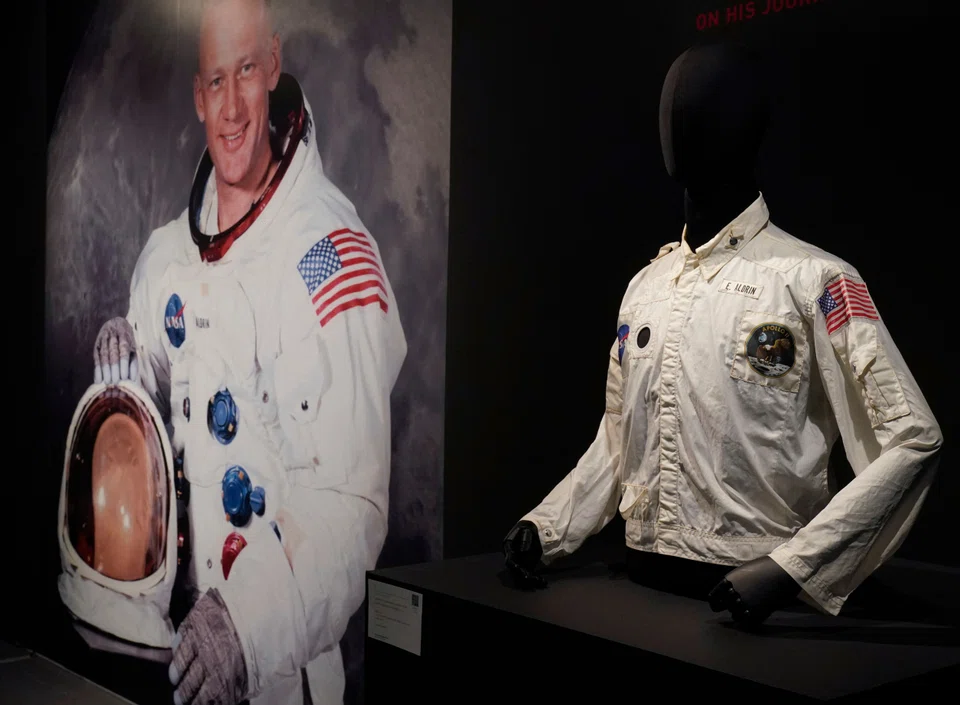
A WHITE, Teflon-coated jacket worn by astronaut Buzz Aldrin during the Apollo 11 mission to the moon in 1969 sold for US$2.7 million at a Sotheby's auction on Tuesday (Jul 26), fetching the highest price among dozens of pieces of rare memorabilia tracing his career in space exploration.
Aldrin, now 92, has a storied career as an astronaut, joining Nasa in 1963 after flying for the Air Force. Within 3 years, he had executed the world's first successful spacewalk in the Gemini 12 mission. Then, on Jul 20, 1969, millions of people watched on television as he became the second man to walk on the moon, about 20 minutes after Neil Armstrong, who declared it "one giant leap for mankind".
The custom-fitted jacket Aldrin wore on that mission sold after fierce bidding lasting 9 minutes, with the auctioneer calling it "the most valuable American space-flown artefact ever sold at auction". (The garments worn by the 2 other Apollo 11 astronauts from that mission are owned by the Smithsonian.)
In all, 68 of 69 lots of Aldrin's belongings were sold for a combined US$8 million on Tuesday by Sotheby's in Manhattan at an auction that lasted more than 2 hours.
Derek Parsons, a Sotheby's spokesperson, said that the Aldrin sale was the "most valuable single space exploration auction ever staged". It broke a record set by one auction of items belonging to Armstrong, who died in 2012, but the other astronaut's total collection still holds the overall record.
The most coveted artefacts sold on Tuesday travelled to the moon and back more than 5 decades ago. A complete summary flight plan of the Apollo mission sold for US$819,000.
Only one lot did not sell: It included the tiny broken circuit switch that nearly marooned the Apollo 11 crew on the moon and a dented aluminium pen that Aldrin used as a manual workaround to achieve lift-off. Bidding stalled at US$650,000, well under the auction's estimate of US$1 million.
Aldrin said in a statement that "the time felt right to share these items with the world, which for many are symbols of a historical moment, but for me have always remained personal mementoes of a life dedicated to science and exploration".
Among the items sold at auction were also gold-coloured lifetime passes to Major League Baseball games, for US$7,560, and an MTV Video Music Awards statuette modelled after the iconic image of Aldrin placing the American flag on the moon's surface, which fetched US$88,200.
A Presidential Medal of Freedom, the nation's highest honour for civilians, bestowed to Aldrin by President Richard Nixon, sold for US$277,200. These medals do not appear frequently at auction, Parsons said.
There was also a letter dated Dec 10, 1973, penned by Armstrong, which went for US$21,420. In it, he attempted to dissuade Aldrin from turning his memoir into a movie: "I can't think of any biography of a living person that has ever been made into a good, high-quality flick."
Aldrin was unpersuaded. The biopic aired 3 years later.
While that movie was not a critical success, Aldrin did inspire the name for Buzz Lightyear, the animated Pixar character from the Toy Story films.
Ten of the sale's 69 lots came with a non-fungible token, or NFT, a unique digital identifier for authenticity. Others, such as flight plans with a checklist of items to bring to space - helmet, tissues, also snacks - were inscribed with Aldrin's signature and the phrase Flown to the Moon.
More space artefacts have come up for auction since the 2012 passage of a law allowing astronauts to keep and sell their souvenirs from space, said Cassandra Hatton, a senior specialist at Sotheby's. Before the law's adoption, Nasa had repeatedly made attempts to block sales of such items, such as James Lovell's checklist from the Apollo 13 expedition.
"Before then, it was kind of a touch-and-go situation," Hatton noted. "People were selling things and there really wasn't any clarity. So there was always this kind of concern that maybe Nasa would come in and shut down an auction."
A 2018 audit from the space agency's inspector general found that Nasa's inconsistent record-keeping had resulted in the loss of a "significant amount" of its property.
In June, lawyers for Nasa intervened in the sale of dead cockroaches that had ingested moon dust. Before the sale was halted, bidding for the insect trio had reached US$40,000.
Now, Sotheby's space sales are its most popular category, attracting a broad audience of bidders, Hatton said, adding that the price ranges made the items more accessible than other valuables, such as fine art. The auction house has previously sold items owned by other astronauts, including a small, white bag that Armstrong used to collect lunar rock samples, which netted US$1.8 million in 2017.
Hatton said that she believed the fascination with space artefacts and with missions to the moon, the last one in 1972, endures because of the significance of those discoveries in human history.
"It's a moment that reminds us all what we can do," she explained. "We can achieve the near impossible like we can escape our fate of being stuck on this planet. We can do amazing things." NYTIMES
Decoding Asia newsletter: your guide to navigating Asia in a new global order. Sign up here to get Decoding Asia newsletter. Delivered to your inbox. Free.
Share with us your feedback on BT's products and services
TRENDING NOW

OCBC mobile, online banking services restored after Friday afternoon disruption

SGX CEO Loh Boon Chye to step down; succession planning under way

Waymo founder predicts ‘landslide’ robotaxi adoption in Singapore, driven by high car costs

Vietnam’s northern provinces, not Hanoi or Ho Chi Minh City, are powering near 10% GDP growth

